
The Light She Kept On
Content notes
alcohol, references to homelessness and bereavement
There is a doctrine in the law of England of so peculiar a beauty that I have never once succeeded in explaining it to a person who did not already feel it, and it is called the doctrine of ancient lights. It works in this manner. If a man's window has enjoyed the light of heaven, uninterrupted and without permission asked, for the space of twenty years, then the light becomes his — not by grant, nor by bargain, nor by any exertion on his part more strenuous than the continued occupation of a room — and his neighbour may not thereafter raise a wall to take it from him. The light has, by the mere passage of time across a pane of glass, ripened into a property. You may still find, if you walk with your head up in the older parts of this city, a small painted board or a plate of zinc screwed to a flank wall three storeys up, bearing the words ANCIENT LIGHTS in a lettering nobody has used since the trams, put there by some long-dead solicitor's clerk to warn a future he would not live to see. I have loved those boards since I was a pupil. I take off my hat to them, inwardly, which is the only way an Englishman takes off his hat to anything he actually cares about.
Observe what the law has done there, and observe it kindly, because it does not often do anything so generous. It has taken a man who has done nothing at all — who has merely sat in his parlour for two decades and been illuminated — and it has said: this is yours now. It has fallen upon you for twenty years and that is enough, and the whole apparatus of the courts of England will now stand between you and any man who tries to interrupt it.
And there is no corresponding doctrine — none, in eight hundred years of an ingenuity that has found a form of words for the ownership of a swan, the tenancy of a dovecote, and the precise moment at which a growing crop ceases to be land and becomes goods — for the other party. For the one at the far end of the beam. For the person, that is to say, who has kept the light on.
The law knows nothing of them. The law has never so much as looked at them. Consider what we are talking about: the lamp burning in a chapel over the years for a congregation that has dwindled to nine; the lightship anchored on a shoal where no ship has struck since 1904 and none will ever strike again precisely because she is anchored there; the porch bulb a mother leaves burning for a son who has stopped coming home, and goes on leaving burning, and pays for, quarter by quarter, out of a pension, into her eighties. Every one of those is an act of the most extraordinary and sustained fidelity, and every one of them is, in the eye of the law, nothing whatever — not a right, not a duty, not an interest, not a licence, not so much as an equity worth the naming. It is simply a person paying for something they do not use, for the benefit of someone who may never come, and if they stop, no court in the kingdom will hear a word about it.
I had supposed, in the settled and comfortable manner of a man who has spent fifty years in the criminal courts and concluded that he has by now met all the varieties of human conduct worth meeting, that this was an interesting little gap in the law, of the kind one raises at a dinner in Hall to appear thoughtful over the port.
I was put right on the point at the age of sixty-nine, in a magistrates' court off Pentlow Street, by a woman of sixty-eight in her good coat, before three lay justices, a bored young man from the Crown, an usher, and a radiator that clanked; and I had, throughout, no standing to say a single word, and did not say one, and it is the only hearing of my life I would not change a syllable of, and I contributed to it nothing at all but the sound of an old man breathing at the back.
She is my wife. Her name is Beatrice. I have called her the Home Secretary, in the privacy of my own skull, for forty-one years.
We live, and have lived since the second year of our marriage, in a mansion flat near Gloucester Road: high ceilings, bad plumbing, a lift that has been condemned by three separate engineers and continues, out of pure Edwardian spite, to work. To reach it from the Underground you may go one of two ways. You may go up the main road, which takes eleven minutes; or you may turn off at the pillar box and go along Trant Street, a small parade of shops running slightly downhill and then slightly up again, which takes fourteen.
For forty years, the Home Secretary has gone along Trant Street.
I have complained about it for forty-one years — in rain, in heat, with a bad knee, with a good knee, and once in a state of considerable moral indignation about something else entirely which I discharged upon the length of Trant Street because Trant Street was there. She has never argued the point. She has simply turned left at the pillar box, and after a moment or two I have found myself turning left at the pillar box, because that is the arrangement; and in one-and-forty years of walking down that street four or five times a week — which is, if you care to do the arithmetic, and I did the arithmetic later, at two in the morning, on the back of an envelope, something in the region of nine thousand journeys — I never once asked her why she liked it.
At the north end, where the parade gives out and the road begins to lift towards the mews, there is a launderette that closed and became a nail bar that closed and is now a place that sells mattresses by appointment, a Greek grocer's that has resisted the century by the simple expedient of ignoring it, and a pub in the tapas phase of its long decline. And at the very end, on the corner, there is a shuttered shopfront with a steel roller down over it, painted the particular municipal green that means nobody has painted it, and above the roller, on a rusting steel bracket, a sign.
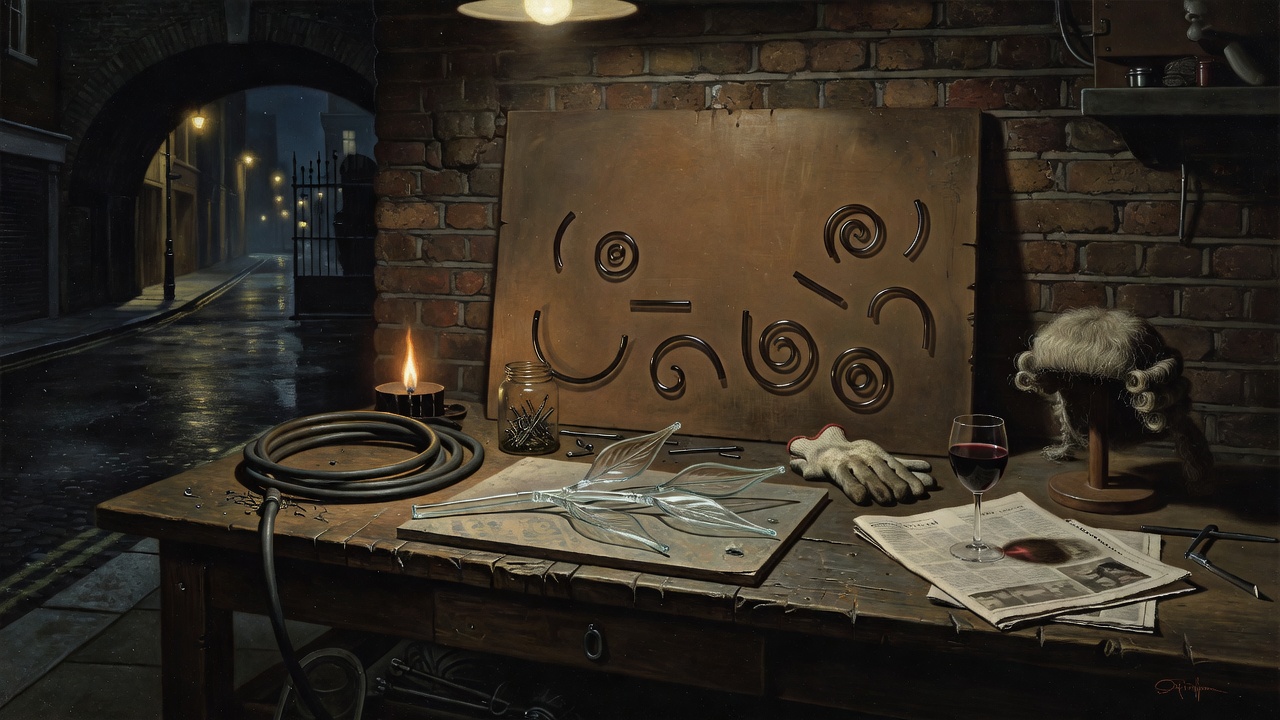
It is a neon sign, of the old sort, the sort that is made and not manufactured. It carries a name in a flowing script — a woman's name — and growing round the tail of the Y, a spray of three leaves. The script was rose-pink. The leaves were gold. I know this not because I ever looked at it, but because I have been told, since, by a man who bent every inch of it with his own hands in a railway arch in Bow in the summer of 1979.
I walked beneath that sign nine thousand times. I could not, in the July of this year, have told you what the name on it was. I could not have told you there was a name on it. I had registered it, if I registered it at all, in the way one registers the shape of a particular tree on a road one drives: as an item of the general furniture of a life, an unexamined given, a thing that was simply there and would presumably go on being there, like the pillar box, or the lift, or my wife.
The scaffold went up on a Tuesday in the middle of July.
I remember the morning, because I have gone over it since with the sort of forensic attention I had hitherto reserved for other people's disasters. It was warm. There was a boiled egg. I was composing, over the toast, a letter to a newspaper which I was never going to send and which we both knew I was never going to send, that being one of the many small fictions on which a long marriage runs. And the Home Secretary said, without looking up from the crossword, which she does in ink:
"They've put a scaffold up on Trant Street."
And I said — and I would give a very great deal to have this back, and I shall not get it back, and there is no doctrine in the law of England for that either — I said:
"Mm. Flats, I expect. They'll have flats up the moment a man dies. There was a time in this city when a shopfront was permitted to remain a shopfront out of common decency, and now the whole of Kensington is being quietly converted into pieds-à-terre for gentlemen from jurisdictions I could not with confidence place on a map." And I turned the page.
She did not say anything else. I have been over that too. She did not say anything else, and she finished the crossword, and she cleared the plates, and she went out at half past nine, and came back at a quarter to eleven, and I did not ask where she had been, because it was the first Saturday of the quarter.
It was not, of course, the first Saturday of the quarter. It was a Tuesday. I offer that as a fair specimen of the quality of attention I have brought, over four decades, to the only subject in my life that has ever repaid it.
I should explain about the first Saturday of the quarter. Four times a year — January, April, July, October — Bea goes out in the morning, on foot, and comes back before eleven, and said, when asked in the early years, that she was going to the bank. In 1985 this was an unremarkable sentence. It went on being said, at intervals, for perhaps a decade, and then it stopped being said, because I stopped asking: it had become weather. The banks themselves have since closed, one by one, all up the Gloucester Road, and been converted into establishments for the sale of coffee at prices that would have got a man transported; and still, four times a year, she went out at half past nine and came back at a quarter to eleven, and in all the years since the last of them shut it never once crossed the threshold of my notice that there was no longer a bank for her to go to.
I have cross-examined, in my time, perhaps four thousand witnesses, and made a comfortable living out of noticing the small inconsistency the police missed, the date that does not fit, the detail one degree out of true. I have stood up in front of juries and said, with real feeling, that the whole of a case lies in the thing nobody thought worth mentioning.
Four times a year, my wife went out to a bank that had not been there for a decade.
Sefton came into my room at twenty past twelve on the Thursday, which is not one of the hours at which Sefton comes into my room, and he came in without the papers, which is not a thing Sefton does at all; and I looked up at my clerk standing in my doorway with his long grey hands entirely empty, and understood, before he had said a word, that whatever had happened had happened outside the law and had come in through a door the law does not use.
"It's Mrs Fenwick, sir," he said.
I have been told since that I stood up. I have no recollection of standing up.
"She's not hurt, sir." He got that out fast, which for Sefton is a species of tenderness so violent as to be nearly indecent. "She's not hurt at all. She's — " and here even Sefton, who has found the briefest possible form of words for the worst possible facts for forty years, ran aground. "She's at the police station, sir. She's been arrested."
"Arrested," I said.
"Yes, sir."
"My wife."
"Yes, sir."
"On what conceivable —"
"They said aggravated trespass, sir." Sefton's face did the thing it does perhaps four times a year, the thing I have learned to watch for the way a sailor watches the falling glass. "She went up a scaffold, sir. On Trant Street. She went up it at ten past seven this morning and she wouldn't come down."
There is a particular sensation, which I have observed in the dock a thousand times and had never until that morning experienced from the inside, of the floor of the world going momentarily soft — not falling away, nothing so dramatic, merely losing, for the space of two or three heartbeats, its settled conviction that it is a floor. I have watched men take hold of the rail when it happens to them. I took hold of the desk.
"Sefton," I said. "My coat."
"It's over your arm, sir."
It was.
The custody suite at a London police station is a place I have entered several hundred times in my professional life and had never once seen. I have gone into them as counsel, which is to say wrapped in a set of arrangements so thick that the room itself never actually reaches you: you are civil to the sergeant, you are shown to a consultation room smelling of disinfectant and defeat, you are brought a man in a grey tracksuit, you do your work, you come out. I had never stood at that desk as a private person and looked at it.
It is painted the colour of a swimming bath. There is a high counter of the sort designed to make everybody on the wrong side of it slightly shorter than they are, a laminated notice about the rights of detained persons, another laminated notice about spitting, and behind the desk a custody sergeant of about fifty with the settled, faintly amused air of a man who has been shouted at by every kind of person there is and has arrived at a sort of peace about it.
"I have come," I said, "about Mrs Beatrice Fenwick."
"You her legal representative?"
"I am her husband."
He looked at the coat, and the collar, and the general architecture of me, and I watched the tumblers of a long professional experience turn over behind his eyes and drop into place.
"You're a brief," he said.
"I am King's Counsel."
"Right," said the sergeant, and made a note, and I have thought about that right a good deal since. It was not rude and it was not impressed. It was the most accurate assessment of my position that anybody made in the whole of that fortnight, and it was made in one syllable by a man with fourteen people in his cells, and the syllable meant: and?
"Can I see her?"
"She's being interviewed. She's declined a solicitor twice, and I've offered twice, and she's very nice about it. Between us, sir, she's the least trouble I've had in here since Easter. She asked if she could do the crossword."
"Did you let her?"
"No pens in the cell, sir." He almost smiled. "She took it very well. She said she'd remember them."
They brought her out at ten past two.
I have made a lifetime out of what a man's appearance in custody tells you. On this occasion it told me everything, and I read every word of it wrong.
She came out through the door beside the desk in her good coat — the grey one, the one she has had since Blair — and her shoes had scaffold on them, a fine pale dust in the seams, and there was a graze on the back of her left hand, and her hair, which is always exactly as she intends it to be, was exactly as she intended it to be. And she was entirely calm. Not the brittle calm of a person holding themselves together, which I know at forty paces; nor the flat calm of shock, which I know at eighty. The calm of a woman who has done the thing she came to do and is now waiting, with reasonable patience, for the paperwork.
They gave her back her property in a clear plastic bag, and she signed for it, and the sergeant read it out because that is what they do, and I stood there in the swimming-bath light of a Kensington custody suite and listened to a police officer itemise my wife.
"One handbag, brown. One purse, containing — cards, notes and coins. One set of keys. One handkerchief. Two flasks, metal."
"Two?" I said.
"Two, sir," said the sergeant.
"One spectacles case," he went on, "one pen, one newspaper, one item of folded paper."
She took the bag. She looked at me for the first time — properly, the full look, the one that has been arriving across breakfast tables and two funerals for one-and-forty years — and she said:
"Hello, Augustus."
"Beatrice," I said, "what in the name of God —"
"Not here," she said. "It's not fair on the sergeant. He's been very good and he's got a queue."
And she thanked him, by name, which she had evidently obtained at some point in the previous two hours, and took my arm, and we went out into the July afternoon; and on the pavement outside I stopped and turned her to face me and asked the question, and she gave me the answer, and I have thought about the answer every day since.
"Bea. Did you do it?"
"Yes," she said.
"You obstructed them. Deliberately."
"I sat on the boards with my back against the fascia so they couldn't get the bar in," she said, "and I stayed there four hours and ten minutes, and when the police came I told them I wasn't coming down, and they were perfectly polite about it and so was I, and then they took me down and arrested me. Yes, Augustus. I did all of it. I meant every part of it." She adjusted the bag on her arm. "And if they put it back up tomorrow I'd do it again, so you may as well have that now and save us both the fortnight."
We went home. She made tea, because there is no crisis in the history of the Fenwicks that has not been met, within eleven minutes, by tea, and I sat at the kitchen table where I have sat for forty years and I did the thing I know how to do.
What I know how to do — the one trick, the thing that has kept me in claret and horsehair for half a century — is to find the human truth the charge sheet has missed. The Crown produces a document. The document is accurate. It is also, almost invariably, a corpse: it has the bones of what happened and none of the blood, and my whole business is to go and find where the blood went, which is generally in a front room somewhere, in a thing the client has not thought worth mentioning, or has thought too shaming to mention, or has decided to protect at the cost of his liberty. I go and I find it and I bring it back into the light and the case turns over like a dog.
So I sat at my own kitchen table and I went to work on my wife.
I began wide, because you always begin wide. "Tell me about the building."
"There's nothing to tell about the building. It's been shut since 1998. Northvale bought the freehold in March. They're making nine flats. It'll be perfectly nice and I've no quarrel with it."
"You have no quarrel with the development."
"None."
"Then it's the sign."
"It's the sign."
"Good." A first fact conceded is worth two extracted. "Now. The sign is — what? Listed? Locally listed? Is there a conservation officer in this somewhere? Because if there is a heritage point I can have Priya on the planning portal by four o'clock and we can turn this into a very different kind of morning."
"There's no heritage point," said Bea. "I've asked. Twice. It's not listed, the parade's not in a conservation area, and the sign's a fixture in the demise, which means it's theirs, and they may take it down and put it in a skip and there is nothing anybody can do about it." She set the pot down. "You may check that if you like. You'll find I'm right."
I checked it. She was right. I shall come to Priya.
"Then it's sentimental," I said, and heard myself say it, and heard the small dry click of the wrong key going into a lock. "It's a fine old sign in a street you're fond of and they're throwing it away, and you've had enough of this city throwing things away, and I don't blame you in the least, I have felt precisely that about eleven separate buildings and one letter box —"
"Augustus."
"— and if that is the case then it is usable, do you see, because there is a version of a woman who climbs a scaffold out of love for her street that any bench in England will —"
"Augustus."
I stopped.
"Don't do that," she said. Not unkindly. That was the terrible part; there was no unkindness in it anywhere. "Don't build it. I've watched you do it for forty-one years to other people's wives and I've admired it very much, and I'd be grateful if you didn't do it to me at my own table."
"I am trying," I said, with what I believed at the time to be dignity, "to help you."
"I know you are."
"Then tell me why you went up the scaffold."
And there it was: the Fenwick question, the one I have put to murderers and cellarmen and frightened boys, the question I have built a career on, delivered at my own kitchen table across a teapot to a woman I have slept beside for one-and-forty years.
She looked at me for a long moment. And I saw — I did see this, I will give myself that much, it is nearly the only thing I got right in the whole of July — I saw her come right up to the edge of it. I saw a sentence arrive somewhere behind her face and stand there.
And then she picked up her cup.
"I'd rather not," she said.
"You'd rather not."
"No."
"Beatrice, you have been arrested."
"I know. I was there."
"You are going to be charged. Do you understand what that means? It means a court. It means a criminal record, at sixty-eight, for a woman who has never in her life had so much as a parking ticket —"
"I had a parking ticket in Rye in 2004."
"— and you are sitting there telling me you'd rather not."
"Yes," she said.
And she drank her tea. And I sat in my own kitchen with fifty years of the finest advocacy in London going round and round in my chest with nowhere whatever to go.
I tried twice more that week. I am not proud of the second one. It involved a bottle of the Cobbs' latest tribute — the Cobbs being a family I have defended, on and off, across three generations — a great deal of reminiscence about 1985, and a manoeuvre so transparent that she let me get all the way to the end of it before she said, "That was lovely, Augustus. The answer's still no," and went to bed.
The charge came through on the Monday, and it was, as advertised, aggravated trespass: an offence conjured up in 1994 for the benefit of hunt saboteurs and persons who wished to dance in fields, and now doing duty against a woman of sixty-eight in a good grey coat who had brought two flasks of tea up a scaffold and given one of them away.
It was, I regret to report, a perfectly good charge. I have spent fifty years pulling charges apart the way one pulls apart a badly roasted bird, and I sat down with this one and turned it over and could find nothing whatever wrong with it. She was on land. She was a trespasser. There was a lawful activity in progress. She had done a thing intended to obstruct it, and had said so to two constables, at length, in a manner they had helpfully written down. Every element was there. The document was not a corpse. It was an entirely accurate and rather well-drafted account of what my wife had done on a Thursday morning in July, and there was, in the whole of it, not one place where the blood had gone missing.
I took it to chambers on the Monday, and that is where the second half of the disaster was explained to me by a woman of eight-and-twenty in the worst room in the building.
"You know you can't act," said Priya Nair.
"I have not the smallest intention of —"
"You've got a notebook," she said.
I had a notebook.
"Mr Fenwick." She put down the tablet, which with Priya is the equivalent of another woman removing her earrings. "You can't act for her. Not as counsel, not as a McKenzie friend, not as the fellow who quietly writes the note she reads out. You're a witness — you were at the breakfast table — and the moment you're on your feet you're an advocate giving evidence from the floor about his own wife, which you'd disembowel a junior for suggesting."
"I am aware of the rule."
"I know. I'd rather say it than watch you look for the way round it."
She did not smile, which is Priya's way of smiling.
"I've looked at the law," she said, more gently. "Four ways, and your wife had got there before me. The freeholder owns the sign, the works are lawful, and there isn't an argument in it. There's no case here. There's a guilty plea and a sentencing hearing, and the only question in the whole matter is what somebody says about her before they pass sentence."
"Then you'll do it," I said. "You'll act. You're better on your feet than half of Middle Temple and you'll be led by nobody and I shall sit at the back with my mouth shut, which I am given to understand is now a thing I do."
"I offered," said Priya.
"And?"
She reached across the desk and handed me a folded sheet of paper. Bea's hand. Ink, of course.
Dear Miss Nair — that is very kind and very like you, and thank you. But I'm going to do it myself. Please don't let him talk you round; he'll try, and he's better at it than either of us. B.F.
P.S. Nine down was "advocate". I thought of you both.
I sat in the worst room in chambers with the damp advancing on the law reports and I read that twice.
"She's a litigant in person," said Priya.
"She is the Home Secretary," I said, "conducting her own defence in a magistrates' court, and I would rather have my liver out with a spoon."
Aldous, of course, found out by Wednesday. Quentin Aldous KC, head of chambers, all teeth and lanyard and the bright pitiless future, appeared in my doorway with his telephone already in his hand, held a little out from his body, the way a man carries a summons he is rather pleased with.
"Augustus. I've had a call from the Standard."
"Then you have had one more call from the Standard than I have ever wished to have in my life."
"'KC's Wife In Kensington Scaffold Protest.' Now — before you say anything — this is shapeable. Local woman, community heritage, the soul of the high street, Hazlitt Court right at the heart of it. I've got a man who does exactly this; he did the barrister who swam the Channel. We'd want a line by Friday and you photographed in the street, ideally with the sign in shot —"
"Quentin."
"— and honestly, Augustus, and I say this with the greatest affection, the human-interest angle on you is criminally underexploited —"
"Quentin," I said. "My wife is going to stand up in a magistrates' court and be convicted of a criminal offence. That is the whole of the event. It is not a campaign, it is not a launch, it is not a narrative, and if I discover that any person in this building has spoken to a journalist about it, I shall go to war with such thoroughness that they will be finding bits of this set in the Thames for a generation."
There was a pause.
"Yes," said Aldous, and put the telephone away, and stood there, and did a thing I had not expected of him in eleven years. He said: "Is she all right?"
"She is entirely all right," I said. "She is the only person in this affair who is."
And Sefton, who had been standing in the corridor throughout with a bundle of returns he did not need to be holding, said, as Aldous went off down the stairs:
"You'll be in the gallery, then, sir."
"I shall be in the gallery."
I went to Verey's on the Thursday, because a weight of that kind cannot be carried up the stairs of chambers; it must be carried down the stairs off Fleet Street into the small amber room and set on the counter and looked at over a glass.
Mr Verey the younger took one look at me and produced, without a word, the bottle from beneath the counter — the one with no label, which he keeps for the nights when the labelled bottles will not do — and poured, and set it in front of me, and waited, which is the whole of his genius.
I did not drink it.
That is not an ornament. I sat there an hour and ten minutes with the best thing in that cellar going quietly warm at my elbow, and did not touch it, and Mr Verey watched me not touch it and did not remark upon it and did not take it away.
"She won't tell me," I said at last.
"No, sir."
"I have asked her four times, in the four different ways I know, which is more ways than most men have, and she has said no in the same way each time, and the fourth no was as kind as the first, which I find I cannot bear at all." I turned the glass a quarter turn on the counter, which is a thing my hands do. "Verey. Your father. Give me your father."
Mr Verey the younger dried a glass that was already dry.
"He never said anything about this, Mr Fenwick," he said.
"He said something about everything. It is the single most irritating quality of dead men."
"Not about this." He set the glass down. "Sorry, sir. He was a wine merchant. He had a great deal to say about wine and a certain amount about people who buy it, and I've been handing it out to you for thirty years, and I've got nothing tonight. If I made you something up you'd know."
"I should," I admitted. "You've no gift for it. Your father would be appalled."
We sat with that.
"There's one thing," said Verey, after a while, "and it won't help you."
"Everything anyone has said to me for a fortnight has not helped me. You may as well join the queue."
"He used to say the hardest part of this trade wasn't the buying and it wasn't the tasting. It was the twenty seconds after you'd asked a customer what they wanted." He leaned on the counter. "My dad could stand through those twenty seconds like a lamp-post. Everybody fills it, Mr Fenwick. He just didn't."
I looked at the glass I had not drunk.
"That is not a strategy, Verey," I said.
"No, sir," said Mr Verey the younger. "It isn't."
If I could not build the case — and I could not, there being no case — then I would at least go and look at the thing itself, because a man who has been told to sit down will generally, if left alone for two days, find a way to get up again in some other room where nobody has told him anything.
So I went to look at the sign, properly, for the first time in nine thousand journeys.
The scaffold was up and still, the works having been paused, on somebody's advice and with the Standard sniffing about, until the criminal matter was resolved, which had put Northvale Residential six working days behind and had done nothing whatever for anybody's temper. The roller shutter was down. The bracket held the sign out over the pavement at the tilt they all have, and the sign was quite dark, and quite dead, and I stood underneath it on a Saturday morning in a good coat and read the name on it for the first time in my life.
Ivy's.
Rose-pink script, though the rose was long gone from it and the tube had gone the greyish-ivory of dead neon; and one long run — the tail of the Y, which swept out and under and came back up to hold the leaves — was cracked clean through, the two ends held apart by nothing at all. Three leaves in a spray, in a clear glass gone yellow with fifty summers.
The Greek grocer had been there since 2007 and knew nothing. In the pub a young man with a beard told me the sign was "iconic," by which he meant he had photographed it. And then I asked the woman in the mattress place, who was seventy if she was a day and had run the launderette before it was a nail bar.
"Oh, Ivy's. That's a caff, that was. Ivy Dann. She died before I had the launderette — eighty-three, eighty-four. Open all night, that place. All the hotel people off the Cromwell Road and the bus crews. My mum used to say you'd get a plate off Ivy Dann at four in the morning and she'd not ask you the time of day." She shrugged. "It was on for donkey's years after she went. Then it went off."
I went home, and did not tell my wife where I had been, and she did not ask, and the two of us sat in the drawing room that evening in a silence I would have described at the time as companionable, and would now describe as the sound of two people declining, for entirely different reasons, to say the same sentence.
It took me four days and a great deal of telephoning by Sefton — who does not merely keep a diary, he keeps a sort of parallel London in his head, populated entirely by men who know a man — to find the last neon-bender in England.
His arch is in Bow, under the railway, and the paint over the mouth of it says ASHBEE & SON, GLASS BENDERS & SIGNMAKERS, EST. 1932, and there is no son. There has not been a son since 1994. He has never painted it out.
I have been into a great many rooms in fifty years — cells, wards, mortuaries, the private cellars of two dukes and one convicted fraudster — and I do not believe I have ever walked into one and been so immediately certain that I was standing inside something about to stop existing. It was hot; the burners were going and it was the middle of July. Glass tubes were racked up the walls in bundles like cane, hundreds of them, throwing bars of colour about; a bench scarred to a topography, with a full-size drawing in pencil on a great sheet of grey board; and everywhere the smell of hot glass and gas and dust, which I had not met before and shall be sorry never to meet again.
And there was Mr Cyril Ashbee, eighty-eight years of age, in a brown coat, with a length of rubber hose in his mouth.
He did not stop. That is a thing I want recorded. A King's Counsel walked into his workshop in a coat that cost more than his van and Cyril Ashbee did not stop, because the glass was in the fire, and glass in the fire does not wait for the Bar.
"You want something," he said, without looking up.
"I want to ask you about a sign."
"They all do." He laid the tube he was turning down on the board and looked at me for the first time, and his eyes were a very light blue and entirely undeceived. "Which one?"
"Trant Street," I said. "South Kensington. Ivy's."
And Cyril Ashbee took the hose out of his mouth.
"Nineteen seventy-nine," he said. "July. Same as this. It was hot then and all."
"You remember it."
"I remember all of 'em," he said, with mild contempt. "I've bent about eleven thousand signs and I could take you round London and stand under the forty that are left." He wiped his hands on the brown coat. "Rose for the name, in a coated tube, and the three leaves in gold, which is neon in a gold glass, and it's the only honest colour in the trade. Everything else is argon and a drop of mercury and a coating, and I've sold that as neon for sixty year and I'll not apologise for it now."
"Why gold for the leaves?"
"Because she said so." He sat down on a stool, slowly, the way the old sit. "Little woman. Not big as you. She come out here on the bus with the drawing done on the back of a menu, and she'd done the leaves in a biro, and I said, you want them white, love, white shows up. And she said no. She said —"
He stopped, and looked at the burner.
"She said, cold light's no good to anybody."
I did not say anything. It is possible that this is the only intelligent thing I did in the entire month of July.
"So I done her gold," said Ashbee. "Cost her more. She had it in an envelope, all coins, half of it. Caff, weren't it. Never shut. I put it up meself, that one — I did installs then, I was forty-one. And she said to me on the ladder: I want it bright enough to see from the top of the road. And I said, what for, at two in the morning, and she said —"
Another pause. Ashbee's pauses were not the pauses of a man contriving an effect. They were the pauses of a man consulting a very long shelf.
"She said, so they know."
"So who knows?" I said.
"Search me," said Cyril Ashbee. "I bend glass."
He got up and went to a rack at the back, where the light from the arch mouth does not reach, and came back carrying in both hands, with the horizontal care of a man carrying something that has already survived longer than it had any right to, a length of bent tube about two feet long, curved out and under and up: the tail of a Y, and the beginning of a spray of leaves.
He laid it on the bench in front of me. There was a brown paper tag on it, tied with string, and on the tag, in pencil, in a hand that had learned to write when handwriting was a subject:
4471 — HOLD.
"Six year that's been on that rack," said Ashbee.
"Six years."
"Letter come in — twenty, it'd be. Said the tail had gone on the Y and the rose was out, and could I do it, and how much." He put a thumb on the tag. "No name on it. There's more of that than you'd think. So I looked the job up in the old book and put the number on the rack, because the number was all I had and the number's all I've wanted. I quoted, and back it come: it'd have to be a bit at a time. And I said please yourself, I'm not going anywhere. Envelope, cash, no letter, four times a year, regular as the rates."
A train went over the arch. They do, every few minutes, and the whole roof takes it and hands it back, and for eleven or twelve seconds there is no conversation in that place at all; and Cyril Ashbee, who has worked under it for sixty years, went on talking straight through it in the manner of a man who gave up competing with trains a long time ago.
"—put a line back each time with what's owing. Never had an answer to that neither. It's about done now. Twenty pound short, if you want it exact, and it'll not be twenty pound short by October."
"You've never met the customer."
"No."
"Do you know who it is?"
"Four four seven one," said Cyril Ashbee.
And I stood in a railway arch in Bow, at the age of sixty-nine, with fifty years of forensic experience and a reputation for noticing the one thing nobody thought worth mentioning, and I looked at a paper tag with a job number on it, and I thought: how extraordinary; there is somebody else in this. And I asked him three more questions, all of them about glass, and I thanked him, and I went out to the road and got the bus.
I have gone over that afternoon more times than is good for a man. Four times a year, regular as the rates. He said it in my hearing, in a brown coat, over a burner, with a train going over; and I have never once permitted myself the train as an excuse. I wrote nothing down; and there was an address in a book on that bench, and I never once asked him for it. A man does not fail to identify his wife. He fails to include her.
I have been paid, for fifty years, to notice.
The hearing was fixed for the second Tuesday in August.
I spent the intervening eleven days doing the only thing left to me, which was writing a speech nobody was ever going to hear.
I told myself, at the outset, that I was preparing a note — an aide-memoire, a modest scaffolding of the kind any wife might be glad of when she finds herself on her feet in a strange forum. By the third evening it had eleven paragraphs. By the seventh it had a structure, and an opening, and a place where the voice drops, and a closing line I had said aloud twice in my study to see how it sat.
It was, I will tell you frankly, the best plea in mitigation I have written in a decade, and I have written some that have kept men out of prison. It ran to nine hundred words. It described a woman of sixty-eight who had lived in one street for forty years and watched it eaten, shop by shop, by a city that no longer troubles to remember anything, and who had one morning in July found she could not watch a further mouthful; it made the bench laugh twice, once early and once at the end, which is where you want them; it conceded the offence squarely, because a bench forgives everything except being managed; and it asked, in its last line, for the smallest sentence the law permits.
It was elegant. It was humane. It was entirely persuasive.
It was also, in every particular that mattered, a lie, and I did not know it, and I would have delivered it standing up.
I gave it to her on the Monday evening.
She was polishing her shoes at the kitchen table, which is a thing she does the night before anything, and always has, and which I had watched her do perhaps six hundred times without once wondering where a woman learns to polish shoes like that. She dried her hands. She read it all the way through, which took some time, because I write a large hand.
Then she put it down on the newspaper, away from the polish, and she said:
"That's lovely, Augustus."
"But."
"It's not true," she said.
And she picked up the brush again.
I sat down opposite her. I did not say anything, and I did not say anything, and the clock in the hall did whatever it does, and I discovered that twenty seconds is a very great deal longer than I had understood it to be, and that everything in me — everything, every muscle, fifty years of it — wanted with a physical urgency to fill it, and that the wanting itself was a kind of noise.
I got to about eleven.
"Bea, if you'd only —"
"Don't," she said, not unkindly, and went on with the shoes.
I have appeared, in the course of a long career, in the Central Criminal Court, in the Royal Courts of Justice, before the Judicial Committee of the Privy Council, and — on one glorious and largely accidental occasion in 1998 — in the Court of Appeal of Bermuda. I had not set foot in a magistrates' court since 1981.
This is not so remarkable as it sounds. Silks do not, in the ordinary way, go to the magistrates' court; the magistrates' court is where the criminal law of England actually happens, at volume, at speed, to hundreds of thousands of people a year, and it happens without us, and we speak of it — I have spoken of it — the way a cardinal speaks of a parish. I went through its door, for the first time in five-and-forty years, at twenty past nine on a Tuesday morning in August, in a good suit, with a nine-hundred-word speech in my breast pocket that I had already been told was not true.
There is a security scanner inside the door. A man asked me to put my belt through it, and my keys, and my fountain pen, and to open my umbrella, which he did with the deep uninterest of a man who has opened forty thousand umbrellas.
"Is there," I said, "a robing room?"
"A what, mate?"
"A robing room. For counsel."
He looked at me with sudden and entirely genuine sympathy.
"There's the advocates' room," he said. "First on the left. There's a kettle. Wants descaling."
The list for Court 3 was printed on four sheets of paper in a plastic wallet screwed to the wall, and there were one-and-thirty cases on it, and my wife was number nineteen.
The waiting hall is a long room with plastic chairs bolted in rows so that no two people can turn towards each other, which I take to be deliberate and which I found, over four hours, to be the cruellest piece of design I have met in an English public building. There is a vending machine with a handwritten note on it, a poster asking ARE YOU A WITNESS? in a typeface of relentless cheerfulness, and a water cooler with no cups. There were, at half past nine, perhaps sixty people in it: a young man asleep sitting up; a woman with two children and a bag of small toys clearly assembled the night before for exactly this purpose; an elderly man in a tie, alone, holding a folded letter.
And through the middle of it, at a speed I can only describe as liturgical, moved the usher — Mr Ocansey, in a black gown, with a clipboard, running the entire building by voice — and the duty solicitor, Mr Gopal Rai, with an off-the-peg suit and a wheeled case and four files and no time at all, who did more law in that building before eleven o'clock, and did it better, than I have done in some years.
Mr Rai came over at about a quarter past eleven, having no earthly idea who I was, and said, "You all right, sir? You've been here a while. You want the list called out? Some people don't like to ask."
"I am waiting for number nineteen," I said.
"Ah. That'll be after the lunch, that will." And he gave me a boiled sweet out of his jacket pocket and went away to do four more.
Bea arrived at twenty to ten, alone, having declined a lift, and she came down the hall in her good coat and sat down beside me on a bolted plastic chair, and took out the newspaper, and did the crossword.
In ink.
At half past twelve Mr Ocansey came past and said, with the immense gentleness of a man who says it eleven times a day, "Madam, I'm going to have to ask you to put that away when we go in," and she said, "Of course. I'm sorry," and put it away, and it was finished.
Priya came at one. She had not been asked. She sat down on my other side with her tablet held against her chest like a hymnal and said nothing at all for forty minutes, which is the single most useful thing anybody did for me that month.
They called number nineteen at eleven minutes past two.
Court 3 at Pentlow Street is about the size of a village hall and rather worse lit: a bench at the front raised by perhaps eighteen inches, the legal adviser below it at her own desk, two tables for advocates, and a glass-fronted dock at the side into which my wife was not put, because in a case of this kind the defendant sits in the body of the court. The public gallery is four rows of the same bolted plastic chairs at the back, separated from the rest of the room by a wooden rail about waist height and a very great deal of law.
I sat in the second row of the gallery. Priya sat on my left. On my right, at the end of the row, there was a young woman with a notebook from a local paper. And behind us, in ones and twos over the next ten minutes, there came in perhaps nine people, none of whom I knew, most of whom were old, one of whom was not old at all, and every one of whom sat down without a word and looked at the front and waited.
Mr Ocansey counted them twice and said something to the legal adviser about capacity.
"Court rise."
They came in: three of them, ordinary people in ordinary clothes, filing in behind that bench the way people file into a pew. And I looked at them and thought — I set this down because the whole of my education that afternoon depends on the confession — amateurs.
The chairman was a heavy, slow-moving man of perhaps seventy-five with white hair and half-moon spectacles, Mr Harold Beake, who had been, I discovered later, the bursar of a girls' school in Ealing for thirty-one years. On his right a woman of about sixty in a green cardigan, Mrs Pargeter; on his left a man of about forty-five in a suit that fitted, Mr Eze, who had the stillness of somebody who intends to say nothing all day and hear everything. The legal adviser, Miss Adeyemi, was perhaps thirty-two, and ran that courtroom the way a good junior runs a conference: three steps ahead of everyone in it, and letting no one know.
"The next matter is Beatrice Fenwick."
Bea stood up at the table where the defence advocate sits, which was empty of everything except her handbag.
"Mrs Fenwick, are you represented?"
"No," said Bea. "I'm doing it myself."
Mr Beake looked over the half-moons. "You're entitled to legal advice, Mrs Fenwick. The duty solicitor's in the building. We can put the matter back."
"That's very kind. I've had the offer three times and I've said no three times, and I'd rather not waste Mr Rai's afternoon, because he's got seven left. I know what I did and I know what I'm going to say about it."
"Very well." He made a note. "Do sit down when you're not addressing us. This isn't the Old Bailey and we don't stand on ceremony here."
"Thank you," said Bea.
The charge was put. Miss Adeyemi read it in the flat clear voice of a woman who has read forty thousand charges, and asked her how she pleaded.
"Guilty," said Bea.
I have heard that word said in courtrooms perhaps two thousand times. I have heard it whispered, wept, mumbled at the floor, spat, and once — memorably, in 1988 — sung. I have never heard it said as my wife said it, which was in the tone of a woman confirming a delivery address.
Mr Sandy Pell rose for the Crown. He was about twenty-nine, he had fourteen files in a crate on the floor beside him, and he had, as far as I could tell, read this one in the corridor, which is not a criticism of Mr Pell but of the arrangements under which Mr Pell is required to live. He opened the facts briskly and, I must in fairness record, accurately: the lawful works; the licensed scaffold; the defendant ascending it at ten past seven and seating herself against the fascia; four hours and ten minutes; two officers attending; the defendant declining to descend and arrested without any resistance whatever; one working day lost, and a re-mobilisation charge from the scaffolding contractor of eleven hundred and forty pounds.
"The Crown's position," said Mr Pell, "is that this was a deliberate and planned obstruction of an entirely lawful activity. The defendant went there intending to stop the works and she stopped the works. There's no previous. The sign in question is a defunct commercial sign which has been derelict since the premises closed in 1998."
And my wife, sitting down, at her own sentencing hearing, said, quite clearly and without heat:
"No."
Mr Beake looked up.
"Mrs Fenwick, you'll get your turn."
"I'm sorry," said Bea. "But that's the only bit that's wrong and I don't want it to go on the paper. The shop's been derelict since 1998. The sign hasn't been derelict a day."
There was a pause of about four seconds, in which the whole of the remainder of my life was arranged, and in which I understood nothing whatever.
Mr Beake asked whether there was anyone present from Northvale, and Mr Culpin stood up at the back of the court: site director for Northvale Residential, a heavy tired courteous man in his forties who had plainly had a wretched fortnight, and scrupulously fair in a way I have not always found in complainants who have lost eleven hundred and forty pounds.
"She wasn't any trouble," he said. "I want to be fair about that. She never swore, she never touched anybody, she never chained herself to anything. She just sat there with her back to it. I asked her four times to come down and she said no thank you each time, and she said she was sorry about my morning."
"Was there anything else?" said Mr Beake.
"She'd brought two flasks," said Mr Culpin. "One for her. She gave the other one to my scaffolders. She'd made it up the night before. They drank it and all — passed the flask back up to her when they'd done — I couldn't say a word to them, could I, they'd been stood there since half seven."
Somebody in the third row of the gallery made a small sound.
And it was at that moment — with a decent man standing at the back of the court describing a flask of tea, and my wife sitting eleven feet in front of me with her hands folded, and the whole of the case running away down a slope I could see and could not reach — that I stood up.
I have no defence to offer. It was fifty years of reflex and it went off in me like a sneeze. There was a fact in the room that needed handling and I was the man who handles facts in rooms, and my legs simply did what they have done since 1979.
Mr Ocansey was extremely quick. He was beside the rail before I was fully upright, and he did not touch me, and he did not raise his voice, and what he said was:
"You'll need to sit down, sir."
And Miss Adeyemi, who had turned round in her chair, said, with a courtesy so exact that it took the skin off:
"Are you a party to these proceedings, sir?"
"No," I said.
"Then I'll ask you to remain seated and not to address the court."
"Yes," I said.
And I sat down, in the second row of the public gallery, with my hands in my lap; and Priya's hand came across and took hold of two inches of my sleeve, just above the wrist, and stayed there; and I did not stand up again for the rest of the afternoon; and my wife, who had not once looked round, said nothing about it and did not need to, because Mr Beake looked at me over the half-moons for perhaps a second and a half with an expression of the mildest possible curiosity and then went back to his notes.
The greatest advocate of his generation. Number nineteen on the list. Told to sit down by an usher, and rightly.
"Mrs Fenwick," said Mr Beake, "is there anything you want to say to us before we consider sentence?"
She stood up.
She had no notes. My nine hundred words were in my breast pocket, folded twice, four rows behind her, and I have gone over what she said perhaps two hundred times since, and I believe I have it very nearly exactly, because I have never in my life listened to anything as I listened to that.
"Yes," she said. "Thank you. I'll try not to be long; I know you've a list."
"Take your time," said Mr Beake.
"I did what Mr Pell says I did. All of it. I went up at ten past seven because they start at half seven and I wanted to be up before them, and I sat where I sat because that's the only place they can't get the bar in behind the fascia, and I stopped them for four hours and ten minutes, and I knew it was against the law before I went up, and I know it now.
"I'm not going to tell you I'm sorry, because I'm not, and I've been married to a criminal barrister for forty-one years and I've heard a great many people say sorry in courtrooms who weren't, and I'd rather not.
"I would like to say I'm sorry to Mr Culpin, though, because that's different. He's had a rotten fortnight through me and he's been decent about it in there just now when he needn't have been. And I'll pay the eleven hundred and forty pounds. I've got it. I'd like that noted, please, whatever else you do."
Mr Beake made a note.
"Now. The sign." She put her hand on the back of the chair in front of her, not for support; to have somewhere to put it. "Mr Pell said it's been derelict since 1998, and I interrupted him, and I apologise for that. The shop's been shut since 1998. That's right. The sign has been on a live supply since 1963 — the glass that's on it now went up in '79, on the same feed — and it's never once been disconnected, and I know that because I've been paying for it since March 1983."
Nobody said anything.
"There's a separate account," said Bea. "The sign's fed off its own little meter in the cupboard under the stair — that's how they did them then, so the shop could switch off and the sign could stop on. It was in Mrs Dann's name. She had the caff. It's called Ivy's; that's her, Ivy Dann. When she died in the March of 1983 I went down to the electricity showroom on the Old Brompton Road and told a young man I was her niece, which was a lie, and he moved it over to me, and I've paid it four times a year for three-and-forty years; and if that's another offence you'd better add it on, though I should think it's out of time."
Mr Beake said, "I shouldn't think we'll be troubling ourselves with 1983, Mrs Fenwick."
"No. Well." She opened the handbag and took out a folded paper — the item of folded paper, itemised by a custody sergeant in July, that I had heard read out and had not thought about for one second since — and she held it, and did not offer it up, because nobody had asked her for it.
"That's the last one. April. Fifty-eight pounds and forty pence, and all but a penny of it is the standing charge."
"Mrs Fenwick," said Mr Beake carefully, "are you telling this court that you have been paying the electricity bill for a sign on a building in which you have no interest whatever, for three-and-forty years?"
"Yes."
"May I ask why?"
And my wife, at her own sentencing, in a village hall off Pentlow Street, with a radiator clanking and one-and-thirty cases on the list and nine strangers sitting behind her, said:
"Because it wasn't a sign."
She stopped for a moment. It was the only time she stopped.
"It was a caff. It never shut — it couldn't shut, there was nowhere else, not then; Kensington wasn't what it's got to be, and that end of Trant Street was bedsits and a launderette and a shop that sold single cigarettes. She had the hotel people in off the Cromwell Road, the night porters and the kitchen staff coming off at two, and the bus crews, and she fed them, and that was the business, and that was all perfectly ordinary.
"But she kept the sign on all night. Every night. And that wasn't the business, and it wasn't advertising, because there's nobody to advertise to at four in the morning on Trant Street, and it cost her money she hadn't got.
"It meant the door was open.
"That's all it meant. If Ivy's was lit, Ivy Dann was awake and the door was on the latch and you could come in, and she wouldn't ask you anything. It wasn't a charity and it hadn't got a name and I don't suppose she said a word about it out loud in her life, because if you say it out loud it becomes a thing people have to be brave enough to come to, and then they don't come. It was a light. You could see it from the top of the road. And people who needed a door that opened at night learned what it was, and they came, and she never once asked anybody what had happened to them.
"I'm not going to tell you who they were. Some of them are alive. It's not my business and it's certainly not the court's, and I say that with respect."
"That's entirely right," said Mr Beake.
"Thank you."
Mrs Pargeter, in the green cardigan, who had not spoken, said: "Mrs Fenwick — did you know her? Mrs Dann?"
And there was a silence in that room of perhaps three seconds.
"Yes," said Bea.
And then, because she has never in sixty-eight years been able to give a true answer that stopped one inch short:
"I was one of them."
I have been present at some considerable moments in courts of law. I was in the Court of Appeal in 1991 when they quashed the Ravensbourne convictions. I have heard three men acquitted of murder. I have never known a room go the way that room went.
"I came down from Doncaster in the September of 1977," said Bea, in exactly the same voice, "for a job at a hotel on the Cromwell Road that they'd given to somebody else by the time I got here, and I got another one, and then I got put out of my lodgings in the December, on the Tuesday before Christmas, for reasons that were partly the landlady's fault and partly mine and are nobody's business now. I was nineteen. I had a case and about eleven pounds.
"I walked past that light three times that night. Up and down. I only went in the third time because it was still on. If it had been off I'd have gone on walking, and I don't know where I'd have gone, and I've had forty-eight years to think about that and I still don't know.
"She didn't ask me anything. She put a plate down in front of me. I was there eleven days, on the banquette at the back, and there were three others in over that Christmas, and I've never once been that warm since, and I've had a very comfortable life.
"In the March of '83 she was dying — it was quick, it was ten weeks — and I sat with her a good deal at the end, and I said: I'll keep the light on. And she said don't be daft, Beattie. And I said I'll do it anyway. And she said suit yourself.
"That's the contract, if you want one." She almost smiled. "There's no writing and no consideration and I dare say my husband could tell you it isn't worth the paper. Only there isn't any paper."
Mr Eze, on the left, who had not said one word all afternoon, said, quietly: "And she never asked you for anything?"
"She asked me to pass the sugar," said Bea.
I put my hand over my mouth. I am sixty-nine years of age and I sat in the second row of a public gallery and put my hand over my own mouth like a boy, and Priya's grip on my sleeve became, briefly, something considerably more than two inches of cloth.
"The rose went out in 2019," Bea went on. "The tail of the Y cracked — they do, they go at the bends, it's the heat — and after that it was just the three leaves in gold, and I'll tell you, it was better. It was smaller and it was better. And then the transformer went two years ago and it's been dark since, and I've gone on paying, because stopping paying is the same as saying it's finished, and it isn't finished, it's broken, and those are different things.
"I found a man in 2020. There's one left in England that can bend it, and he's eighty-eight and he's in a railway arch in Bow, and he's had the tube bent and waiting on a rack for six years, and I've been paying him a bit at a time, because it had to be money nobody would miss, and I'm about twenty pounds off. I'd have had it lit before Christmas.
"And in the July they put a scaffold up, and I went to Northvale's office in Hammersmith and sat there an hour and a half and a very young man explained to me that it was a fixture in the demise, and it is. It's theirs. It has always been theirs and it is theirs now and I've no right to it of any kind, and I understood him perfectly, and I said thank you, and I came home.
"They were taking it down on the Thursday. So I went up the scaffold." She paused. "I'm sixty-eight and I got up it in about four minutes, which I was pleased about."
Mrs Pargeter laughed, and stopped herself, and Mr Beake did not stop himself, and the room let out about a third of what it was holding, which is all a room can safely let out at once.
"That's all," said Bea. "I did it on purpose, I'm not confused about the law, and I'd do it again on Thursday, so I'd be obliged if you didn't spend the court's afternoon on whether I've learned my lesson.
"Except one thing, and then I'll sit down."
And for the first time since she had come into that room, my wife turned round.
"I ought to have told my husband," she said. "I've had forty-one years. I don't know why I didn't; I've thought about it a great deal in the last three weeks and the honest answer is that I could never think of the sentence. You'd have to start it somewhere and every place I ever tried to start it was worse than not starting it, and then it got to be twenty years old, and then thirty, and by then it wasn't a thing I hadn't told him, it was a thing I'd kept from him, and those are different too.
"So he's hearing it now. Same as you. That's my doing and not this court's, and I'd ask you not to hold it against him." She looked at me. "He's not allowed to say anything. He's finding it very hard."
The gallery laughed — the whole of it, the nine strangers and the girl from the paper and Mr Ocansey by the door — and it was the kindest sound I have ever heard in a courtroom, and it went through me like a bar of hot iron, and my wife sat down.
Mr Beake put the top on his pen.
"We'll retire," he said. "Mrs Fenwick, don't go far. Twenty minutes."
"Court rise."
They were out for thirty-five.
We went out into the bolted-chair hall. Bea sat down and I sat down beside her, and neither of us said anything, and after a while she put her hand flat on the plastic seat between us, palm down, and I put mine over it, and we sat like that under a poster that said ARE YOU A WITNESS?, two people of sixty-eight and sixty-nine, in front of forty strangers, none of whom looked at us, all of whom I have silently thanked since. At one point I said, "Bea," and she said, "Not yet, love," and that was the whole of our conversation.
The nine strangers had come out too, and stood in a loose knot at the other end of the hall. The one who was not old — a woman of perhaps forty in a nurse's cardigan under a coat — went past us to the water cooler, and stopped, and said to Bea, "My mum used to talk about that light," and then went very red and went away, and Bea said, "Thank you," to her back.
I asked Priya afterwards whether she had guessed, when I came back from Bow and told her about the tag; and she said, and I have not entirely forgiven her for the honesty of it:
"I thought it might be a friend of hers. I never once thought it was her. You don't, do you. Not about someone's wife."
"Court rise."
They came back in and Mr Beake did not sit down.
"Mrs Fenwick, would you stand up, please."
She stood.
"You've pleaded guilty and we've convicted you, and there's no getting round that, and I don't propose to pretend to you that there is. What you did was against the law and you knew it was and you've told us so about four times, which is more than most people manage. Northvale has lost eleven hundred and forty pounds and you've offered to pay it, so we'll make a compensation order in that sum, payable within twenty-eight days."
"Yes," said Bea.
"Now, as to penalty." He looked down at his notes, and then took his spectacles off, which I have since learned from Miss Adeyemi is a thing Mr Beake does perhaps twice a year.
"We've spent some time on this and I'll tell you where we got to, because you've been straight with us and you're entitled to it.
"We considered a fine. A fine would be beside the point; you'd pay it this afternoon and it wouldn't mean anything to either of us.
"We considered a conditional discharge, which is what a court would ordinarily do with a woman of sixty-eight of good character in a matter like this, and I want to explain why we're not going to. A conditional discharge means we let you go on condition you commit no further offence for a period we set. In substance we'd be asking you to promise us you won't go up that scaffold again." He put his spectacles back on. "You've told this court, in terms, and without being asked, that you would. I believe you. And it seemed to the three of us that it would be a poor sort of justice to require you to make a promise we'd all know you were going to break — and, if I may say so, a worse sort to be the court that asked you for it."
I have sat under some of the finest judicial minds this country has produced. I set that sentence down exactly as he said it.
"It will be an absolute discharge," said Mr Beake. "You're convicted, Mrs Fenwick; the conviction stands, and I'd not have you leave here thinking otherwise. But there'll be no penalty of any kind. And Miss Adeyemi tells me there's no surcharge on an absolute discharge, which I'm glad of, because I'd have found that hard to say out loud this afternoon."
He gathered his papers, and then did not go.
"One other thing, and then we'll get on, because we've got twelve left.
"This court has no power over that sign. I want to be clear, because people sometimes go out of here having heard what they hoped for rather than what was said. We can't save it. We're a magistrates' court, not a planning committee and certainly not a fairy godmother, and the gentleman from Northvale is entitled to take it down tomorrow, and if he does he'll have done nothing wrong at all.
"But I've sat in this building nineteen years, Mrs Fenwick, and I don't believe I've heard anything better than what you told us this afternoon, and I don't intend to pretend I have. So I'll say the only thing that is actually within my power, which is that it's been said now, out loud, in open court, and it goes in the register, and there are about twenty people in this room who didn't know it an hour ago and do now.
"Thank you for coming. Court will rise."
I never did discover whether they were unanimous.
Outside it was raining in the desultory August manner, and the girl from the local paper asked Bea for two minutes and Bea gave her four, and Priya said she'd get a cab and did not get a cab; she walked off up the road in the wet to leave us alone, and I have not forgotten it.
And then there was nobody, and we stood on the pavement outside Pentlow Street Magistrates' Court, a convicted woman and a King's Counsel, under my umbrella, which the man on the door had opened ten minutes earlier and which had dried out entirely and now had to start again.
"Well," said Bea.
I stood on a wet pavement in front of my wife of one-and-forty years, with a nine-hundred-word speech folded in my breast pocket, and could not produce a sentence.
What came out, eventually, was:
"You gave them your tea."
"There were four of them," said Bea, "and they'd been stood there since half seven, and it wasn't their fault."
"Bea."
"Mm."
"Three-and-forty years."
"Yes."
"Why did you not —"
And I stopped. I stopped because I heard, quite clearly and in a Cockney I have no business reproducing, a dead wine merchant saying everybody fills it, and because my wife had already told a room full of strangers the answer and I had not been listening properly, having spent the whole of it listening to something else, which was myself.
So I did not finish it. I stood there in the rain and I let it be a silence.
She looked up the road for a while.
"Because you'd have paid it," she said.
"I —" I stopped again. "Well. Yes. Of course I'd have paid it."
"I know," said Bea. "That's it. That's the whole of it, Augustus." She took the umbrella out of my hand, because I had been holding it over her and not over myself for some minutes, and moved it back to the middle, which she has been doing since 1985. "You'd have set up a standing order in about four minutes and done it gladly and never once mentioned it, and it would have been the kindest thing anybody ever did for me, and it would have stopped being mine.
"It wasn't a bill. I know it looks exactly like a bill. But it was the only thing I have ever done that nobody knew about, and the whole of what it was, was that nobody knew. She never told anybody either. That was the point of her. If I'd handed it to you it would have turned into something we did — something rather touching about the Fenwicks — and I'd have been very glad about that, and it would have been gone."
"And now everybody knows," I said.
"Yes," said Bea. "Well. I had to choose, didn't I."
We began to walk. At the pillar box we turned left along Trant Street, and I did not complain about it, and she noticed that I did not complain about it, and neither of us said anything about that either.
The scaffold was still up. The sign was still on its bracket, dark, the tail of the Y broken, the three gold leaves gone yellow with fifty summers.
"Bea," I said. "There is something you ought to know, and I should like to get it in before somebody else does, having had a very educational fortnight on the subject of things not being said."
"Go on."
"I have met your Mr Ashbee."
She stopped dead on the pavement.
"You've never."
"I went to Bow a week last Wednesday, on the bus, and sat in that arch and watched him bend a tube, and I have not been so comprehensively out of my depth since the Bermuda business. He has your Y on a rack at the back with a paper tag on it." I cleared my throat, which had developed an obstruction. "The tag has your job number on it, and one word, and the word is HOLD."
She put her hand up to her mouth.
"He's never met me," she said.
"He has never met you and he does not know your name. He said, and I quote, it's about done now; twenty pound short, and it'll not be twenty pound short by October."
And my wife, who had been arrested, charged, convicted and discharged in the space of four weeks without so much as a tremor, stood on Trant Street under my umbrella and cried for about nine seconds, briskly, the way she does everything, and then stopped, and blew her nose, and said:
"Twenty-two, actually. He's got it wrong. He's had it wrong for six years, he keeps taking off the wrong figure, and I've never corrected him because I thought he'd be embarrassed."
I went back to Bow on the Friday.
I did not telephone, because Cyril Ashbee has a telephone in the same sense that he has a son. I simply went, on the bus, with a bottle in a bag, and stood in the mouth of the arch until he looked up.
"You again."
"Me again."
"You'll want tea. It's condensed milk or nothing; I've not had the fresh in since the shop went."
We had condensed milk. It was, and I say this as a man of some pretension in the matter of what goes into him, wholly disgusting and one of the four or five best cups of tea of my life.
And then I told him the whole of it, in the order it had happened, down to a girl of nineteen walking past that light three times in the December of 1977 and going in the third time because it was still on.
He did not interrupt once. He is the only other person I have ever met who could do it.
When I had finished he sat for a while on the stool.
"Four four seven one," he said.
"Four four seven one."
"Well," said Cyril Ashbee. "I never." And then, after a while: "Cold light's no good to anybody."
"No," I said.
He got up and fetched the Y-tail off the rack, and untied the paper tag and put it in the pocket of the brown coat, and laid the glass on the bench under the light and turned it, and looked at it the way I have seen a very few men look at their own work after a long time away from it: without vanity, without much affection, and with an attention that would strip paint.
"That's no good," he said.
"I beg your pardon?"
"Bend's tight. I done it in a hurry, six year back, I was cross about something." He put it down. "I'll do it again."
"Mr Ashbee, she has been saving for that piece of glass for six years."
"She's been saving for the sign," said Ashbee. "This is a bit of tube."
And he put a fresh length across the bench, and measured it against the pattern with his thumb, and lit the ribbon burner.
He put the tube in the flame and turned it, evenly, with both hands, four or five revolutions to the second, watching the glass and not his hands, a length of red rubber hose in his mouth running to a cork in the far end. He turned it for perhaps a minute, and nothing happened, and nothing happened, and then something did — the tube in the flame went from an object to a substance, a shift so slight I caught it only because he had told me to watch for it — and Cyril Ashbee lifted it out and swung it down flat against the board and bent it and blew, all in one motion of the whole body, the way a man casts a line; and the bore stayed round and open through the curve because he was breathing into it at exactly the pressure that kept it from pinching, which is a thing that cannot be measured and can only be known.
He held it against the pattern until it stopped moving.
"Glass don't go soft all over," he said, around the hose. "It goes soft where it's hot and stays stiff where it ain't. That's the whole trade. Knowing where you've made it soft."
He did the leaves next, and sealed the electrodes on, and did a thing with a transformer and a great deal of buzzing that he called bombarding, and pumped it out, and let the gas in — gold, which is neon, which is the only honest colour in the trade — and tipped it off, and stood it in a rack in the corner.
"It wants a day," he said. "They're never right the first night. Come Sunday. And it wants a transformer — yours has been dead two year, they always go before the glass does. There is one in that drawer will do it, and you can give me thirty pound for it."
"And then?"
"And then it's a sign, ain't it," said Cyril Ashbee.
"Will you come and see it lit?"
He looked at me for some time, and then laughed, once, which sounded like something in the arch settling.
"I've bent about eleven thousand signs," he said, "and I've never seen one lit in its place. Not one. I done installs till I was fifty and I never once stopped and looked up. I light 'em on the bench. That's my bit. What it does after that's between it and whoever's stood underneath."
"And Mrs Fenwick," I said. "Would you not care to meet her? I should think it could be arranged with very little difficulty."
"No," said Ashbee, with perfect composure. "What would we say?"
I have thought about that answer a great deal, and decided that it is not sad, and that I ought not to go about improving people who are already finished.
"Then I shall have to tell you about it," I said.
"Tell me about what?"
"About what it looks like. Lit. In its place. With somebody standing underneath."
Cyril Ashbee took the hose out of his mouth and looked at me for the third time that afternoon.
"Go on, then," he said. "If you like."
The van came on the Wednesday, at ten past eight in the morning, which is an hour at which nothing whatever occurs in a set of barristers' chambers; and in the back, laid flat on four moving blankets and strapped, was the sign.
"You Fenwick?"
"I am."
"Right." He handed me a docket. "Sign that."
It was a delivery note for one item, described as GLASS SIGN PANEL (SALVAGE), from Northvale Residential to A. Fenwick KC, Hazlitt Court, and in the box marked VALUE somebody had typed £0.00.
"Who authorised this?"
The young man — his name was Ashley Pring, and he was one of the four scaffolders who had drunk my wife's tea on a July morning while trying to get her down off their own scaffold — looked at me with the flat and beautiful blankness of a man who has been given a job and a form of words and intends to hold to both.
"It got took down careful," he said. "That's all I know about it."
"Mr Culpin —"
"Mr Culpin's at a site meeting in Hounslow," said Ashley Pring, "all day," and he was, I have no doubt, and I have never enquired further, and do not intend to, because there are perhaps four things in a man's life best left in exactly the shape they arrive in, and a delivery note valued at nought pounds is one of them.
Clipped behind the docket there was a second sheet, and that one had not come from Mr Culpin. It was headed NORTHVALE RESIDENTIAL — COMMUNICATIONS, and it was perfectly polite. Northvale was pleased to gift the panel to the Fenwick family. Northvale had listened, and was proud to have listened. And Northvale would be grateful, once the panel was installed and working, for the opportunity of a photograph — Mr Fenwick KC, in the street, with the sign in shot — the Evening Standard having indicated an interest, and the caption to name the donor.
"There's a lady rings about that one," said Ashley Pring, helpfully. "She'll ring you."
I read it twice, standing in the courtyard at ten past eight in the morning with a pen in my hand, and heard myself four weeks earlier, at some volume, informing Quentin Aldous KC that my wife's prosecution was not a campaign and not a launch and not a narrative, and that there would be no line by Friday and no photograph in the street with the sign in shot.
Then I signed the docket, and went upstairs and telephoned the lady and said yes, and gave her the Monday; and I did not ask for the caption to be altered, and I did not ask that my wife be kept out of it, and I made no condition of my own, having none to make. It was not a gift. It was a price, named by somebody in an office in Hammersmith who had worked out, correctly, what I would pay.
They carried it in across the courtyard, and Sefton had the doors, and the whole of Hazlitt Court came out onto the stairs to watch, including two silks who have not spoken to each other since 2011.
Aldous arrived at half past nine.
"Augustus." He stood in the clerks' room and looked at the thing propped against the panelling, eight feet of it, dark and dusty, with fifty years of Trant Street on the steel and three gold leaves and a woman's name in rose-pink script. "Augustus, is that a pub sign?"
"It is a caff sign, Quentin."
"It's — Augustus, we're listed. Grade II. You can't put a — is that neon? Do you know what the Inn will —"
"It is going in the ground-floor window," said Sefton, from behind him, "on the inside, sir, free-standing, on a bracket what don't touch the fabric, and I've spoke to the Inn's surveyor, who I've known since 1994, and there's no consent required for a thing stood on the inside of a window, and I've got that in writing, which I'll leave on your desk."
There was a silence of about four seconds.
"Ah," said Aldous.
I have said a number of unkind things about Quentin Aldous KC in the course of these reminiscences, most of them earned. I shall now record the following. He stood in front of eight feet of dead glass, and something crossed his face that I had not seen there before and have not seen since, and what he said was:
"Will it still light?"
"Sunday," I said.
"Right," said Aldous. And then, briskly, because he cannot help it and because a man is entitled to be what he is: "Because if it does, Augustus — and I'm thinking aloud, entirely aloud — a working neon sign in the window of a two-hundred-year-old set, at this particular moment, when we are — when the set is — " he stopped, and rearranged himself, and I saw, for perhaps the second time in eleven years, the shape of the thing he has been carrying about under all that lanyard since the spring — "well. It'd be a light on. People would see it was on."
"Yes, Quentin," I said. "That is rather the idea."
And then, because it had to be said, and because he was going to see it in the paper in any event:
"Quentin. There is to be a photograph. In the street, with the sign in shot, on the Monday, for the Standard. Northvale wants it, Northvale is entitled to it, and I have said yes."
Aldous turned round from the glass rather slowly. I watched a man who had waited eleven years for that sentence decline to enjoy it out loud, and I record that he managed it.
"I'll keep out of the way," he said.
"You will not," I said. "You'll stand where they put you."
They came on the Monday after we lit it, at four in the afternoon, when the daylight was wrong and the sign therefore had to be on, which I take to have been the entire reason for the hour — and I set it down here, out of its order, because it belongs with the docket and not with the light. There were two of them; they were courteous; they took eleven minutes and something over a hundred exposures. In the courtyard, with the window over my shoulder. Looking up at it. Not looking up at it. Looking up at it again. A young man with a recorder asked me how it felt to have saved a piece of old Kensington, and I said that I had not saved anything, and that the person who had was not available for comment, which was true, because she had gone to Peter Jones.
It ran on the Thursday, page eleven, three columns, under the words KC'S NEON RESCUE, with Northvale Residential named twice in the caption and once in the copy. Sefton bought four. Aldous had one framed, and it hangs in the waiting room, and I go past it perhaps nine times a day.
We lit it on the Sunday, at eight in the evening, in the window of the clerks' room at Hazlitt Court, which faces the courtyard and, through the arch, a slice of the lane beyond.
There were rather more people there than I had expected. Sefton, who had spent the afternoon on a stepladder with a spirit level, refusing all assistance, and had then stood back and adjusted it by three millimetres. Priya, in from a conference in Croydon and not asked. Mr Verey the younger, who shut the bar for an hour, which he has done twice in thirty years. Aldous, hovering. Two of the strangers from the third row, whom Sefton let in without a word and gave chairs to. And, out in the courtyard, standing rather apart with her handbag over her arm in the way she stands at weddings, the Home Secretary.
The transformer hummed. There was that half-second in which nothing happens and a man's whole chest goes cold. And then the gold came up in the three leaves, from the ends inward, the way it does; and then the rose came up in the script, rather slowly, as though it were remembering how; and then it was simply on, and warm, and quite steady, and threw a long soft stain of pink and gold across the wet stones of the courtyard and up the panelling and over all our faces, and there was a smell of hot dust off the steel that I shall now be unable to smell anywhere on earth without stopping dead in the street.
Nobody said anything, which was correct.
Bea came in. She stood in front of it with her hands folded and looked at it for a long time, and I did not go and stand beside her, because there are moments a man must be sensible enough to stay out of, and I have not always been, and I was that once.
Then she came over and said, "Well, it's crooked."
"Sefton spent three hours."
"It was crooked on Trant Street too," said Bea. "It's always been crooked. He put it up crooked in 1979 and Ivy wouldn't have it changed; she said it looked more like somebody meant it." She took my arm. "Don't you dare tell him."
I told him on the Tuesday, in Bow, over condensed milk.
I had prepared for it, which I am rather ashamed of; I made notes on the bus and threw them away at the top of Bow Road, because a man who needs notes to describe a light has not looked at it properly.
So I told Cyril Ashbee what his sign looked like, lit, in its place, with somebody standing underneath it.
I told him about the half-second of nothing. I told him the gold comes up from the ends of the leaves inward and the rose comes up slow and a little uneven and then evens out, and that there is one point in the second leaf where the tube runs a fraction closer to the window and throws a small hard star onto the pane. I told him it stains the wet stones about eleven feet out, and the colour on wet York stone is not pink at all but something nearer the inside of a shell. I told him it hums, and that after two days you stop hearing it and then hear it again whenever you think about it. I told him it is crooked, and always has been, and why, and that we are not going to straighten it. I told him Sefton has begun turning it on at four and leaving it all night without being asked, and that Aldous has been seen crossing the courtyard at eleven and stopping.
And I told him what a woman of sixty-eight looks like, standing in a courtyard in the Temple with her handbag over her arm, looking up at a light she has paid for four times a year for three-and-forty years and never once expected to see again.
It took me about twenty minutes. I have made speeches to juries that took less and cost me more.
Cyril Ashbee heard the whole of it with his hands round a mug and his eyes on the burner, which was not lit.
"Second leaf," he said, at the end.
"The second leaf."
"That'll be the collar. I never was happy with that collar." He drank some tea. "Well," he said. "That's all right, then."
And that is the entire review the man gave of a lifetime's work, and I have decided that it is sufficient, and that I shall try to arrive somewhere near it before they carry me out.
I told the Home Secretary about it that evening, over dinner — which is the truest court I am ever tried in, and the only one whose verdicts I have never once contrived to appeal — and I want to record that this is the first time in one-and-forty years the sentence has run in that direction: that I came home and told her about her own case, the whole of my contribution to the matter of the Crown against Beatrice Fenwick having been to sit at the back with my hands in my lap and then, a fortnight later, to describe a light to an old man in Bow.
She was doing the crossword in ink, which she does to intimidate me, and listening with one ear, which is more than the generality of my arguments are accorded.
I got as far as the second leaf and the collar, and she put the pen down.
She does that perhaps twice a year. I have learned to regard it the way other men regard a comet.
"He said that's all right, then?"
"He said that's all right, then."
"Yes," said Bea. "Well. He would."
And she picked the pen back up, and did four across, and I sat and looked at her, and thought about the nine hundred words, which are in the drawer of my desk in chambers and will stay there, and about the fact that they would have worked. That is the part I cannot get round. They would have worked. Mr Beake would have been moved by the woman who loved her street and would very probably have given her a conditional discharge, which is the sentence the law reaches for when it is being kind and has not been told anything; and my wife would have gone out of that building with her promise unnamed and twenty-two pounds still owing in Bow, and I would have driven home extremely pleased with myself, and it would have been the most complete defeat of my professional life and I would never have known.
Fifty years I have spent going into front rooms and finding the thing the client had not thought worth mentioning. And the whole time, four times a year, in my own house, at half past nine in the morning, the thing walked past me in a grey coat and I held the door for it.
"Bea," I said.
"Mm."
"What else don't I know?"
And she stopped, with the pen a half-inch off the paper.
And I did not say anything.
I did not say and I ask because. I did not say you needn't, of course. I did not say only it occurs to me, which is the great disarming clause of my whole career and which was standing up in me at that moment like a dog at a door. I sat at my own table with my hands round a glass and let the silence run, and it ran, and went on running, past the point at which it was comfortable and then past the point at which it was bearable, and I found that a clock in a hall can make a very great deal of noise indeed.
I got to about forty.
And then the Home Secretary set the pen down for the second time in one evening, which has not happened in one-and-forty years, and said, "Well. There's the thing about my mother's ring, which you've never asked about, and I've always thought you must have wondered —"
And she told me.
I have no intention of writing down what she said. It was not a large thing: no crime in it, no scandal, nobody living who would mind. It took her four minutes and I could set it out here in nine lines. I am not going to, and I find I am rather pleased about that, because there is a species of thing that belongs to two people, and one of the two ought to be able to keep his mouth shut, and it has taken him sixty-nine years and a magistrates' court to learn how.
We sat up rather late. She did not tell me not to sit up, and I did not sit up alone.
It burns in the window of Hazlitt Court every night now, from four until Sefton locks up, and lately rather later than that; and it is crooked; and we are not going to straighten it.
Enjoyed this story?
Read next
 Eleven seconds of telephone footage had shown the whole of England a man seize a frightened woman, fling her to a railway platform, and step over her and walk away — and the whole of England had tried him, named him, and condemned him before luncheon; so that by the time the Crown of England got round to charging Daniel Quist with assault, there was nothing left to do but the trial, the verdict having been handed down weeks before by a jury of forty thousand strangers who had each seen the same eleven seconds and not one of them the twelfth.
The Eleven-Second Man
 The store's flawless system said the ring was checked in, logged to his counter, and never logged out — so by the machine's own perfect record only Albert Sturrock could have taken it; and to save him, Fenwick must win the one way he cannot stand, with his junior's data, and supply the one thing no machine has a column for: that the keeper carried a frightened girl's lost heirloom home by hand, off the books, because a lost-property office exists to reunite, not to hoard by the rulebook.
The Keeper of the Reunions
 A nineteen-year-old Cobb is caught with the dock-workers' burial fund and will not say one word in his own defence — and the silence everyone has read as guilt is in fact the only act of love his family has left, and the one thing standing between the boy and the truth.