
Candle Ice
Content notes
alcohol
There is no such thing, in the law of England, as a set of barristers' chambers.
I have told pupils this for forty years, generally on their first morning and generally in the tone of a man breaking it to a child that the family dog is in fact a fox, and I have never yet seen one of them believe it. But it is the plain truth. A barrister is a sole trader. He may not go into partnership with another barrister; he may not employ one; he may not share with any living soul his profits, his clients, or the blame. What he may do — what we have done, since long before anybody thought to write the rule down — is take rooms off the same staircase as a number of other sole traders, and share with them a clerk, a coal bill, a boy to run the papers, a kettle, a grievance against the Inn, and a name. The name has no standing whatever. It cannot sue or be sued. It owns nothing. It can be dissolved by a show of hands on a Thursday afternoon. A set of chambers is not a thing at all; it is an arrangement, kept up by a number of people who have agreed, for the time being, to walk the same way to work.
And at the foot of the staircase, at every set in the Temple, there is a board.
Ours was black, and had been black since 1824, and down it in gilt letters an inch and a quarter high were painted the names of the members in order of seniority, the head of chambers at the top and the newest tenant at the bottom. When a man died, or took silk, or went to the bench, or left in a temper for the Chancery side, a signwriter came with a pot of black and a pot of size and a book of gold leaf and made the alteration, and the board went on. Black paint does not quite cover gilt. On a wet afternoon with the light coming in low across the court you could read, under the living names, the ghosts of the dead ones — a pair of brothers who had not spoken for thirty years and were painted six inches apart for all of them, a young man killed at Loos, a woman whose name went up in 1923 to considerable correspondence in The Times — standing an eighth of an inch behind us, like people at the back of a lift.
On Michaelmas Day of this year — the twenty-ninth of September, a quarter day, on which leases fall in and rents fall due and nobody under sixty can tell you why — Mr Tolley came with his pot of black to paint out all of us.
I am going to tell this backward. I walked up to that afternoon once already, a day at a time, in the ordinary direction, as one does, and I don't propose to walk up to it again. I shall begin there, where it is finished, and walk away from it, back towards the June morning when every name on that board was still gold; which is a thing a man may do with a story and with nothing else on earth.
Michaelmas.
Mr Tolley is a small, neat man of about seventy in a brown overall, who has painted the boards of the Temple for half a century and has opinions about every one of them, most of which he keeps to himself and the rest of which he keeps to Sefton. He set up his steps at the foot of our stair at two o'clock, put down a dust sheet that had seen more of the legal profession than most judges, and began at the bottom.
"Juniors first," he said, when I came down. "That's the custom, sir."
I've been at the Bar for very nearly fifty years and I had never heard of the custom, and I said so.
"It's a custom now," said Mr Tolley, and loaded his brush.
So I sat on the bench in the court, in my coat, with the plane tree dropping the first of its leaves on me in a manner I chose to regard as sympathetic, and watched him take us off one at a time from the bottom up. He worked quickly. A name that had taken an afternoon to gild took him four strokes to bury. The newest tenant, a boy called Okonedo who'd been with us eleven months, went in under a minute. Then Priya Nair, who had been the best junior in the building since the day we took her on and was starting on Monday at a set of chambers with a terrace; and Priya came out of the door with a box of files on her hip and stopped dead on the bottom step and watched her own name go, and said, "It's only paint, Mr Fenwick," and did not move until it was finished.
Up the board he went. Two silks who had not spoken to each other since 2011 went within a minute of one another, which was as near as they had come in fifteen years to doing anything together. Quentin Aldous KC, our head of chambers, at the very top, had come down to see his own name done; he stood beside the steps with his telephone in his hand, not looking at it, which for Quentin is a species of mourning.
"It's a good building, Augustus," he said, when his name had gone. "Atrium. Twenty-two floors. There's a terrace."
"So I gather."
"There's a coffee machine that knows your face."
"Then it has the advantage of most of my clients."
He stood a moment longer. I have recorded a number of unkind things about Quentin Aldous in these reminiscences and I have meant nearly all of them, so I shall record this: he did not say if you'd only. He looked as though he had it ready, and he put it back.
"Goodbye, Augustus," he said instead, which I believe was the first time in eleven years he'd ever said it without an agenda attached, and he went off through the arch towards the Embankment, and the river, and London Bridge, and twenty-two floors of glass.
At four o'clock, Sefton turned on the sign.
He did not mean to. I watched it happen through the window of the clerks' room. For six weeks — ever since it arrived in August from a street in Kensington, by a route I have set down elsewhere and shall not set down twice — the sign had stood in that window on its own bracket, crooked, eight feet of rose-pink script and three gold leaves, and every afternoon at four o'clock Sefton had reached up and switched it on without being asked. The clerks' room behind it was quite empty now: the desks gone, the pigeonholes gone, the great fee books gone into tea chests, the telephone, which had rung in that room since the Attlee government, disconnected at noon by a young man who had called Sefton "mate." There was nothing left in there but Sefton and the sign. And at four o'clock Sefton crossed the bare boards to the window and reached up, and the transformer hummed, and the gold came up in the leaves from the ends inward, and the rose came up slow behind it, and then he stood there with his hand still raised, looking at it, and I saw him remember.
He didn't switch it off. He left it burning, and went back to his tea chests.
The Home Secretary — my wife, Beatrice, whom I have called the Home Secretary in the privacy of my own skull for one-and-forty years — did not attend. She sent sandwiches. They came at half past four in a tin, by taxi, with a note to Sefton in her hand that he read and put in his breast pocket and did not show me, and he gave the sandwiches to the removal men, who were the only people in the court with any appetite, and who ate them standing in the arch under the sign's pink light like carol singers.
I had asked Mr Tolley to leave me till last.
He did as he was asked. By five, the board was black from top to bottom, and there was nothing left in gold but the second line, which said A. FENWICK KC, as it had since I took silk, and as it had said A. FENWICK, without the letters, for twenty-two years before that. Mr Tolley stood on his steps and looked at it, and loaded his brush, and looked at me.
"Go on," I said.
He did the F last of all. It took him rather under a minute. When he'd done he came down the steps and stood back and looked at the board — black all over now, wet and shining, with the gilt ghosts showing very faintly through it in the low light, two hundred years of them, and mine the newest ghost of all — and he said, "It'll want a second coat, sir, when it's dry."
"I'm sure it will," I said.
Sefton turned off the sign at six. The removal men took it out through the arch with its bracket, wrapped in four blankets and carried flat between two of them like a casualty, and Sefton walked beside it with one hand on the edge of the blankets the whole way to the van.
He has found us two rooms. I am not to see them until he's had them painted.
Nobody voted me off that board. I should like that understood before we go any further. There was a vote, and it needed every hand in the room, and mine was the last one up.
Five days before.
The members of Hazlitt Court met on the Thursday in the old conference room, where Quentin Aldous installed a server some years ago, and where it has stood ever since in a black cabinet in the corner, humming, with a small green light that blinks without reference to anything; I have always declined to sit with my back to it, on the principle that one does not turn one's back on a thing that hums.
There were thirty-one of us. The table seats twenty; the rest stood along the panelling or sat on the window seats or, in the case of the two silks who do not speak, on chairs brought from their own rooms and placed at opposite ends of the room like seconds at a duel. Sefton stood by the door, as clerks have stood by doors at chambers meetings since there were chambers, with no vote and a face like a closed church.
On the wall at the end of the room, on a white screen that had been brought for the purpose, there was a slide, and the slide said PROJECT CONFLUENCE.
I had been referring to Project Confluence in the privacy of my own skull for six months in the tone a medieval peasant reserved for the Black Death, and I want to be honest about that, because the whole of what follows depends on it. For eleven years Quentin Aldous had tried to make Hazlitt Court into something else — digital, efficient, a brand, with a website and a mission statement and a person called a Head of Client Experience — and for eleven years I had stood in his way, and the instrument with which I stood in his way was a single sentence.
It is clause eleven of our lease. A set of chambers may not exist, but its lease does — the Inn lets the building to all of us jointly, and every one of the thirty-one had signed it — and the lease was drafted in 1824 by a man who wrote with a goose and trusted nobody. The tenancy shall not be surrendered, assigned or altered save by the consent of every member. Any of us could have packed his books and walked; none of us could hand back the building, or its roof, without the rest. Every member. Not a majority; not two-thirds; every. The clause can be amended, of course — by the consent of every member. Quentin had tried four times. Four times the hand that did not go up was mine. Clause eleven had stood between Hazlitt Court and the twenty-first century for over a decade, and clause eleven, when you came down to it, was me.
The figures went up on the screen. I shall not trouble you with them; they went up and came down, in columns, in the colours they use now for figures, and the room looked at them in the silence of thirty-one advocates who would each of them cheerfully have cross-examined a forensic accountant to a standstill and had not the smallest idea what a cash-flow forecast was for. The Inn wanted the building back, to re-roof it, and would let it to us again afterwards at a rent that could be paid only by a firm of solicitors or a foreign power. Atrium Chambers — four hundred barristers, twenty-two floors of glass at London Bridge, standing so close to Southwark Crown Court that from the windows of Court Four you can watch its members eating salad — would take us in. Our tenants would have rooms, and a clerking team, and a terrace. Our name would go. Our board would go. The lease fell in at Michaelmas; the Inn would give us one more year at the new rent if we asked; and Atrium, which was not a charity, would not take a set with the Inn's roof still tied to it.
And then Quentin put down the little clicker he had been holding, and did not put up the next slide, and stood there at the end of the table for so long that one of the juniors began, very quietly, to look at her shoes.
"There's one more thing," he said. "I should have said it in March. I've been trying to say it since March." He looked at the green light on the server, which blinked. "Atrium's offer extends to every member of chambers whose practice is — whose practice aligns with —"
He stopped. He took a breath that I heard from the far end of the table.
"It doesn't extend to Augustus," said Quentin Aldous. "And it doesn't extend to Sefton. They have their own clerks, and they don't do legally aided crime, and they were very clear. I've been back to them three times. I'm sorry. I should have said it to your face in March, Augustus, and I'm saying it now, in front of everyone, which is worse, and which is my fault."
I record that he looked at me while he said it. That is not nothing. Most men, in my experience, look at the server.
Nobody said anything. Thirty heads did not quite turn to look at me, which is a thing a room can do, and which I have watched juries do to defendants for fifty years without ever understanding what it was like from the inside. It is like standing in a draught.
"We vote by show of hands," said Quentin, "in reverse order of call. The custom is the most junior first." He glanced at me. "I'm told it's a custom."
They went up the room. Okonedo, eleven months a tenant, put up his hand with the air of a boy volunteering to be shot. Then the next, and the next. Priya Nair put up her hand and looked at me over it, straight, without apology, which is how she does everything and is the reason I'd have put her in front of any jury in England; and I nodded to her, because she was right to, and because I could not at that moment have managed anything more elaborate than a nod. Up the room. The two silks who do not speak put up their hands at the same instant and were visibly annoyed about it. Quentin put up his.
Thirty hands.
The green light blinked.
I had come into that room with no notes. I want that recorded too, because there are men in the Temple who will tell you that Augustus Fenwick has never in his life entered a room without a peroration folded in his breast pocket, and they're very nearly right. Everybody at that table had been told for six months what I was going to say. Some of them had heard me rehearse it at lunch. It involved the Inn, and Lord Eldon, and the third book of The Prelude, and a passage about the Visigoths at the gates of Rome that had reduced a junior to tears at the Christmas dinner, although that may have been the port.
I put up my hand.
Quentin Aldous looked at my hand for some time, in the manner of a man who has had a bird land on him.
"Augustus," he said at last. "Do you — is there anything you want to say?"
"No," I said.
The silence went on. I let it. I have lately learned to let a silence go on, at an age when most men are learning to fill them, and I find it is a great deal harder than it looks and that the room does all the work.
And then, because a man cannot entirely help what he is:
"It's gone soft, Quentin," I said. "I've had it from somebody who knows."
"We could go another year." He said it fast, as if it had been waiting behind his teeth. "I could go back to them a fourth time. I could ask the Inn for the year. If you want another year, Augustus, God knows I'd —"
"No," I said. "Not another winter."
By the door, Sefton did not move at all.
Quentin looked at me as though I'd addressed him in Portuguese, which in a sense I had; and then he sat down, carefully, in the manner of a man who has spent eleven years putting his whole weight against a door and has just found it open.
The day of the verdict.
The jury were out for forty minutes.
I have waited on juries, in my time, for a week. I once waited on one through the whole of a bank-holiday weekend, and spent the Saturday at the zoo, in a wig, because I'd forgotten I was wearing it. Forty minutes is not long enough for a man to finish a sandwich in the robing room, and I didn't finish mine. The usher put her head round the door and said, "They're back, Mr Fenwick," in the voice ushers use for all verdicts, good and bad, which is the voice of a woman announcing that a train is approaching platform two; and we went back into Court Four at Southwark, with the river going past outside the window and the glass of Atrium standing beside it in the afternoon sun, and the foreman, a thin man in a cardigan who had picked up a pencil off the floor on the second day of the trial and handed it back to me, stood up and said not guilty in a voice that carried to the back of the public gallery and very possibly to the terrace across the road.
Mrs Isobel Rintoul, seventy-two, of Anstruther in the Kingdom of Fife, lately Superintendent of the Whitefish Lake Winter Road in the Northwest Territories of Canada, received the verdict standing in the dock in a man's waxed jacket, with her hands folded in front of her, and did not move a muscle of her face. When the judge told her she was free to go she said, "Thank you, your honour," and came down out of the dock and collected a carrier bag from the floor beside the usher's desk, and put on a woollen hat, in September, and that was the whole of her reaction to being acquitted of a six-million-pound fraud at the age of seventy-two.
I caught her up on the steps.
"Mrs Rintoul."
She stopped. She looked at me the way she'd looked at me all through the trial, which was the way I imagine she had looked for thirty-one winters at a stretch of grey ice: without hostility, without warmth, and with an attention that weighed things.
"You asked him," she said.
"You told me to."
"I told you to ask." She shifted the carrier bag to the other hand. "I didn't know you would. Your lot don't, as a rule. Ask what they don't know." She looked out at the river for a moment, and at the glass beside it, and then back at me. "You'll do," said Isobel Rintoul, and shook my hand once, hard, like a woman closing a gate, and went off down the steps to get the Tube to King's Cross and the train to Edinburgh, and I have not seen her since and do not expect to.
I went back to chambers. I should have gone home; it had been a long trial and the Home Secretary had been promised me by seven. I went back to chambers because a man who has just won a case wants, for an hour or two, to be in the building where the case began.
It was dark by eight. The sign was burning in the window of the clerks' room, as it burned every night by then, throwing its pink and gold out across the wet stones of the court, and Sefton was sitting underneath it at his desk with the books.
Not Quentin's figures. Not the colours on the screen. Sefton keeps books — real ones, fee books, bound in green cloth with red leather corners, ruled by hand, one for every year since 1986, in which every brief that has come into Hazlitt Court and every fee that has gone out of it is entered in a copperplate that would make a Victorian bank manager weep — and Quentin has spent a decade telling him to stop, and Sefton has spent a decade saying "Yes, sir" and buying another one from the stationer's in Chancery Lane. There were three of them open on his desk under the green-shaded lamp, and a fourth, and a fifth. He had his jacket off. I had not seen Sefton with his jacket off in twenty years.
"You heard," I said.
"The list officer at Southwark and I go back to 1991, sir. I had it before you were out of the building." He did not get up. "Well done, sir."
"Thank you."
"She was right about the ice, then."
"She was right about the ice."
Sefton nodded, slowly, and turned one of the books round on the desk so that it faced me, and put one long grey finger on a column.
I shall not take you through it. It took him forty minutes, which by coincidence is how long the jury had taken, and he did it the way he does everything, without ornament, in the briefest possible form of words, entry by entry, as if he were taking a dying man's deposition and wished to spare him the effort. Legal-aid rates, which have not risen since a year I can remember being young in. Fees owed and not paid — two years, three years, one of them nine. The Inn's new rent. The roof. The gentleman in the Lake District whose divorce we had done in 2019 and who had paid, in the end, in a pair of Herdwick fleeces. And here and there through all of it, in that beautiful copperplate, for the better part of thirty years, a line I knew without needing to read it:
Received of Mr Cobb, in respect of fees, six bottles of red wine. Provenance not enquired into.
The Cobbs are a South London family of small-time and loyal villains I have defended across three generations, and who have paid me, across three generations, in wine that fell off the backs of things. I had always thought it a great joke. I had told it at dinners. Sefton had entered every bottle.
"Mr Aldous's figures are right, sir," he said at the end. "They're just thin. They don't show you why." He closed the last book. "It's gone soft, sir. It's been going two winters. It'll bear another, I should think. Most likely."
"Most likely," I said.
"Yes, sir."
We sat. The sign hummed. One gets used to the hum and then hears it again whenever one thinks about it.
At the foot of the last column, under the totals, in pencil and much smaller than the rest, Sefton had written Atrium — not A.F. Not clerks' room.
"And Atrium won't have me," I said. "Nor you."
"No, sir. Mr Aldous has been trying to find a way of saying so since March. He came into the clerks' room on the twentieth of March and stood where you're sitting for seven minutes and asked me about the cricket."
"He doesn't follow cricket."
"No, sir," said Sefton. "It was a very difficult seven minutes."
I sat on the other side of Sefton's desk, under eight feet of neon, with five green fee books between us and my client's verdict four hours old, and I thought about a woman standing alone at noon on a frozen lake in April with a steel chisel in her hands, and a perfectly good radar a mile behind her telling everybody who would listen that the ice was a metre thick.
"Sefton," I said. "These figures. You've sent them up to me before."
"On the first of every month, sir. Since the spring before last."
"Typed."
"Typed on the system, sir. Mr Aldous's system. They have to be, now, for the accountant."
I had a rule, in those days, about paper that had been through the server. I would not read it. I'd announced the rule at a chambers meeting in a speech I was rather proud of, and kept it with great consistency, and everything Sefton had typed on the system for the past two years had gone, unopened, into the second drawer of my desk, on top of everything else, to keep the Visigoths out.
"Leave the sign on," I said, and went home.
The trial.
Rex v Rintoul — on the private prosecution of Corran Specialty, or more exactly of the managing agents of a syndicate at Lloyd's — came on at Southwark in the second week of September, before Her Honour Judge Pennick, and I want to begin with the judge because there is nothing to say about her, and I mean that as the highest praise I possess.
Judge Pennick was about fifty, brisk, modern, entirely courteous and entirely without expression. She ruled against me twice on the first morning on points of admissibility, quite correctly. She did not smile at my jokes, nor at anybody's. She did not, at any stage in the proceedings, take off her spectacles and say something wise. She ran the trial like a well-maintained railway, and when it was over she thanked the jury and discharged them and went on to her next case, and I have no idea to this day what she thought of any of us, and that is exactly as it should be.
The prosecution — I shall not call it the Crown, because the Crown had looked at this case and declined to bring it — was conducted by Ms Celia Marchbank KC, head of the insurance-fraud group at Atrium Chambers, which stands across the road from Southwark Crown Court and which, in the week of this trial, was proposing to swallow mine. I had known this for a month — five months after everybody else, the earlier papers having gone into the second drawer. Celia Marchbank knew I knew it. Neither of us mentioned it, at any point, and I will say that for her: she was far too good to need to.
She opened beautifully. She is one of those advocates who make the facts seem to arrange themselves, as though she'd merely come into the room and found them already in order; and the facts, as she arranged them, were these.
The Whitefish Lake Winter Road runs two hundred and fourteen kilometres north from the end of the all-weather highway to the Carver diamond mine, across forty-one frozen lakes and the portages between them. For eight or nine weeks every winter, when the lakes are thick enough, it is a road; the rest of the year it is water, and the mine is supplied for twelve months by what comes over the ice in those weeks — fuel, cement, steel, explosives, food — in some four thousand loaded lorries. The road was built and run every winter by a haulage contractor, Ptarmigan Haul. The contractor had a policy in the London market, written by a syndicate at Lloyd's called Corran Specialty, insuring it against the road being closed for safety before the season's tonnage was delivered. The policy paid out on a single document: a written declaration by the Road Superintendent that the ice was unsafe for heavy traffic. That declaration was sent to, and the money paid out of, a room in Lime Street, which was enough to make it an English fraud.
On the fourth of April last year, with some eighteen per cent of the season's tonnage still to come north, the Road Superintendent signed that declaration and closed the road.
The Road Superintendent was Mrs Rintoul. She had held the post for thirty-one winters. It was her last.
Corran paid six million two hundred thousand pounds.
"And the ice," said Ms Marchbank, "was over a metre thick."
She proved it. She proved it with the contractor's own ground-penetrating radar — a sled, towed behind a truck, that sends a pulse down through the ice and times its echo off the water underneath — run every day of that season by Mrs Rintoul's own crew, on Mrs Rintoul's own instructions, and logged to the centimetre. She proved that on the eve of the closure the thinnest reading anywhere on its length was a hundred and four centimetres, at a place called the Nineteen-Mile Narrows, and that a hundred and four centimetres of ice will, by the contractor's own published tables, bear a loaded lorry of sixty tonnes. She proved that Ptarmigan Haul had been eleven days behind schedule and in some financial difficulty, and that Mrs Rintoul's pension came out of Ptarmigan Haul. She proved — and the jury liked this very much — that Mrs Rintoul had booked her flight home to Scotland three weeks before she closed the road, for the seventh of April.
And then she proved the thing that was meant to finish it.
Six days after the road was closed, a loss adjuster acting for Corran, a Mr Dale Kerslake of Edmonton, hired a driver and a fuel tanker, thirty-eight tonnes loaded, and drove the whole length of the closed road, two hundred and fourteen kilometres, from the highway to the mine. It was filmed. It was logged by satellite. It took nine hours, and nothing happened.
"The road that Mrs Rintoul declared unsafe," said Ms Marchbank, "carried a tanker of thirty-eight tonnes, loaded, from one end to the other, without a crack. You may think, members of the jury, that that is what the radar said would happen. You may think it is what Mrs Rintoul knew would happen. The prosecution's case is that she closed a sound road because the contractor needed the money and she wanted to go home; and that she knew, when she signed that declaration, that it was false."
She sat down. I looked at the jury and saw the case go into them, as I have watched cases go into juries for fifty years, the way a ring goes onto a finger.
The radar man was called on the second morning. He was a Dr Hallam, a glaciologist from Bristol, lean and decent and careful, the sort of expert I like least, because they cannot be made to look foolish and do not try to look clever. He took the jury through the sled and the pulses and the readings, and every word he said was true.
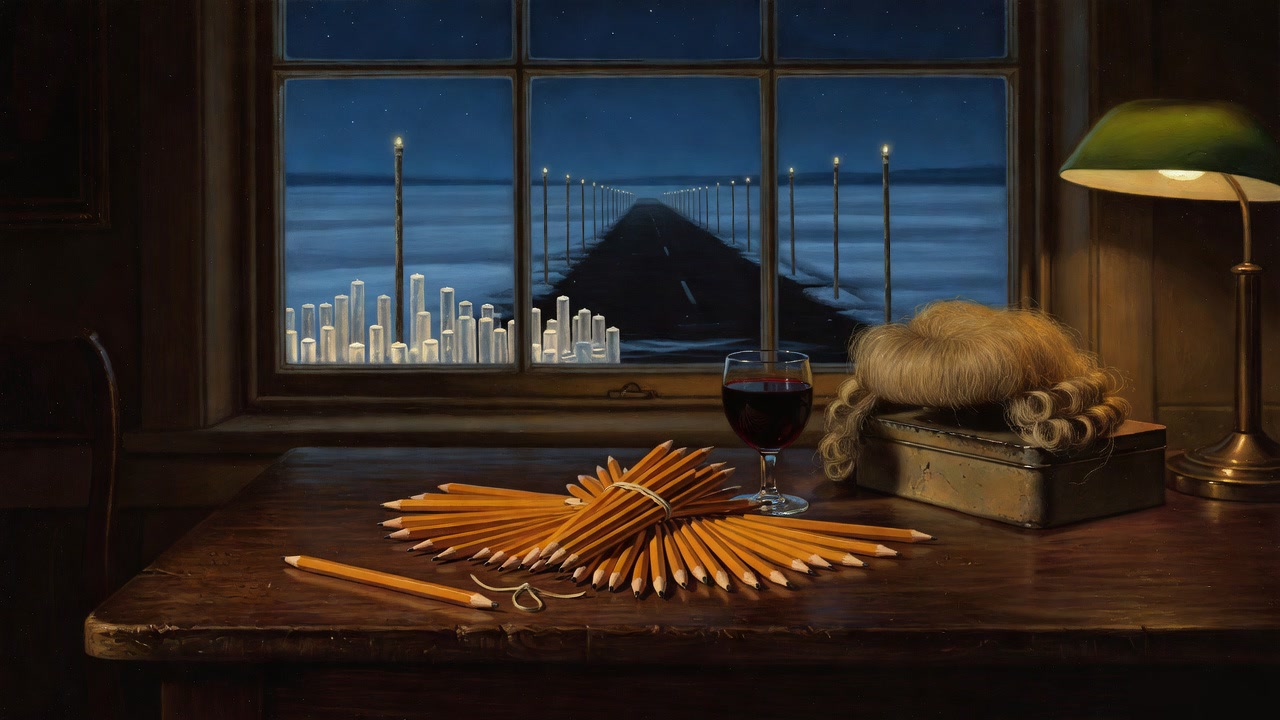
I rose to cross-examine him with nothing in my hands but a bundle of pencils.
They were Mrs Rintoul's. She had brought a fistful of them to our first conference in June — pencils, because ink freezes at forty below, and the whole of the north is run on pencil — and left them on my desk, and I had kept them, and that morning I had put a rubber band round them. There were perhaps thirty. Hard, yellow, hexagonal, chewed at the ends by a woman who had been chewing pencils on frozen lakes since 1975.
"Dr Hallam," I said, "I am an old man and I've never knowingly understood a machine in my life, so I'll ask you to be patient with me. Your radar sends a pulse down through the ice and listens for it coming back off the water."
"That's right."
"And from the time it takes, you know how far down the water is."
"Yes."
"So it tells you how thick the ice is."
"Very accurately."
"Does it tell you what the ice is like?"
He considered that, which I liked him for. "It tells you thickness. There's some information in the signal about structure, but the system that was used on that road isn't calibrated for it. Thickness is what it measures."
I held up the pencils, upright, in their band. "How thick is this, Dr Hallam?"
The judge looked at me over her spectacles without expression. Ms Marchbank did not move.
"About four centimetres," said Dr Hallam.
"Is it strong?" I put the end of the bundle on the edge of the bench in front of me and pressed down on it with the flat of my hand, hard, and it held, as a bundle of pencils will. "It seems strong."
"Endwise, yes."
"And now?" I took the band off.
I had practised this in my room, and in my room the pencils had fallen over neatly. In Court Four at Southwark they went everywhere. They went across counsel's row and under the clerk's desk and into Ms Marchbank's papers, and one of them ran the whole length of the well of the court with a noise like a very small train and fetched up against the foot of the jury box, where the foreman, a thin man in a cardigan, bent and picked it up and looked at it, and then — this was the only moment in the trial at which Judge Pennick's face did anything at all, and it did very little — leaned over the rail and handed it back to me.
"Thank you," I said. "Dr Hallam, the thickness of that bundle hasn't changed. Your radar would give it the same reading now that it gave it a minute ago. What's changed?"
"The — there's nothing holding them together."
"Is there a kind of ice that does that?"
He was an honest man. I had banked on it, the way a man banks on the tide.
"Candle ice," said Dr Hallam. "Or candled ice. In spring, when the sun gets high enough, the light gets into lake ice and melts it along the boundaries between the crystals. The crystals in lake ice grow vertically — long columns, top to bottom. The melt goes down between them. You get ice that's still the full thickness but it's become a — well. A bundle of columns. Candles. It can lose most of its strength while it keeps all of its thickness. And on a ploughed road, with no snow on it to shade it, it starts weeks before the lake round about."
"Would your radar see that?"
"No. Not as configured."
"So on the fourth of April last year, at the Nineteen-Mile Narrows, the ice might have been a hundred and four centimetres thick and rotten all the way through, and your instrument would have reported it in perfect good faith as a hundred and four centimetres."
"It's possible," said Dr Hallam. "I'd want to say — candled ice isn't necessarily weak all the time. If it gets cold enough at night, the melt between the crystals can refreeze, and it can recover some strength — for a few hours, and less each night as spring comes on. It's very variable. But yes. It's possible. The radar can't tell you."
"Thank you," I said, and sat down; and it was a good cross, and I have done better, and I knew it had moved the jury perhaps a third of the way towards a door that the loss adjuster was going to slam on them the next morning. The radar couldn't tell you. That was all I had. Possibly rotten. And a thirty-eight-tonne tanker had gone over the Nineteen-Mile Narrows six days later as if it were the M1.
My client, in the dock, had not watched the pencils at all. She'd watched the radar man. When I sat down she wrote something on the pad they give defendants, in pencil, and turned it face down.
Mr Dale Kerslake gave his evidence the next morning, and I liked him at once, which was a misfortune, because the witnesses I like are the ones who hurt me. He was large and bald and pink and fifty-five, an Albertan with a voice like a reasonable bear, and he had driven the closed road because he believed in his work and had been told it was safe by a hundred and four centimetres of radar, and he gave his account of it with the slightly embarrassed pride of a man describing the day he did something brave and slightly stupid in front of his children.
"We set off from the south end in the small hours," he said, in chief. "My driver was a fella called Rudy Lamoureux, independent, a lot of years on the ice roads, and I paid him very well, I'll say that. Thirty-eight tonnes, loaded. I rode in the cab. I filmed it on my phone and we had the tracker on. Nine hours, highway to mine. It was —" he hesitated, and the jury liked him for that, too — "it was quiet. It's the quietest place I've ever been. You hear the ice talking sometimes, a sort of boom, way off, but that's just ice. Nothing happened. We pulled up at the mine gate about eleven in the morning and I phoned my office and said, she's sound."
"And you returned to Edmonton how?" said Ms Marchbank, as a matter of form.
"I flew out from the mine strip, ma'am. Rudy came back down for the truck on next winter's road."
"Thank you, Mr Kerslake. Wait there, please."
And while I was getting up, the pad slid along the ledge of the dock to the rail, and the dock officer passed it to my junior — I had a junior — not Priya, who had already said yes to Atrium and could hardly be led against its head of insurance crime, but a quiet young woman from another set who'd been given me by the solicitors and had said perhaps eleven words in three days, all of them correct — and my junior put it in front of me, and I turned it over.
Six words, in pencil, in capitals, pressed so hard into the paper that I could read them off the back.
ASK HIM WHAT I TOLD HIM.
Every advocate at the English Bar is taught the same commandment on the first day, and taught it again every day thereafter by the experience of watching other advocates break it. You do not ask a witness a question in cross-examination unless you already know the answer. Not think. Know. You do not go fishing in front of a jury; you do not open a door you haven't looked behind; because the one answer you didn't expect is the one that will be read back to you in the Court of Appeal. I have kept that rule for very nearly fifty years. I have lectured on it. I've watched brilliant men destroy good cases in a single sentence by forgetting it for one afternoon. And I did not know what she'd told him. I knew she had told him not to go — she'd said so in June, in five words, and I'd taken the five words for the whole of it. In three months of preparation it had not once occurred to me to ask her whether she'd told him anything else. She had expected him, I think, to say it himself; he was an honest man, and she'd have thought it his to tell.
I looked at the dock. Mrs Rintoul was looking at Mr Kerslake.
"Mr Kerslake," I said. "Before you made your journey — did you speak to Mrs Rintoul?"
There was a very small pause, of the kind that a man of fifty years' practice can hear the way a piano tuner hears a string go flat.
"I did, sir. I called her. It was a courtesy. It was her road."
"What did you tell her?"
"I told her I was going to drive it. That my principals wanted it tested."
"And what did she tell you?"
Mr Kerslake looked at the dock, and then at me, and then, for some reason, at the jury; and then he did the thing that the honest ones do, which is the greatest gift a cross-examiner is ever given and the one he has least right to expect: he simply told the truth, plainly, as though nobody had ever thought to ask him for it, which nobody had.
"She told me not to go," he said. "She told me it was rotten, and I'd go through at the Narrows. I said I was going regardless — I'd got the truck, I'd got Rudy, I had a flight booked. And she was quiet a minute, and then she said: if you're set on it, go at two in the morning. Keep off the Nineteen-Mile Narrows after the sun's up. And don't come back by road."
Nobody in Court Four moved at all. Across the road, on a terrace twenty-two floors up, a man in a white shirt was watering a tree in a pot.
"What time did you leave the south end, Mr Kerslake?"
"Ten to two, sir."
"What time did you cross the Nineteen-Mile Narrows?"
He knew. He had it in his own exhibit, in his own satellite log, to the minute, and he didn't need to look. "About twenty past three."
"In the dark."
"Yes, sir."
"At what temperature?"
"It was minus twenty-one on the dash, sir. I remember because Rudy said it was a good night for it." He stopped. I watched him hear what he had just said. "Rudy said that. A good night for it."
"And you came back by air."
"Yes, sir."
"Why?"
Dale Kerslake looked at the dock for a long moment, and Mrs Rintoul looked back at him.
"Because she told me not to come back by road," he said. "And by then — sir, I'd driven nine hours on that lake in the dark with her voice in my head. When we pulled up at the mine it was full daylight and it had got up to two above, and I looked back down that road and I didn't want to. That's the truth of it. I didn't put it in my statement. I didn't think it was — I didn't think it mattered what she said. I thought it only mattered that we made it."
I did not ask him anything else. There was nothing else to ask. I said thank you, and sat down, and I have never in my life sat down more carefully; and Ms Marchbank, who is very good, rose to re-examine, and asked the only question there was to ask.
"Mr Kerslake. Whatever Mrs Rintoul told you — the ice bore your tanker?"
"It did, ma'am."
"Thank you," said Celia Marchbank; and sat down, and did not look at the jury, which is how I knew.
I called my client. I had not been sure, until that morning, that I would. She went into the witness box in her waxed jacket and took the oath on the Bible in a voice that made it sound like a bill of lading, and I asked her four questions.
"Mrs Rintoul, why did you close the road?"
"Because it was rotten."
"How did you know?"
"I went and looked at it."
"Did you tell Mr Kerslake when it would be safe to drive?"
"I told him when it would be least likely to kill him. That's not the same."
"When you signed the declaration that the road was unsafe for heavy traffic — did you believe it?"
"I'd have signed it if there'd been no insurance in the world," said Isobel Rintoul. "There's men drive that road with their sons in the cab."
Ms Marchbank cross-examined her for an hour and a quarter, courteously and well, and could not lay a finger on her. I shall give you two exchanges, because they are the only two I've been able to forget.
"You were tired, weren't you, Mrs Rintoul? Thirty-one winters. Seventy-one years old. The contractor behind schedule and leaning on you. You were tired."
"I was tired every April for thirty years," said Mrs Rintoul. "Tired's not the same as wrong. You'll find that out."
And:
"You booked your flight home for the seventh of April three weeks before you closed the road. Before there was any candle ice at all, on your own account. How did you know, three weeks ahead, that you'd be closing the road that week?"
"I didn't. I book it every year for the first week of April." Mrs Rintoul looked at her as if she were a young driver who had asked why the poles were on the left. "The ice candles in the first week of April. Most years. It's not me that's regular, Mrs Marchbank. It's the sun. And I didn't take it, as it happens. There was a man wanted to drive my road."
"He drove it safely, at night. Why not simply run the road at night?"
"One truck," said Mrs Rintoul. "Once. At twenty below, with me telling him beforehand where the rot was. I'd eighteen per cent to come north. That's seven hundred loads, Mrs Marchbank, night after night, with the cold going out of the nights a degree at a time and nobody knowing which night it goes. That's not a road. That's a lottery with men's sons in it."
I made a closing speech. It was eleven minutes long, which is the shortest of my career by some distance, and I don't propose to reproduce it, because it contained nothing the jury hadn't already seen for themselves.
In August.
The sign had been in the window a fortnight when Quentin Aldous came to ask me to return the brief.
He came at six, which is an hour at which Quentin is generally on a train to Sevenoaks, and he stood in the doorway of my room with a printed sheet in one hand, held a little out from his body the way he always held things he was proud of; except that he wasn't proud of this one. I could see that much. I chose not to see anything else.
"Augustus. The Rintoul matter."
"The Rintoul matter is going very nicely, thank you, Quentin. I've had a conference with an expert on the behaviour of lake ice in the spring that has done more for my understanding of the natural world than the whole of my education."
"Celia Marchbank's leading for Corran."
"So I gather. I look forward to it. I haven't been against her since the Baines fraud, and she was so polite to me afterwards that I've never entirely recovered."
"Augustus." He came in and sat down, which he never does. "Celia's head of insurance crime at Atrium. The vote's at the end of September. This is — I'm not asking you to do anything improper. Nobody could ask you that. I'm asking whether, this month of all months, it might be wise — there are two other sets with a criminal fraud practice who'd take it on at a week's notice —"
"I'm a cab on the rank, Quentin."
He closed his eyes.
"The cab-rank rule," I said, "requires a barrister to accept any brief, in a field in which he practises, at a proper fee, from any client who hails him, without regard to whether he likes the client, the cause, the opponent, the colour of the opponent's chambers or the number of floors it has. It is the oldest rule we've got and the only one that has ever made us any better than anybody else. Mrs Rintoul's solicitors tried two other sets in May. Both found they were very busy. She came to Hazlitt Court because we were the cab at the front of the rank, and I'm going to drive her to Southwark in the second week of September, and if Atrium Chambers wishes to take exception to that I shall be delighted to explain the rule to them in person, on their terrace, at length."
"That isn't —" He stopped. He looked down at the printed sheet in his hand, and I saw him decide to put it on my desk. "Augustus, will you at least look at these? It's not about Celia. It's the — it's where we are. As a set. The figures. There's something about the terms that I've been trying to —"
"Has that been through the server?"
"Augustus, for God's sake —"
"I have a rule about paper that has been through the server, Quentin. You were present when I announced it. I believe you minuted it."
He sat there with his sheet. Outside, in the court, the sign had come on at four and was throwing its pink across the stones in the long August light, where it was hardly needed. I remember thinking, with the particular complacency I seem to have reserved for that summer, that I'd never seen Quentin Aldous look so tired, and that it was very probably the server.
"Whatever it is," I said, quite kindly, "it'll keep until I've won."
He folded the sheet in half, and then in half again, and put it in his pocket, and went.
On the first of September, Sefton's figures came up in their buff folder, as they had come up on the first of every month since the spring before last; and I put them in the second drawer of my desk, on top of the others, without opening the folder, and went back to the reading I was doing, which was a paper on the spring decay of freshwater ice, by a man in Manitoba, which I had sent for specially and was finding absorbing.
In June.
Sefton brought me the brief on a Tuesday morning in the middle of June, with the windows open and the plane tree in the court in full leaf and the whole of the Temple smelling of cut grass and hot stone, and he set it down on my desk the way he sets down a brief he expects me to take and wishes I wouldn't.
"It's been to two sets, sir," he said. "Both found they were very busy."
"What is it?"
"Fraud, sir. A private prosecution. An insurer. The lady's on legal aid." He paused. "She closed a road."
"Is that an offence?"
"Apparently, sir, it depends on the road."
She came at eleven. I heard her on the stairs before I saw her, which with most clients means nothing; but she came up our four flights at a steady pace that did not alter on the steep bit by the second landing, where most people over fifty stop and pretend to admire the engraving of Lord Mansfield, and on the third landing she did stop, and I came out onto the landing to see why.
She had put her hand flat on the wall. There's a place on the third landing where the plaster has been going since about the time of the Suez crisis — we have it painted every few years, and it comes back, a soft brown map of nowhere in the corner by the window — and Isobel Rintoul was standing with her palm against it, quite still, as though it were the flank of an animal she was assessing at a market.
"The damp," I said, "is very nearly as old as the building and entirely loyal. Good morning. You must be Mrs Rintoul."
She took her hand off the wall and looked at it, and then at me.
"Aye," she said. "I must."
She was small and square and seventy-two, with a face the colour and texture of a good saddle and very pale grey eyes, and she wore, in the middle of June, a man's waxed jacket and a woollen hat, both of which she declined to remove. Sefton brought tea. She drank hers black, without sugar, at a temperature that would have taken the enamel off my teeth, and while she drank it she looked round my room — at the books, and the window, and the photograph of my father in his robes, and the brief on the desk in its pink tape — the way she must have looked at a stretch of road.
"I've read the papers," I said. "I'd like you to tell me in your own words what happened on the fourth of April."
"It's in the papers."
"The papers say what the radar said. I'd like to hear what you saw."
She put down the cup. Then she put her hand into the pocket of the waxed jacket and took out a fistful of pencils — thirty of them, perhaps, yellow and chewed — and put them on my desk in a heap, as another person might put down their keys; and she took one out of the heap and held it, not writing with it, just holding it, and told me.
I've thought a great deal about how to set down what she said, and decided that the best I can do is to set it down very nearly as she said it, which was flatly, in order, without once raising her voice or looking for an effect, as if she were reading me the log.
"The radar crew came in on the third and said a hundred and four at the Narrows, and that's thick. That's plenty. I've run sixty tonne over ninety. But I'd not liked the colour of it, coming up on the second. It had gone grey. Good ice is black, or blue, or white where there's snow on it. When it goes grey it's letting the light in.
"So on the fourth I went out myself at noon, to the Narrows, with the spud. That's a chisel on a long handle; you knock it into the ice and listen. Good ice, it goes into you up your arms like a church bell. That day it went in like you'd hit a sack of wet sand. And I knelt down and put my face to it, where the snow was blown off, and you could see them. Down in it. All standing up together, side by side, like —" she lifted the pencil in her hand, and looked at it, and put it back on the heap — "like that.
"There was a wee wind. And where there was a crack at the edge, where the current comes through and the ice is always worst, the top of the candles had come loose, and the wind was moving them. And they were ringing. Like glass. Like somebody'd dropped a tray of glasses a long way off and it was still falling.
"I've heard that four times in thirty-one winters. I went back to the hut and wrote CLOSED in the log, and signed it, and told the contractor's man, and he called me a word I'll not use in your room. Then I signed the paper for the insurance because the contract said I had to. That's all.
"There was a man from the insurance wanted to drive it after. I told him not to. He drove it."
"And then?" I said.
"And then I took the poles up."
I asked her what she meant, and she looked at me with a patience I've seen only in very good nurses and very old judges.
"The road's marked," she said. "With poles. Reflectors on top, so the drivers can see the line at night and in a white-out. Every five hundred metre, two hundred and fourteen kilometre. Four hundred and twenty-eight poles." She turned the cup a quarter turn on its saucer. "I counted them on in January and I counted them off in April. Took me four days on a skidoo with a sledge behind, and I did the Narrows at first light, when it was still froze. Ice that'll not bear sixty tonne will bear a skidoo and an old woman, if she's quick. The crews had gone by then. They'd have left them. Most do.
"But if you leave the poles up," said Isobel Rintoul, "somebody drives it."
She had nothing more to say after that, and didn't pretend to. By May, she told me, when I asked, there was no road at all — only grey honeycomb nobody would set foot on, and by midsummer the lakes, open and black and moving, the way they'd been all along, and would be again until January; and the poles in a stack behind the hut at the south end, four hundred and twenty-eight of them, ready for whoever came next.
I told her I'd take the case. I told her — I remember this exactly, and I've remembered it a good deal since — that she'd been prosecuted for a disaster that hadn't happened, which was the most English thing I had heard in years, and that we should win it on a Thursday and be home for tea. She looked at me with her pale grey eyes and said nothing at all, and I think now that it was very civil of her.
She left the pencils. I didn't notice until she'd gone. Sefton showed her down, and from my window I watched the two of them cross the court together in the sun, a small square woman in a waxed jacket and a long grey man in a black one, not speaking, at exactly the same pace; and at the arch she stopped and said something to him that I couldn't hear, and he bent his head to listen, and stood there in the arch a long moment after she'd gone.
Below me, at the foot of our stair, Mr Tolley was up his steps in the sunshine with a pot of size and a book of gold leaf, putting the gold back on my name, which had begun, that summer, to go at the F.
Enjoyed this story?
Read next
 A developer's scaffold went up over a dead neon sign at the wrong end of our own street, and my wife of one-and-forty years climbed it at ten past seven in the morning with two flasks of tea and would not come down; and because a man cannot defend his own wife, the finest advocate of his generation sat at the back of a magistrates' court with his hands in his lap and no standing to say a single word, and there learned — at the same moment as the bench, the usher, and a bored young man from the Crown — what she had been quietly paying for since the year before we met.
The Light She Kept On
 Eleven seconds of telephone footage had shown the whole of England a man seize a frightened woman, fling her to a railway platform, and step over her and walk away — and the whole of England had tried him, named him, and condemned him before luncheon; so that by the time the Crown of England got round to charging Daniel Quist with assault, there was nothing left to do but the trial, the verdict having been handed down weeks before by a jury of forty thousand strangers who had each seen the same eleven seconds and not one of them the twelfth.
The Eleven-Second Man
 The store's flawless system said the ring was checked in, logged to his counter, and never logged out — so by the machine's own perfect record only Albert Sturrock could have taken it; and to save him, Fenwick must win the one way he cannot stand, with his junior's data, and supply the one thing no machine has a column for: that the keeper carried a frightened girl's lost heirloom home by hand, off the books, because a lost-property office exists to reunite, not to hoard by the rulebook.