
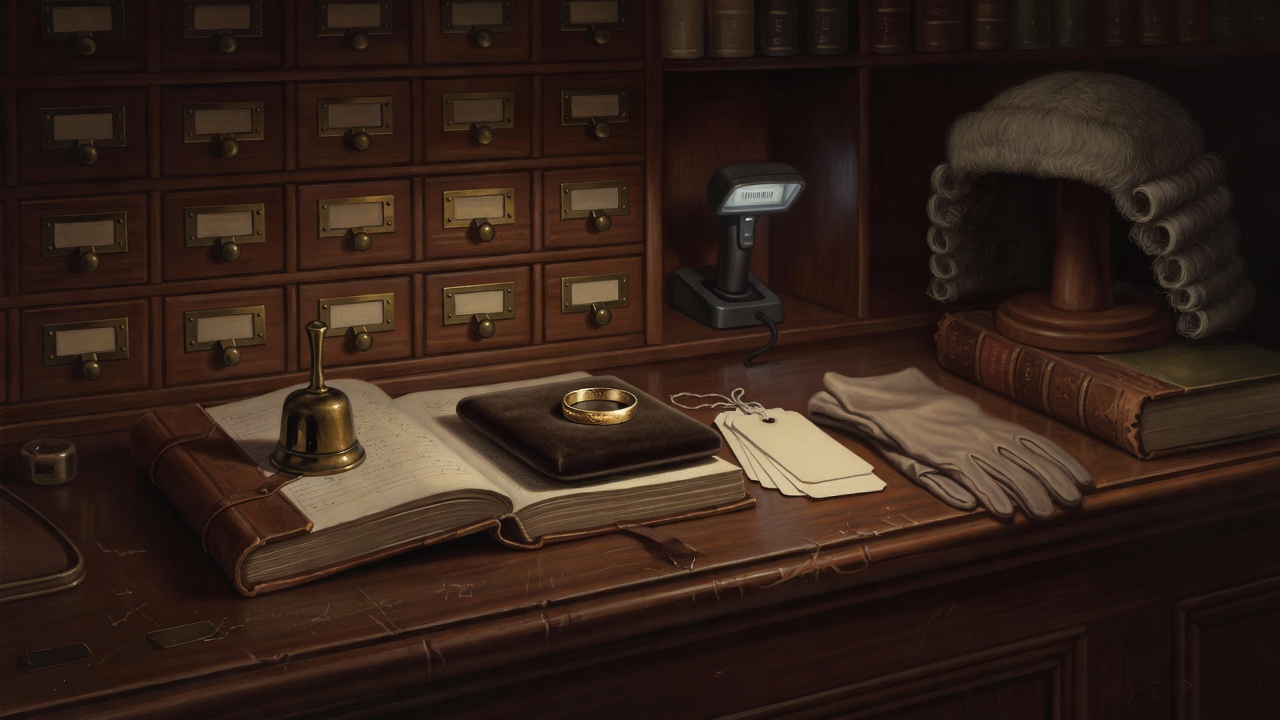
The Keeper of the Reunions
Content notes
mild language, alcohol
I have spent the better part of fifty years persuading juries that the most damning fact in the case is the very thing that exonerates my client, and I had supposed, in my vanity, that there was no instrument of accusation I could not turn in my hand and hold up to the light until it shone for the defence. The witness who lies, the witness who is mistaken, the witness who is honest and wrong, which is the most dangerous of the three — I have made my living among them, as a man makes his living among bees, by understanding that the sting is in the misunderstanding and not the creature. I was, I freely confess, a little proud of it.
And then they brought me a machine that did not lie, and could not be mistaken, and was honest and wrong in a way I had never met, because it was not honest and wrong as a man is — out of weakness, or hope, or the desire to be liked by the foreman of the jury — but honest and wrong as a clock is wrong that keeps perfect time in the wrong house. And I discovered, at an age when a man ought by rights to have discovered everything mortifying about himself that the world intends him to discover, that I could not so much as read the thing that was destroying my client, and that the only person in London who could was a young woman of eight-and-twenty whom I had spent three years declining, with the most exquisite courtesy, to need.
I begin with that humiliation because the humiliation is the whole of the case, and a casebook, unlike a database, may be opened at whatever page best serves the telling — which is the single advantage the old way retains over the new, and I intend to enjoy it while it lasts, which I am given to understand will not be long.
The store was Marchmont & Hale, of Knightsbridge, which any Londoner of a certain vintage will know the way one knows a cathedral: not as a shop, exactly, but as an institution one assumes will outlast oneself, full of marble and gloved assistants and the particular hush of money that has stopped needing to announce itself. It has stood on that corner since 1871, when it sold gentlemen's gloves and ladies' fans and a line of patent corsetry the advertisements described as hygienic, which I have always taken to be the Victorian word for cruel. It survived the Zeppelins, the Blitz, three recessions, and the arrival of a thing called online, which I understand to be a sort of shop you cannot stand inside, a notion so dismal I decline to examine it further. And in the basement of Marchmont & Hale, down a service stair the customers never see, behind a counter of dark mahogany worn pale at the edges by a hundred and fifty years of forearms, there is a room.
It is called, on the brass plate that has hung over its door since before either of us was born, the Bureau of Lost Effects, and it is, when you consider it without flinching, the most quietly heartbreaking room in London. Everything anyone has ever left behind at Marchmont & Hale ends there. The umbrella set down to try on a hat and never recovered. The single glove. The reading spectacles, the walking stick, the teddy bear forgotten in the toy department by a child now grown and possibly itself a parent of forgotten teddy bears. They are gathered up each night by the floor staff, carried down the service stair, and given into the keeping of the Bureau, where they are logged, and labelled, and shelved in the dark, and made to wait against the small and mostly disappointed chance that someone will come back and want them again. A warehouse of the lost, kept in perfect order for the sake of a reunion that, in the great majority of cases, never comes.
And the keeper of that room, for one-and-thirty years, the man who logged the umbrellas and labelled the spectacles and posted, more than once, at his own expense, a stranger's lost effects to a stranger's address because the stranger was old and lived in Inverness and could not be expected to come for them — the keeper of the Bureau of Lost Effects was a man named Albert Sturrock, sixty-eight years old, with a hearing aid in each ear and a war pension he had never claimed and a manner so unfailingly courteous that the younger staff, I am told, called him the Vicar behind his back, with the affection the young reserve for the genuinely good, whom they find faintly embarrassing and entirely safe.
And the Crown of England, in the fullness of its wisdom, charged Albert Sturrock with theft.
Sefton brought me the brief in the manner of a man delivering a verdict already passed, which with Sefton is not an occasion but a temperament.
Sefton is my senior clerk. He is a long, grey, funereal person who dresses like an undertaker on his afternoon off and runs my professional life with the despairing devotion of a man tending a fire he is convinced will go out the moment he leaves the room, which, in fairness to Sefton, it would. He does not approve of me. He has never approved of me. It is the steady weather of our long association, and I should be lost without it, as a man is lost without the climate he was raised in and goes about, in foreign sunshine, vaguely expecting rain.
"It's an awkward one, sir," he said, and set the papers on my desk with the particular care he reserves for briefs that trouble his conscience, which are a distinct and rarer category from the briefs that fail to pay.
"They're all awkward, Sefton, until they're read, at which point they collapse into the same three offences the human race has been committing since it left the trees, which are theft, false witness, and the failure to anticipate one's wife. Which is this?"
"Theft, sir. A department store. Marchmont and Hale — the lost-property office. They've charged the keeper."
I confess my interest was not, at the first, engaged. The theft of merchandise from a great store is among the dreariest crimes in the calendar, a matter of CCTV and store detectives and the particular squalor of the modern, and I had no wish to spend the autumn of my life squinting at footage of a man secreting cufflinks. I said something to that effect, with feeling.
"It's not merchandise, sir," said Sefton, and did the thing he does perhaps four times a year, the thing I have learned to watch for the way a sailor watches the falling glass: his face became, briefly, against every governing principle the man holds, the face of a person with a heart somewhere about him. "It's lost property. A ring. And it's the keeper they've charged — Mr Sturrock. One-and-thirty years at that counter, sir. There's a commendation in the file from the store itself, framed, dated last Christmas. For long and devoted service. And there's a letter from a woman in Carlisle whose late mother's wedding ring he tracked down and posted back to her in 2009, at his own cost, with a card. He kept a copy of the card, sir. It's in the antecedents. It says —" Sefton, who carries the awkward in his memory the way other men carry small change, produced it exactly — "it says, I hope this finds its way home to you. They so seldom do, and it is a pleasure when one does."
I put down my pen.
"They so seldom do," I said, "and it is a pleasure when one does. Sefton, that is not the sentence of a man who steals rings. That is the sentence of a man whose entire vocation is the opposite of stealing rings. What in the name of all that is holy do they say he took?"
"A ring, sir. As I say. An antique — a signet, gold, with a stone, valued for insurance at eleven thousand pounds. Found on the shop floor by an assistant on the morning of the third of October, handed in to the Bureau, logged by Mr Sturrock himself, and assigned to his counter because it's high-value, and high-value goes to the senior keeper, by the rules. And then —" Sefton turned his long hands palm upward, a gesture from him as eloquent as another man's weeping — "nothing, sir. The log shows it come in. It shows it go to Mr Sturrock's station. And then for nine days the record is silent, and on the twelfth there's a quarterly audit, and the ring is not on the shelf, and there is no entry — none, sir — to say it ever left. Never logged out. Never released to a claimant. Never transferred. Just gone. And the last hand the system records upon it is his."
"So the machine," I said slowly, "has performed the conjuror's trick of proving a negative. It cannot show that he took the ring. It can only show that the ring was there, and then was not, and that no one but Sturrock is recorded as having touched it. And from the absence of a record of its leaving, the Crown concludes there was a theft, on the impeccable logic that if a thing is gone and the machine did not see it go, then it must have gone by the one route the machine does not watch, which is a man's pocket."
"That's the case, sir, near enough." Sefton paused. "The solicitors say it's the cleanest evidential package they've ever handled. Airtight, they said."
I have, over a long career, developed a deep and abiding mistrust of the cleanest evidential package anyone has ever handled. A case that is merely strong has been assembled by people who looked at it. A case that is airtight has been assembled by people who stopped looking the moment the machine agreed with them, and a machine will agree with almost anything if you only ask it the question it was built to answer and decline to ask it any other.
"And Sturrock," I said. "What does Sturrock say?"
And here Sefton looked at me with the expression of a clerk who has read every page of a brief and understood none of the man inside it, which is the look the rest of us reserve for poetry and for our own children.
"That's the rub, sir," he said. "He says he didn't take it. Quite firm. Quite calm. I did not take that ring, and I never would. And then —" Sefton spread his hands again — "and then he stops, sir. Won't say another word about it. Where it went, what happened on his counter, why there's no entry — nothing. His own solicitor's at his wits' end. The man'll deny the theft till the cows come home, perfectly serene, and the moment you ask him then where is the ring, Mr Sturrock, he folds his hands and says he has nothing to add. Nine days, sir, and a man's liberty, and nothing to add."
I sat for a moment with that, turning it over the way one turns a coin one suspects is lighter than it ought to be. I did not take that ring, and I never would. Not I do not know what became of it, which is what an innocent man of failing memory says. Not there has been some mistake, which is what an innocent man of failing nerve says. A flat, serene denial of the act, and then a locked door over everything after — and I had heard that exact shape of silence before, somewhere, long ago, though where would not come to me until it came, as the important things always do, uninvited and across the dinner table.
"Sefton," I said, "a man does not spend one-and-thirty years posting strangers' wedding rings home to Carlisle and then, at sixty-eight, with a commendation on his wall and a war pension he is too proud to claim, steal a signet ring and sit in a police interview being calm about it. Calm is the thing that gives them away. The guilty are frightened, Sefton; it is the most reliable fact in the criminal law. A frightened man weeps, or lies, or talks far too much. A man who is calm and will not speak is not concealing what he did. He is protecting what he did. And those are two entirely different cases, and the prosecution, I will wager you the better of Mr Verey's Burgundy, has charged the first one."
"Yes, sir," said Sefton, with the particular flatness that means he agrees with me completely and would sooner be drawn and quartered than say so aloud. "There's the fee, sir."
"There is always the fee."
"It's legal aid, sir."
"Then bring me the brief," I said, "and pour me something restorative, because legal aid is the Crown's annual reminder that virtue must be its own reward, that being the only sort of reward the Lord Chancellor has budgeted for."
I had read perhaps thirty pages of the disclosure before I understood, with the cold completeness of a man who feels the floor go from under him in the dark, that I was beaten, and that the only person on earth who could un-beat me was the one person I had spent three years arranging never to be indebted to.
The brief, you see, was data. There was no eyewitness; no one had seen Albert Sturrock so much as glance at the ring after he logged it. There was no useful CCTV — Marchmont & Hale, for all its marble, keeps its cameras on the cash registers and the doors and the goods, not on the basement room where nothing is sold and nobody but staff ever goes; the Bureau is a blind spot in the great electronic eye, which is itself a fact I found suggestive, since it is precisely in the rooms the machine does not watch that human beings remain at liberty to behave like human beings. There was no forensic recovery, no fingerprint upon a ring that no one had ever found. There was, in the entire prosecution, exactly one thing, and that thing was the log.
And the log was a document I could no more read than I could read the migration of birds. Page upon page of timestamps to the second, reference numbers in long unlovely strings, four-letter codes invented by a person who had clearly suffered some grievous wrong at the hands of the English language and meant to be revenged on it. ITEM_INTAKE. STN_ASSIGN. CUSTODY_HOLD. AUDIT_DISCREP. RECON_NULL. I sat with those printouts for the better part of an afternoon, with a glass at my elbow to fortify the siege, and I extracted from them, by main force and at the cost of a headache I felt I had earned, the following intelligence: that there were numbers, arranged in columns, beneath headings composed by my enemy, and that they appeared, with a unanimity I found chilling, to be hanging my client.
I tried. I want that entered in the record, by whatever recording angel keeps the log of my own days and will, I trust, prove kinder in the reading than the one at Marchmont & Hale. I read RECON_NULL — which I took, correctly as it turned out, to mean the reconciliation found nothing where something should have been — until the words came apart in my hands like wet paper. And I understood, somewhere in the third hour, the thing I had been refusing to understand since the brief arrived, which was this: that the language in which my client's innocence was now written, if it was written anywhere, was a language I had never been taught, and was too old, too proud, and too far gone in claret to learn; and that the key to it was held by a young woman in the room down the corridor, the room with the damp that nobody else wanted, and that she had been waiting, with a patience I found frankly menacing, for the old man to come and ask.
I did not go and ask. Not that first day. We of my vintage would sooner be right in the wrong century than wrong in the right one, which is, I have come at last to see, the precise and entire definition of a fool, and I was being one with a thoroughness that would have done credit to a much younger man.
What I did instead was the only thing I have ever reliably known how to do at such an impasse, which is to go to Verey's and think.
Verey's is a small dark amber room down a stair off Fleet Street, beneath a barber's who has cut the same nine heads for forty years and shows no sign of seeking a tenth. It is, in the only sense that signifies, my true chambers — the chambers of the soul, as distinct from the chambers of Hazlitt Court, which are merely the chambers of the rent. Mr Verey the younger keeps the good Burgundy under the counter and the twenty-first century outside the door, where it can do no harm, and he produces the one and excludes the other with a discretion I have never seen equalled at the Bar.
"You've got the face on, Mr Fenwick," he said, setting a glass before me unasked, a small dark thing the colour of a bishop's misgivings. "Not the murder face. The other one. The innocent-client face."
"You read me like a wine list, Verey."
"It's the same skill, near enough. Who is it?"
"A lost-property keeper," I said. "One-and-thirty years. They say he stole a ring. He didn't."
"How d'you know he didn't?"
"Because he won't tell me what he did with it." I drank. "Verey, I am going to confess to you a thing I would not confess to the Benchers of my Inn under torture, and I require you to keep the bottle within reach while I do it, on the established principle that confession dries the throat. I cannot win this case. Not because the man is guilty — he is the most innocent creature I have encountered since the last most innocent creature, and you will recall how very nearly that one finished me — but because the whole of the case is written in a language I cannot read. The entire prosecution is a log, Verey, a thing of columns and codes, and I have sat with it half a day and understood of it precisely nothing, except that it is killing him."
Mr Verey refilled the glass, which had not, in strictness, required it.
"And there's a young person," he said. It was not a question.
"There is a young person," I conceded, with the dignity of a deposed monarch reviewing his abdication. "A junior tenant of eight-and-twenty who reads these logs the way I read a cellar book — with fluency, with pleasure, and with an air of knowing rather more than she is letting on, which in a witness I would find sinister and in her I find, God help me, indispensable. She has, on three prior occasions, found the heart of a case in just such a swamp of figures. And on each occasion, Verey — here is the confession — I took her finding, and I dressed it in my own clothes, and I let it be understood, by her, by chambers, by the whole grinning Temple, that the old man had done it with his nose and his Wordsworth and a feel for human nature she could not hope to acquire this side of sixty. And the trouble —"
"The trouble is she knows," said Mr Verey.
"The trouble is she knows," I said. "And this time, Verey, I cannot even do the dressing. There is nothing for me to add. It is the data or it is nothing, and if it is the data, then it is hers, and I shall have to walk into that wretched damp room and ask a child to win my case, and mean it, and stand up afterward and say so."
I turned the glass on the counter, and watched the light move in it, and said the rest, because Verey is the one man on earth to whom I say the rest.
"And there is a creature at my own set, Verey. The head of chambers. A man named Aldous — all teeth and lanyard and the bright pitiless future. He has been saying for three years that I am a relic, that the world has moved past me, that Hazlitt Court must be a thing of servers and analytics and capability, and not a museum keeping an old fellow alive on briefs out of charity. And the unendurable part, the part I cannot stomach, is that on this one case the man is right. I cannot win it without the machine. And if I win it the only way it can be won, I shall be standing in open court proving Quentin Aldous correct with my own mouth, in front of every person whose good opinion I have spent fifty years pretending not to care about."
Mr Verey looked at me for a while in the amber light, the way his late father used to look at me when I was a young man with more brief than sense, and he topped up a glass that was by now, frankly, offended.
"My old dad," he said, "kept this cellar in a book. Every bottle in his own hand — where it lay, when it went down, when it ought to come up. And when I took the place on, I put the cellar on a computer, and he watched me do it, and didn't say a word for the best part of a week. And then one night, late, after the last of you had gone, he said: Son, the book never once told me which bottle to open. It only ever told me what was in the racks. You still have to know the table." Mr Verey set the bottle down with a small click. "Maybe your young person's machine tells you what's in the racks, Mr Fenwick. It still leaves somebody to know the table. And in this city there's exactly one man I'd trust to know a table, and he's sitting on that stool feeling sorry for himself and not paying for his Burgundy again."
I have, in my time, paid leading silks four-figure fees for opinions worth a great deal less than the ones Mr Verey hands me across that counter for the price of a glass I generally forget to settle.
I went to see Albert Sturrock before I went to Priya Nair, because I have never in fifty years believed a defence could be built upon the papers, the truth of a case being almost never in the disclosure and very nearly always in the front room, in what stands upon the mantelpiece and, more tellingly, in what has lately been taken down from it.
He lived in a small flat in a quiet street in Pimlico, above a shop that mended clocks, which struck me as the right address for the man entirely. He made me tea in a pot, with a strainer, in the manner of a generation that regards a tea-bag as the first step on the road to barbarism, and he set out two biscuits each on two small plates, which is the etiquette of people who have known want and have resolved that it shall never be seen. The flat was as ordered as a card-index. Everything in it had a place, and was in it. He was a neat, spare old man with a soldier's back and a hearing aid he adjusted with two fingers, courteously, when I spoke, as though tuning me in like a wireless he was rather glad to receive.
And on the mantelpiece, between a carriage clock that worked and a photograph of a woman I took, correctly, to be the late Mrs Sturrock, there was a space. A clean rectangle in the faint bloom of dust, where something had stood, and had stood for a long time, and now did not.
I noticed the space. I am old, and slow, and increasingly deaf myself, and there is a great deal I no longer notice; but the absence of a thing in a careful room is the loudest sound that room can make, and I have not yet gone deaf to that. I said nothing of it. You do not, in the first ten minutes, name aloud the thing your client has hidden. You note where the body is buried and you go on admiring the garden.
"Mr Sturrock," I said, "I am going to do you the discourtesy of being honest, which is so rare in my trade that I beg you to savour it. The case against you is, on its face, perfect. The store's record says the ring came to your counter and never left it by any lawful road, and the prosecution will tell the jury that this can mean one thing and one thing only. You have told everyone who asked that you did not take it, and you have told no one what did happen to it. Now. I have defended liars for half a century, and grown rather fond of the better ones. You are not a liar. So I shall not waste your good tea asking whether you stole that ring, because I know you did not. I shall ask you something else, and I ask you to consider, before you fold your hands, whether the person you are protecting would truly wish to be protected at the price of your liberty."
His hands, which had begun, gently, to fold, stopped.
"There's nobody to protect," he said, which was the first untruth he had told me, and I was glad of it, because a man who will lie to shield another is a man with a reason, and a reason is the one thing in all the world a defence advocate can build upon.
"Tell me about the room," I said, abandoning the bolted front door for the window, which is generally ajar when the door is barred. "The Bureau. Not the ring. The room. One-and-thirty years. Tell me what it is to keep it."
And the careful order of his face eased, a very little, because I had asked him about the work, and there is nothing on this earth that the good and the unregarded love so much as to be asked, at last, about the work.
"It's the best room in the building, Mr Fenwick," he said simply. "I know how it sounds. Marble upstairs, and chandeliers, and a hat could cost you a month's pension. And down in the basement there's a room full of umbrellas." He smiled, and it was a private smile, the smile of a man recalling a long marriage. "But every other room in that store is for taking. Selling, buying, wanting, getting. The Bureau's the only room in the whole place that's for giving back. Somebody's lost a thing — and you'd be surprised, sir, the things people lose, and how it's never the dear things by their price; it's the dear things by their love. A man'll walk past a diamond and come back across London on his lunch hour, white as a sheet, for a brass cigarette case worth four pounds, because his brother carried it through Korea." He adjusted the hearing aid. "And it comes to me, in the dark, on a shelf, with a label. And once in a while — not often, sir, not as often as you'd hope — somebody comes back, and wants it, and I get to give it to them. That's the work. That's the whole of the work. I find the people, and I give them back the things." He looked at the fire. "There's not many jobs left that are only about reuniting people with what they've lost. I've thought, sometimes, it's the nearest a man like me will get to —" He stopped, and would not finish it, but I finished it for myself, and I think you may finish it too.
"And the ring," I said gently. "It came in on the third of October. A signet, gold, a stone. Found on the shop floor and handed down to you. You logged it. Tell me what you did next, Mr Sturrock."
And there it was again — the careful order coming undone, very slightly — and he looked, for the briefest moment, not at me but at the clean rectangle on the mantelpiece, and then away from it, quickly, the way you look away from a grave.
"I logged it, sir," he said. "And I assigned it to my counter, being high-value, as the rules require. And I've nothing further to add." His hands folded, and were still. "You've been very kind. The tea's gone cold. But I've nothing further to add, Mr Fenwick, and I'd be obliged if you didn't ask me again, because I'd have to be rude to a gentleman who's only trying to help me, and I was raised not to."
I have heard I've nothing further to add in a great many rooms, and in almost all of them it has meant I am guilty, and I am clever, and I have decided that silence is my best chance. From Albert Sturrock it meant a thing I had heard precisely once before, very long ago, when I was young; and as I went down the stairs past the clockmender's window, with its dozen patient faces all telling slightly different times, the memory came — not the case, but the shape of it — and I knew where I had heard that exact serene and locked refusal. I had heard it from a man who had done a thing that was against the rules and entirely right, and who would go to prison without a murmur sooner than let the thing he had done be undone, or named, or spoiled by the explaining of it.
It is not the silence of a man hiding a sin. It is the silence of a man guarding a kindness from people who would only break it.
I did not yet know what the kindness was. But I knew its weather. And I went home, and I slept badly, and in the grey of the morning I rose and did the thing I had been putting off since the brief came in, the hardest single thing I have done at the Bar in thirty years, harder than any cross-examination, harder than any plea in mitigation for a man I knew to be guilty: I went to ask Priya Nair to win my case for me.
She was in the room they have given her, which is the room nobody else wanted, which in chambers is invariably the room they give the cleverest junior, on the unspoken theory that talent, like damp, will find its own level and is best kept somewhere it cannot spread to the carpets. She had her tablet, and a second screen propped against the law reports nobody opens, and the general air of a control room for a launch to which I had pointedly not been invited.
"Miss Nair," I said, and got no further, because the next part required a run-up, and at my age and my weight the run-up takes a moment.
"You've got the Sturrock brief," she said, not looking up. "Sefton told me. I read it on the train." She turned, and there was upon her face the look of polite forbearance she has perfected across three years of watching me decline, with great courtesy, to enter the present century — and underneath it, just visible, something warier, because she has also learned to recognise the particular weather of my coming to take something from her without saying so. "It's bad, Mr Fenwick. It's the cleanest —"
"— evidential package anyone has ever handled," I finished. "Yes. The solicitors said it, and Sefton said it, and now you, and it is a remarkably confident phrase for a thing that nobody in this entire matter has actually troubled to interrogate. Miss Nair." And I did a thing I have never done in that room, a thing she did not expect, because I do not sit in junior tenants' rooms — I loom in them, magnificently, and deliver an instruction, and leave: I drew out the spare chair, the one with the wonky leg, and I sat down in it.
She watched me do it the way you watch a cat do something out of character, which is to say with deep suspicion and a readiness to flee.
"I am going to say a thing to you now," I said, "once, and I shall deny on oath ever having said it, including to the Home Secretary, who would extract a fortnight's entertainment from it and a lifetime's leverage. I cannot win this case. I cannot read it. The whole of it lives in that log, and the log is written in your tongue and not in mine, and I am too old to learn the one and too proud, until approximately ninety seconds ago, to have admitted the other. On three prior occasions, Miss Nair, you handed me the heart of a case, and I took it, and I wore it as my own, and I let the world believe the old man had divined it out of the air. I knew that you knew. I made certain you knew that I knew. It was unjust, and it was the conduct of a coward, and I have come to your room — your terrible room, with the damp that is, I notice, advancing on the law reports as we speak — to do it differently this time, because this time there is no help for it. There is nothing for me to wear. The finding, if there is a finding, is yours and can only be yours, and I am asking you to make it, and I am telling you, in advance and in cold blood, that when it is made I shall stand up in open court and say whose it was."
There was a silence of a length I am wholly unaccustomed to producing in the young, who as a rule cannot bear silence and rush to fill it the way nature is said to abhor a vacuum.
"You'd stand up and say it was mine," she said, at last. Carefully. The way one handles a thing that may be a trap, or may be a gift, and one has been disappointed too often to assume the second.
"I would stand up and say a great many things," I said. "I am constitutionally incapable of standing up and saying only one. But yes. The finding, if you find it, will be credited to you, in the transcript, in front of Aldous and the solicitors and the whole gleaming Temple, in language nobody can later quietly amend. And the consequences — which include the prospect of Quentin Aldous concluding, with my assistance, that he has been right about me all along, a conclusion I would wade into the Thames at low tide to avoid — those consequences are mine, and I shall bear them, because there is an old man in Pimlico with a clean rectangle on his mantelpiece and a war pension he is too proud to claim, and he did not take that ring, and I am not going to let him go to prison to spare my vanity. My vanity, Miss Nair, has had a long and indulged life and can stand to lose a little weight. That is the whole of it. Now. Will you read me the log?"
She looked at me for a long moment, and I watched a thing move behind her eyes that I had not seen there before — not the moment when the machine becomes a question, which I had given her once or twice and rather prided myself upon, but the moment when the old man becomes one. The moment she revised me. It is not a comfortable thing, to be revised by a person you have spent three years gently condescending to, and I commend the experience to every man of my age exactly once, the way one commends a cold sea-bathe: bracing, salutary, and on no account to be repeated until it becomes necessary.
"All right," said Priya Nair. And then, because she is who she is, and because the young will not let an old man have a moment of grace without making him pay the toll on it: "But you have to actually listen. Not the thing you do where you look at the cornice and quote The Prelude and then claim you understood the whole of it through the soles of your feet."
"I make no promises whatever about the Wordsworth," I said. "It comes upon me unbidden, like weather, and like weather it is best not resisted but merely waited out. But I shall listen, Miss Nair, and I shall mean it. Begin."
And she turned the second screen toward me, which she had never once done before in a manner I had been willing to accept, and she began.
I will not pretend I understood it at the first telling, or the third. But Priya Nair, I discovered, is a teacher of the kind I have spent my whole life aspiring to be and only intermittently contrived to become — the kind who somehow never once makes the pupil feel the breadth of his own ignorance, but only the pleasure of the thing slowly becoming clear. She walked me through the log the way I walk a frightened client through a courtroom: naming each thing, letting me touch it, refusing to go on to the next until I had hold of the last.
"This is the ring," she said. "Logged at the basement counter on the third of October, at nine-forty-one in the morning. The keeper who logs it scans their staff card, so the system records who did it — that's Mr Sturrock, here's his card ID. Because it's flagged high-value, it auto-assigns to the senior keeper's station for safekeeping, which is also him. All exactly by the book."
"And then?"
"And then nothing," she said. "That's the prosecution's whole case in a single word. After nine-forty-one on the third, there is not one event logged against this ring. No scan, no transfer, no release, no disposal. Nine days of silence, and then the quarterly audit on the twelfth flags it absent." She looked at me. "Mr Fenwick, an item logged to a station and never logged out is, by the system's own logic, still at that station. The machine has no concept of a thing leaving except by being logged out. So when the auditor finds the shelf empty, the only event the system can offer to account for the absence is the last human event attached to the ring. And the last human event —"
"Is Albert Sturrock's hand upon it, the morning it came in."
"Is Albert Sturrock's hand upon it." She nodded. "That's the case. Not he was seen taking it. Not it was found on him. Just: the record is perfect, and it ends with him, and a perfect record that ends with one person reads, to a prosecutor, as proof. There's no gap in it. It's airtight."
And here I said the thing I did not know I knew until I heard myself say it, which is, in my experience, the only way any of us ever knows the thing worth knowing.
"Miss Nair," I said. "You have told me four times now that there is no gap in this record. And yet you have just spent ten minutes describing to me nothing whatever but a gap. Nine days of gap. The prosecution has not found a record of a theft. It has found an absence of a record, and resolved to call the absence a theft, on the sole ground that the only other thing an absence could possibly be is a thing the system cannot see — and a man who has staked his whole faith upon a system cannot afford to believe in the things his system cannot see, because the moment he does, the system stops being a god and becomes a tool, and gods are so much more comfortable to work for." I leaned forward, and the wonky chair protested under me, and I ignored it. "So I ask you, in genuine and humiliating ignorance: is there any other reason a ring would be in that building on one day and gone the next, leaving no record behind it? Any reason at all, that is not theft?"
She was quiet for a moment. And then she did the thing that I had been hoping, against the whole grain of my training and my prejudice, that she would do — she stopped defending the log and started interrogating it, the way I would interrogate a witness who had so far told me only the part he wished me to believe.
"There's one," she said slowly. "The system only knows what someone tells it. It records a card-scan, a button-press, an entry made by a human hand. So if an item left the building without being logged out — if somebody physically carried it out and simply never made the entry —"
"Then the log would show exactly what it shows now," I said. "Present, then absent, and no record between."
"Then the log would show exactly what it shows now." She set the tablet down, and looked, suddenly, much younger, and much less certain, and infinitely more useful to me than she had been thirty seconds before. "Which means the data is identical whether he stole it or whether he carried it out the front door for the kindest reason on earth and just — didn't fill in the form. The log can tell us the ring left his station. It can't tell us why, or to whom, or in what spirit. There's no column in the system for the spirit of the thing."
"There is no column," I said, very softly, "for the spirit of the thing. Miss Nair, I have been saying that sentence to juries, in one shape or another, for twenty years, and being thought a sentimental old fossil for my pains, and you have just proved it to me out of the prosecution's own evidence, which means that for the first time in either of our careers we have arrived at the same place along two different roads, and are saying the same true thing in two tongues. Now." I got to my feet, the wonky chair surrendering with relief, and I felt the case turn over inside me at last, the slow heavy turn of a wine that has finally decided to open. "The prosecution has given us the log of the ring. I want the log of the building. Every door, every staff card-swipe, every scan of every kind, for the nine days that ring sat in the dark. Not the conclusions the system reached. The things it recorded and does not know it recorded, because it has filed them under the wrong heading, which is the only sort of heading a machine has ever possessed. Somewhere in that mountain of figures, Miss Nair, is the true story of where a ring went, and the machine is telling it without the faintest idea that it is telling it."
"That's a disclosure request," she said. "A big one. The CPS will fight it. They'll say it's a fishing expedition."
"Then we shall fish," I said, "and you shall draft the application, in the cold clean language they respect, and I shall settle it and sign it in the hand they fear, and between your figures and my flourishes, Miss Nair, we shall prise open this machine and see what mercy it has spent nine days mistaking for a crime."
She looked at me sharply.
"You said mercy," she said. "You don't know it's mercy. There's no data anywhere that says mercy."
"No," I agreed. "There is not. There never will be. That part, Miss Nair, is mine. You find me the what, and the when, and the whom-it-went-toward, and I shall find you the why, and if we are very fortunate they will turn out to be the same single act seen from two sides — the way your machine and my nose are merely two ways of knowing the same wine, neither of them the whole of it, neither of them any use at all alone. Get me the building."
She got me the building, though it took three weeks, a contested application, and a ruling — and I shall come to the ruling, for the ruling was delicious and entirely at my expense.
But first I must give an account of Quentin Aldous, because Aldous had got wind of the case, as he gets wind of everything, by some process I assume involves the lanyard, and he had seen in it the opportunity he had been awaiting for three years: the chance to watch me drown in a glass of water and to call the drowning modernisation.
He materialised in my doorway on a Tuesday, all teeth and the particular soft grey suit that costs a very great deal of money in order to look as though it cost none, which is the single most expensive thing a suit can be made to do.
"Augustus," he said. "The Sturrock matter. Pure data case, isn't it. Pure data." He pronounced pure data the way a curate pronounces grace, with his eyes half-shut and a small private rapture about the mouth. "I won't pretend I'm not pleased to see it land in the set. I've been saying for years — chambers has to be where the work is going, not where it's been. And the work, Augustus —" he tapped his temple, by which I understood him to indicate not his brain, which would have been an ambitious claim, but the server he has installed in the old conference room, where I once ate the finest Stilton of my life and can no longer set foot because the wretched thing hums — "the work is here."
"Was there something, Quentin?"
"Only that I think we should put Priya properly on it. Lead, even. She's wasted as your — note-taker." He smiled, and the smile was the worst of him, because it was not, in its way, unkind; Aldous genuinely believes he is rescuing the young from me, the way a man believes he is rescuing a fish by lifting it out of the water. "It would make a marvellous showcase for our analytics capability. A data acquittal — properly run, properly credited to the data team. Hazlitt Court: where heritage meets the tools. That's a story the market wants, Augustus. That's a story that brings in the work."
"And if there is no acquittal?" I asked. "If your data, properly run and properly credited, convicts him?"
The smile flickered, because Aldous had not considered this, his entire personal acquaintance with jeopardy being confined to the quarterly figures, which always, in the end, recover.
"Well," he said. "The data is the data, Augustus. We follow it where it leads. That's the whole point of it. We don't — we don't spin it."
"No," I said. "We do not spin it. We do, however, very occasionally read it, which is a different and a rarer accomplishment, and one your deck has not, I think, yet found a slide for. The brief is mine, Quentin. The junior upon it is mine. And the credit, when it falls, will fall precisely where it is earned, which is a place your machine has no column for and never will. Now. I have a ring to find, and you are standing between me and it, which is, I will allow, the most useful thing you have done for any client of mine all year."
He went. But he went smiling, and that I did not like, because Aldous smiling is Aldous who has worked out that he wins whatever the verdict — for if I lost, I was the relic he had warned them of, and if I won, the victory belonged to his machine and his glorious data-driven tomorrow, and either way old Fenwick was the past. He had constructed for himself a flawless little log of his own, in which every possible outcome was already entered to his credit; which is, when you examine it, the identical disease the prosecution was suffering from, and the identical disease that had put Albert Sturrock in the dock — the serene, total, and entirely unjustified conviction that one has understood a thing merely because one possesses a system that accounts for it.
The ruling. I had said I would come to it, and a man must keep his word even to his own discredit, that being very nearly the definition of a gentleman.
We came before a district judge for the disclosure application — Priya's figures, my flourishes, the whole apparatus — and the Crown, represented at that stage by a junior of great keenness and small mercy, resisted it as a fishing expedition, and the judge, a sensible woman, asked me directly what I expected to find in the building records that the item record did not contain. And I, who had not been able to read the item record, and was relying for my reply entirely upon a note Priya had passed me thirty seconds before, rose to answer, and discovered, to my profound and public discomfort, that I had got the note upside down.
I shall not dwell upon it. I recovered. I always recover; it is the one talent that never deserts a man, the talent for recovering in public from the consequences of his own pride. But there was a moment — a long, hot, ringing moment, with the judge waiting and the Crown's junior beginning, kindly, to smile — when I stood in open court holding a piece of paper I could not read about a case I could not read, and I understood, with a completeness I had spent three weeks evading, exactly how Albert Sturrock had come to be in the dock: because the world had changed its language, and the people who could not read the new one were no longer to be trusted with the truth, however much of the truth they happened to be holding in their hands.
And then Priya Nair, sitting behind me, leaned forward and said, very low, "Other way up, Mr Fenwick," and I turned the note, and read it, and won the application; and I have thought since that the whole of the modern condition is contained in that small mercy — that I should have got nowhere at all, that an innocent man should have gone down, but for a young woman quietly turning the page the right way up for an old one too proud to ask which way it went. The data did not save me in that courtroom. She did. The data only made it possible for her to.
The building, when its records came at last, told its story slowly, and it was Priya Nair who heard it first, sitting up late in the terrible damp room with the law reports gone soft at the corners, and she came into my room without knocking — which she has done, in the whole of our acquaintance, exactly four times, and each time it has meant that she had found the case.
"It went out the front," she said. "On the morning of the seventh of October. I can't prove whose hand carried it — there's no camera on the basement room, you were right about that, the Bureau's a blind spot. But I can prove the shape of the day, and the shape of the day is not a theft."
"Show me," I said, and she turned the screen, and for once I did not pretend to understand before I did.
"Three things, lined up on one clock," she said. "The store runs everything off a single master time-server, so the door logs and the till logs and the item logs all stamp to the same second; you can lay them over each other. First thing. On the morning of the seventh, at ten-fourteen, Mr Sturrock badges out of the staff entrance. He's gone for sixty-three minutes. He badges back in at eleven-seventeen. That's an unusually long break for a man who, by his own timesheet, took twenty minutes for his lunch every day for thirty-one years and never once more."
"A man going somewhere," I said. "And coming back. Not a man fleeing with the loot, who does not, as a rule, return to the scene to finish his shift."
"That's your half, and I agree with it, but it's not in the data," she said, with the precision I had come to depend upon and to find, in the manner of all the best things in my life, mildly infuriating. "Second thing. The Bureau keeps a manual day-book as well as the system — a paper one, a habit older than the computer; Sturrock writes the weather in it, and who came to the counter, and his own little notes. The Crown disclosed it as a formality and never read past the dates. On the morning of the seventh, in Sturrock's hand, there's a line." She slid a photograph across. "Out on an errand of the Bureau's. AS."
"An errand of the Bureau's," I said softly. "Not out on a personal matter. Not out, back shortly. He wrote down, in his own hand, in the book that nobody reads, that whatever he did that morning, he did as the keeper of the Bureau — in the office, of the office, for the purposes of the office. Miss Nair, that single line is worth more than the whole of the prosecution, and they handed it to us themselves and never once looked at it."
"And the third thing," she said, "is the thing I'm proudest of, and it's the thing that gets you to the door and no further." She brought up a new column of figures. "The ring had a tag. High-value items get an RFID security tag clipped on at intake — same as the goods upstairs. Every door has a reader that logs a tagged item passing it, but the alarm gates, the ones that actually sound, are only on the customer exits; the staff door just reads and logs, no alarm — staff carry tagged stock through it all day and nobody wants a klaxon every time. So a tag going out the staff door makes no noise at all. It just leaves a line in the log. Now. The system removed the ring from the active inventory when the audit flagged it gone, on the twelfth — so officially the tag stops existing on the twelfth. But the raw gate-reader log, which nobody reconciles because it's just noise, the door equipment chattering to itself — the raw log has one last ping from that tag. At ten-sixteen on the seventh. At the staff door. Two minutes after Sturrock badged out."
I sat very still. It is a sensation I am granted perhaps twice a year, and it is, I am no longer ashamed to admit, the entire reason I have never retired and never shall: the sensation of the first wing of the lock beginning, very slightly, to give.
"The ring left the building," I said, "at ten-sixteen on the seventh of October, through the staff door, two minutes after the keeper of the Bureau badged out of it for an errand of the Bureau's, written down in his own hand, and came back an hour later and finished his shift. Your machine has just told us, against its own conclusion, exactly when the ring went and which way it went out — and it did not go into a pocket in the dark, Miss Nair. It went out the front in daylight, by the staff door, two minutes behind a man who wrote in his book that he was about the Bureau's business."
"It got us to the door," she said, and there was a real frustration in it, and I loved her for it, because it was the frustration of a person who has finally come up hard against the limits of her own instrument, which is the precise beginning of mastery in any trade. "I can put the ring through that door at ten-sixteen. I can put Sturrock through it at ten-fourteen. Where he went in his sixty-three minutes — who he saw, what he did, why — the system has no idea, because the system stops at the kerb. After ten-sixteen it's —" she stopped, and almost, very nearly, smiled — "after ten-sixteen it's your half."
"After ten-sixteen," I said, "it is a question for a person who can be cross-examined, which is the only species of question I have ever been the slightest use at. You have brought me precisely to the threshold, which is what you told me, three weeks ago, the data could do and no more, and you were right, and I have the increasingly tiresome impression that you are going to go on being right with a regularity I shall find as trying in you as I find it in the Home Secretary, which is the highest compliment in my gift and I will thank you not to repeat it." I rose. "Now. A man of sixty-eight, on foot, with a ring, for sixty-three minutes, about the Bureau's business. He cannot have gone far. And he went somewhere he meant to go, and came back calm, and logged nothing, because the thing he did is not a thing the store recognises as a thing one does. Miss Nair — the claim. Somebody lost that ring. Somebody dropped a signet worth eleven thousand pounds on the shop floor of Marchmont and Hale, and a ring like that, with a stone like that, is not a thing a person loses and shrugs off. Is there a record of anyone reporting it lost? Anyone telephoning? Anyone, in those nine days, coming to the counter to ask after a ring?"
She blinked, and went very still, and I knew she had thought of something.
"There's a found-item public log," she said slowly. "Items handed in get a reference; if you've lost something you can ring up or come in and quote a description and they check. It's all timestamped. I never pulled it, because the ring was found, not lost — I was reading the case the prosecution wrote. But if someone came looking for that ring —"
"Then there is a record of the person it wanted to go home to," I said. "Get me the claim. Get me whoever telephoned, whoever came, whoever described a gold signet with a stone to the counter at Marchmont and Hale in the first week of October. Because the question that wins this case, Miss Nair, was never who took the ring. It is where did the ring want to go — and a lost-property office exists, and has existed for a hundred and fifty years, for the single purpose of answering exactly that question, and is at this moment prosecuting the one man in it who answered it too well."
The trial came on before His Honour Judge Wickstead, which I shall not pretend was welcome news.
Wickstead is a circuit judge of the modern school, by which I mean that he is humourless, technically literate, and possessed of an unshakeable conviction, which he repeats at every opportunity and several at which there is no opportunity, that digital data is, in his own beloved phrase, the best evidence we have. He thinks me a relic; I think him a man who would convict a sundial on the affidavit of a stopwatch. We have, across the years and a number of cases, arrived at a wary mutual regard of the kind that exists between a lighthouse and a rock: each acknowledges the other's permanence, and neither has the slightest wish to draw any nearer. There is an irony, which I savoured in advance and shall not spoil for you by naming, in such a man presiding over a case in which the data, faithfully and to the second, tells the exact opposite of the truth.
The Crown was led, this time, by a Mr Tobias Crouch — silk, able, of the data persuasion, a smooth and well-fed advocate who had clearly read the log and clearly believed it, and who opened his case to the jury with a confidence I found almost tender, because it was the confidence of a man who has never had a flawless case turn to ash in his hands, and was, I had reason to hope, about to.
"Members of the jury," said Mr Crouch, "this is a simple case, and I shall pay you the compliment of not pretending otherwise. There is a record. It is complete. It is automatic. It is contemporaneous — made not afterward, by an interested party, but at the very instant of each event, by a machine that has no friends to protect and no enemies to injure and no reason on this earth to tell you anything but the truth. And that record shows you three things, and only three, and they are all you need. That on the third of October a ring worth eleven thousand pounds passed into the sole custody of this defendant. That it never left that custody by any honest, recorded route. And that it is gone. The defence, I have no doubt, will seek to make this complicated. I invite you to hold fast to the fact that it is not. The machine recorded the truth. The defendant took the ring. That is the case, and when you have heard it, you will convict."
It was a good opening. It was the kind of opening that wins ninety-nine cases in the hundred, against defendants who did it, before tribunals who would rather the machine had spared them the bother of thinking. And I had, against it, a silent client who would not give evidence about the nine days, and a log I could not read, and a truth I had sworn to an old man in Pimlico I would find a way to tell without spoiling.
I rose to cross-examine the prosecution's principal witness, a Mr Pardoe, the store's head of security and the high priest of the log, the man who had run the audit and brought the charge; and I confess that my heart did the small absurd lift it has done since I was a pupil, the lift I have at last identified as the actual and undignified reason I have never hung up the wig.
"Mr Pardoe," I said. "Your system is a wonderful thing."
He had braced himself for an assault, and the compliment unbalanced him, which was its entire and only purpose. "It — thank you. Yes. It's a very robust system."
"Robust. Indeed. It records every occasion on which an item is handled, scanned, moved, or released. To the second."
"To the second. That's the point of it."
"It records everything that happens to an item in your care."
"Everything. Yes."
"No," I said, pleasantly, and let the pleasantness sit a moment in the warm courtroom air. "It records everything your system has a category for. That is a different thing, Mr Pardoe, and a much smaller one, and a man's liberty is living this morning in the exact distance between the two. Tell me — your system has a code for an item released to a claimant who comes to the counter, fills in the form, and signs for it?"
"Yes. RELEASE_VERIFIED."
"And a code for an item moved from one keeper's station to another's?"
"CUSTODY_TRANSFER."
"And a code for an item destroyed, or auctioned, or sent off to the charity it goes to after the statutory period lapses?"
"DISPOSAL. With a sub-code, yes."
"You have a code, Mr Pardoe, for a great many things. You have, I do not doubt, a code for nearly everything that has ever happened in that basement in the ordinary way of business. Tell me — and take all the time you wish, for there is no hurrying this question — do you have a code for an item carried by hand to the person who lost it, in time of need, without the paperwork being completed?"
A pause. "That — wouldn't happen. That's not a process. There's a procedure for claims, and it has to be followed —"
"I did not ask you whether it was permitted. I asked whether your system had a code for it. A field. A button a keeper might press, when a lost thing has been carried home by an irregular road. Does it?"
"No," he said. "Because that isn't —"
"Thank you. No. Your system has no code for it. So tell the jury — if such a thing were to occur, if an item were to leave your building in the hands of someone who meant to put it back where it belonged, and the form were never filled in — your great machine would record that event how, Mr Pardoe?"
He saw it coming now, and he was an honest man, which is the very best thing that can befall a cross-examiner, an honest witness being one who will, however it costs him, agree in the end with the truth.
"It would — record nothing," he said. "Against that item. There'd be no entry."
"There would be no entry. The item would simply be present on one day, and absent the next, with no record at all between."
"Yes."
"Which is precisely what your log shows in this case."
"Yes. But —"
"Which is also precisely what your log would show if Mr Sturrock had dropped the ring into his pocket and pawned it in Hatton Garden. The theft, and the merciful errand for which your system has no code — these two utterly opposite acts produce, in your flawless log, the identical record. An absence. A null. A nothing. Do you agree?"
The court had gone very quiet. Mr Crouch had stopped writing. Wickstead was regarding me over the top of his spectacles with the particular expression of a man who has heard a clock he has trusted all his life strike thirteen.
"I — yes," said Mr Pardoe. "The log would look the same."
"The log would look the same," I repeated, gently, to the jury, the way one sets a full glass down upon a tablecloth so as not to spill a drop. "So when my learned friend tells you the machine cannot lie, he is, in a narrow sense, perfectly correct. The machine has not lied to you. It has recorded an absence, faithfully, accurately, and forever. It is the reading of that absence as a theft that is the falsehood — and the machine did not make that reading. People made it. People who had a code for theft, and no code at all for a kindness. No further questions of this witness for the present, My Lord, though I shall want him kept available."
I called Priya Nair to give evidence — which one is permitted to do with a junior who has carried out the analysis herself, and which I had never once done in fifty years at the Bar, and did now with a deliberateness I intended the whole court, and one absent man in chambers in particular, to mark.
I had told her, the evening before, over the worst coffee in London in the terrible damp room: "You will give this evidence. Not the old man reading out the young woman's notes and taking the bow. You. In your own language, in your own name. The answers will stand in the transcript under your name, and when Aldous reads it — and he will read it, the man reads transcripts the way other men read the racing results — he will find that the data half of this acquittal was discovered and given, on oath, by Priya Nair, and the credit will be hers and uncontestable, because it will be in the record, and the record, as the two of us have learned the hard way, is a remarkably difficult thing to argue with."
She had looked at me for a long moment in the damp.
"And your half?" she'd said.
"My half," I'd said, "is unprovable, and unrecorded, and will be put down to the old man's famous instinct, and they will be wrong, because I should have found nothing without your what, and you should have proved nothing without my why, and the only honest account either of us can give is that it took the two of us, which is a thing neither of our tribes wishes to hear and both of them are perishing for want of. Now drink your dreadful coffee, Miss Nair. We are in court at half past ten, and I intend to win."
And so she gave her evidence, and she was magnificent — clear, exact, wholly unshowy, leading the jury through the building's records as she had led me, naming each thing, letting them touch it, laying the door log over the till log over the gate-reader log on their single shared clock, and arriving, without a flourish, without a flicker of triumph, at the last ping of a tag at a staff door at ten-sixteen on the seventh of October. And Mr Crouch, to his great credit, saw the danger and rose to meet it.
"Miss Nair," he said. "You have shown us that a security tag pinged a door reader at sixteen minutes past ten. You cannot tell us, can you, who carried the item through that door?"
"No," said Priya. "The reader logs the tag, not the hand."
"You cannot tell us where it went after it left the building?"
"No. The system stops at the door."
"So for all your records, all your analysis, all these overlaid logs — where that ring went, and why, and into whose keeping, is, in the end, a matter of pure speculation. Is it not?"
And here Priya Nair did a thing that very nearly caused me to disgrace myself, sitting at counsel's table with my hands folded over my waistcoat in the attitude of a man digesting an excellent lunch, by audibly chuckling in a Crown Court, which is a thing I have not done since 1986 and on that occasion regretted.
"It's not speculation," she said. "It's the edge of the evidence. The data knows what left, and when, and which door. It doesn't know why, and it never could, because there's no instrument anywhere that measures why. For the why you need a person who was there and can answer for it — which is exactly why my learned leader is about to call one. The data did the job data can do. It carried the case to the door. It was never going to be the thing that walked through it. That was always going to have to be a human being."
I have, across fifty years, watched a great many witnesses cut a cross-examiner off at the knees, but I had never before seen it done by a witness who, in the very act of answering a hostile question, quietly explained the entire moral architecture of the case to twelve jurors who would carry it into the room with them. Mr Crouch sat down. There was, in fairness to him, very little else for the man to do.
I had the claimant by then. Priya had run her down — the public found-item log had a single entry against a gold signet ring with a green stone, a telephone call on the morning of the seventh of October, at nine-fifty-one, twenty-three minutes before Albert Sturrock badged out: a young woman, who had given her name and a number, and asked, the note said, most distressed, whether anyone had handed in such a ring. And from the number Priya had found the woman, and the woman had been, after some persuading, willing to come.
So I called her. Her name was Miss Eleanor Vane — no relation, I should say, to anyone the regular reader of these reminiscences may recall, the name being commoner in this city than the honesty that ought to go with it — and she was three-and-twenty, and she came into the witness box in a coat too thin for October and with her chin set in the particular way of the young when they have resolved not to cry in front of strangers and are by no means certain they will manage it.
"Miss Vane," I said. "On the morning of the seventh of October, you telephoned the lost-property office of Marchmont and Hale to ask after a ring. Will you tell the jury about the ring?"
"It was my grandmother's," she said. "My nan's. A gold signet with a green stone — a peridot; it was her birthstone. She left it to my mum, and my mum —" she steadied herself — "my mum left it to me. It's the only thing of either of them I've got. We never had things, my family. We had that."
"And how did you come to lose it?"
"I didn't lose it, exactly." She looked down at her hands. "I'd taken it to Marchmont and Hale. To the — they've a counter that buys things. Old jewellery. I'd gone in to —" and here the chin nearly went, and held — "I was going to sell it. I had to. There were — there were reasons. Money reasons. I'd stood at that counter for half an hour and I couldn't do it, I couldn't make myself say the words, and in the end I put it back in my bag and I left, and somewhere on the way out, on the shop floor, with my hands shaking the way they were, I must have — it must have fallen. I didn't even know it was gone till I got home. And then I was — I can't describe to you what I was."
"And how long was it," I said, "before you could bring yourself to telephone?"
"Four days," she said, very low. "I knew it was gone the night I lost it, and I — I couldn't. I couldn't face that it was gone on top of everything else; I told myself it'd turn up, the way you do, when you can't bear the other thing. And then on the fourth morning I made myself ring, the very minute they opened. Nine, I think, near enough. And a man answered, an older man, ever so kind, and I described it, and he went quiet for a second, and then he said —" she stopped, and looked, for the first time, directly at the dock, directly at Albert Sturrock, who was sitting very straight with his hands folded and his eyes bright — "he said, I believe I have your grandmother's ring, my dear. It came in to me a few days back. It's quite safe. And I started crying, I'm afraid, down the telephone, like an idiot, to a stranger, because I thought it was gone, I thought I'd lost the last —" She pressed her lips together. "And he said — he said, don't you come all the way across London on a morning like this. You stay where you are and put the kettle on. I'll bring it to you myself. They so seldom find their way home, and it's a pleasure when one does."
The court was entirely silent. Somewhere a clock I had not previously noticed had become, all at once, audible.
"And he came," I said.
"He came," said Eleanor Vane. "An hour on the bus, it must have been, each way, an old man, on his break. He came to my door, and he gave me my nan's ring, in a little soft cloth, and he wouldn't come in, he wouldn't take a cup of tea, he wouldn't take the bus fare I tried to press on him, he wouldn't take anything at all. He just stood on the step and watched me put it on, and he said, there now, that's where it lives, and he tipped his hat — he had a hat — and he went back to his bus." She was crying now, quite openly, and not ashamed of it, which is the bravest kind. "And then a month later two policemen came to my work and told me an old man had been charged with stealing it, and I — I rang the number on the card, I rang the store, I told them, I said you've made a terrible mistake, that man didn't steal anything, he brought it to me, I'll swear to it, I'll do anything — and the woman on the telephone said it had gone to the police now and there were procedures, and the system showed the ring had never been logged out, so as far as the store was concerned —" She looked at the jury, and her voice, which had been breaking, went suddenly and terribly steady. "As far as their system was concerned, my nan's ring was still on that shelf, and the only man who'd touched it was the man who'd brought it back to me. The machine couldn't see what he'd done. So they decided he'd stolen it. They sent a good man to court for the kindest thing anyone's ever done for me in my life, because there wasn't a box on the form for it."
"No further questions," I said, after a silence I let run as long as I dared, because there are moments in a courtroom when any word the advocate adds is a theft from a thing already whole; "of this witness. Nor, I rather think, My Lord, of any other."
It fell to me to make the closing speech, and I am vain enough to have looked forward to it, and old enough to know that the case had already been won — won by a young woman with a tablet and an old man with a hat and a young woman in a thin coat — and that my one remaining duty was the hardest duty an advocate has, which is not to lose with eloquence a verdict the facts have already handed him. Eloquence at the wrong moment is the surest method known to the profession of throwing away a won case; and so I kept it short, for me, which is to say that it was merely long.
"Members of the jury. My learned friend told you, when this case opened, that the machine cannot lie. And I want to begin by agreeing with him, wholeheartedly and without reservation, because the agreement is the very heart of the matter. The machine has not lied to you. The log is true. Every single entry in it is accurate, to the second. The ring came in on the third of October. It was assigned to Mr Sturrock's counter. It was never logged out. It is gone from the shelf. All of that is true — flawlessly, irrefutably, beautifully true.
"And all of it is entirely wrong.
"Because a record can be perfectly accurate and completely misunderstood, and that is not a flaw in the record — it is the nature of a record. A record tells you what was done. It has never once, in the history of the world, been able to tell you what was meant. It can tell you that a man left a building. It cannot tell you that he left it to carry a grieving girl's grandmother's ring across London on the bus, on his own break, and put it back on her finger, and refuse her bus fare, and tip his hat, and go home. You heard Mr Pardoe admit, from that witness box, that his great system has a code for theft, and a code for sale, and a code for disposal, and no code at all — none — for a lost thing carried home by hand to the person who has lost it. And so when such a kindness came, the machine did the only thing a machine can ever do with a kindness it has no code for: it filed it under the nearest thing it understood. And the nearest thing the machine understood was a crime.
"My learned friend invited you to keep this case simple. I shall accept his invitation, and go him one better, for the case is simpler even than he made it. There was no theft. There was a ring that a frightened young woman lost on the worst morning of a hard year, and there was a man who had spent one-and-thirty years learning that the entire purpose of his trade — the whole of it, the only part that ever mattered to him — was reunion; and that man, presented with a lost thing and the person who had lost it, did the one thing his life's work exists to do. He reunited them. He broke a rule to do it, and he has never once pretended otherwise; you will not hear me pretend it for him. He should have made her come in and fill in a form and prove her own grandmother's ring was hers and wait out the verification period, and he did not, because she was weeping down a telephone and he had the ring in his hand, and he judged — rightly, members of the jury, rightly — that the forms are for the things, so that the things get home to the people, and that here was a thing, and here was the person, and the form could go hang.
"You will hear, when I sit down, a great deal about the importance of the rules. And the rules are important; Mr Sturrock would be the first man in this room to tell you so, and was. But there is a difference — and it is the oldest difference there is, older than the store, older than the law itself — between breaking a rule and committing a crime. A man may break a rule and do no wrong. A man may, indeed, break a rule and do the only right thing left available to him. And your verdict is the one place in all this gleaming machinery where that difference still lives. The Crown has proved to you, with a flawless and tireless and incorruptible log, that Albert Sturrock sent a ring home. It has not proved a crime — because sending a lost ring home is not a crime; it is the precise thing the office was built, a hundred and fifty years ago, to do — and you cannot convict a man for doing, imperfectly and against the paperwork, the one good thing his whole working life was for.
"There is, members of the jury, exactly one instrument in this entire building still able to tell the difference between a theft and a kindness. It is not the machine, which cannot, and has told you so through its own keeper's mouth. It is not me; I am only an old man who could not so much as read the log that brought you here. It is not even Mr Sturrock, who is too modest to claim it. It is you. That difference — between the rule and the wrong, between the what and the why, between the thing that was done and the thing that was meant — is the one judgment no machine has ever been built to make, and it is, members of the jury, the precise and entire reason you are here. That is what a jury is for. The data got us to the door. You are the only thing in all of England that can walk through it. Walk through it. Acquit him. Send him home, the way he sent the ring."
They were out for thirty-five minutes, which is exactly long enough for twelve sensible people to be certain, and to drink the tea the usher brings, and to feel, out of respect for the dignity of the place, that they have not simply done the thing over their biscuits — though they had, and rightly, and I would not have had them do otherwise.
Not guilty.
Albert Sturrock did not weep. He stood, in the dock, and he straightened the front of his jacket with both hands, the way a man does before something formal, and he bowed his head a fraction, the small bow of a man at the end of a long service of some kind, and then he looked across the court — and his eyes went first to Priya, and then to me, and then to the public gallery, where Eleanor Vane sat with both her hands pressed to her mouth and her grandmother's ring on her finger catching the cold light from the high windows. And he did a thing I have seen perhaps a dozen times in fifty years and have never once managed to grow used to: he mouthed thank you — not to me, I noticed, or not to me alone, but to all of us, his eyes travelling from the young woman with the tablet to the old man with the wig and back, as though he had grasped, in an instant, the thing it had taken me half a century and a signet ring to learn: that it had wanted the two of us, and neither alone.
Wickstead discharged him, and then — Wickstead, who is not a warm man, who has spent thirty years being the coldest fixture on the circuit — Wickstead did a thing I have seen him do exactly twice. He leaned forward, and he addressed not the lawyers but the man, and he said, in a voice meant for the record and, I rather think, for me: "Mr Sturrock. You have been acquitted, and rightly. I will add only this, since it appears no one in your store thought to: that I have spent a good part of my career on this bench insisting that the best evidence we have is the evidence that machines provide, and I have not, until this morning, been obliged to reckon with the fact that the best evidence we have is sometimes the evidence of what evidence cannot reach. The court is obliged to you for the lesson, and to your counsel — and to your counsel's junior, Miss Nair, whose analysis was a model of its kind. The court rises." And he was gone before any of us could thank him, which is the Wickstead way, and which I have come, late, to understand is not coldness at all, but a kind of terrible English shyness about being caught in the very act of having a heart.
Aldous was waiting in the corridor, of course. The corridor is his native country, the corridor being the place where credit is assigned before the facts have had a chance to settle and spoil the assigning.
"Augustus," he said. "Marvellous. You see — you see — this is precisely what I've been saying for three years. Data and heritage, hand in glove. I knew the moment I saw the brief that Priya's analysis would carry it. The acquittal of the future, this — a properly run data acquittal. I'll want her front and centre in the capability deck; this is exactly the —"
"Quentin," I said. "It was not a data acquittal."
He blinked. "But — the log analysis. The building records. The tag at the door. The overlaid clocks. Priya's work. It won the case."
"Priya's work carried the case to the door," I said, "and she said precisely that, on her oath, to twelve jurors this very morning; you may read it in the transcript, which credits her by name with every yard of ground the data could cover — and that ground is real, and it is considerable, and it is hers, and I will thank you to put it in your wretched deck in letters a foot high. But a ring going out of a door is not an acquittal; it is, if anything, the opening of a conviction. What walked Albert Sturrock out of that court was a question your data could not so much as ask, and the answer came not from a log but from an old man in a hat and a girl in a thin coat."
"So you didn't need the data," he said, and there was, beneath the disappointment, something almost hopeful in it — a man reaching, gratefully, for the old simple binary in which I am the relic and he is the future and the two of us need never trouble each other again.
"I needed it entirely," I said, "and it was not enough, and I shall thank you not to make me choose between the two, having just spent a morning proving in open court that one need not. There is no slide for that in your deck, I notice. There never is." And I left him there in the corridor, holding his lanyard in both hands as though it were a thing he had been handed at a funeral and did not quite know where to set down, and I went to find Priya Nair, who was standing by the great doors of the court with her tablet clasped against her chest like a hymnal, looking out at the wet grey London afternoon; and I stood beside her a moment before I spoke.
"You were right," I said. "About the data getting us to the door, and no further. You were right in the damp room, and you were right in the witness box, and you turned my note the right way up in front of a district judge when I was one syllable from losing the application and an innocent man with it, and I have not thanked you for that, and I do now, because without it none of the rest would have come to anything at all." I cleared my throat, which had developed, inconveniently, a small obstruction. "It took the two of us, Miss Nair. I find I am too old to go on pretending otherwise, and too fond of being right to keep insisting on it alone, which I have lately discovered is a contradiction I have lived inside for fifty years without once noticing it was there."
She looked at me, and almost smiled, which from Priya Nair is a standing ovation with the house on its feet.
"You quoted Wordsworth in the closing," she said. "The thing that was done and the thing that was meant. That's not Wordsworth, but you said it like it was, and you looked at the cornice."
"I looked at the cornice," I admitted, "because the cornice has never once let me down, which is more than I can say for the law, the Bar, or my own memory for attribution. Come along, Miss Nair. I am going to buy you a glass of something at an establishment that has never in its history heard the word server, and present you to Mr Verey, who will pretend to disapprove of you and will in fact approve of you so violently that he will produce the bottle with no label, and we shall talk about the next one — because there is always a next one — and I find, to my very considerable inconvenience, that I should like you on it."
I told the Home Secretary about it that evening, over dinner, which is the truest court I am ever tried in, and the only one whose verdicts I have never once succeeded in appealing.
Bea was doing the crossword in ink, which she does to intimidate me, and listening with one ear, which is more than the generality of my arguments are accorded. I told her the whole of it — the log I could not read, the ring with the green stone, the old man on the bus with his hat, the girl in the thin coat — and I told her, because in the end I tell her everything, the part I had not told Aldous, nor Priya, nor, quite, myself: that there had been a moment in a district judge's courtroom, holding a piece of paper upside down, when I had felt the door of the whole age swing shut in my face, and understood that I was on the wrong side of it, and that no quantity of Wordsworth was going to open it for me again.
She finished a clue. She set down the pen, which she does perhaps twice a year, and which I have learned to regard the way other men regard a comet.
"And then you went and asked the girl," she said.
"And then I went and asked the girl."
"After three years of letting her win your cases and taking the bows for it yourself." She was not looking at me; she was looking at seven down. "You took her name into court, Augustus. You put her in the box and let the credit settle on her where the whole Temple could see it land. You'll have made an enemy of that dreadful Aldous creature for life, doing it that way, and you'll have made something else entirely of Priya Nair, and I shouldn't wonder if between the two of them it's the best afternoon's work you've done in ten years." She took the pen up again. "It only took you forty years to learn you can't do it alone. I learned it of you in the first month, but then I had the advantage of having married you, which is a faster and a far more expensive education than the Bar provides."
"You have spent your entire life," she went on, before I could marshal a defence, "standing alone in rooms being magnificent. It is a great deal harder, Augustus, to stand in the room and let the verdict be and."
This is the trouble with the Home Secretary. She arrives, by a shorter road and in a quarter of the words, at the place it takes me a whole closing speech to reach, and she does it while filling in seven down. I did not tell her she was right. One-and-forty years of marriage have taught me that telling the Home Secretary she is right merely confirms her in a habit already long past the reach of correction. I poured us each a glass of something the Cobbs had sent me, which was almost certainly stolen and was, as the Cobbs' tributes invariably are, very nearly undrinkable — and which I drank anyway, the occasion plainly calling for a toast and the cellar, that evening, offering nothing finer than larceny — and I raised mine an inch, to her — and to a ring with a green stone in it, on a young woman's finger somewhere across the river, in a small flat where, against every code in every machine in London, a clean rectangle on a shelf had been quietly, mercifully, and without a single column to record it, filled back in.
"To the and," I said.
"Mind it stays unanimous," said Bea, and finished the crossword, in ink, and rose to clear the plates, and told me not to sit up.
I sat up. I poured the last of the bottle, and I thought of all the rooms the great machine does not watch — the basements, the breaks, the buses, the back stairs where there is no camera and no code and no column — which are, I have come to suspect, the last places on earth where a human being is still entirely free to behave like one.
The machine logged the ring. It logged the hour, and the door, and the hand. It never once thought to ask where the ring was going.
Enjoyed this story?
Read next
 A developer's scaffold went up over a dead neon sign at the wrong end of our own street, and my wife of one-and-forty years climbed it at ten past seven in the morning with two flasks of tea and would not come down; and because a man cannot defend his own wife, the finest advocate of his generation sat at the back of a magistrates' court with his hands in his lap and no standing to say a single word, and there learned — at the same moment as the bench, the usher, and a bored young man from the Crown — what she had been quietly paying for since the year before we met.
The Light She Kept On
 Eleven seconds of telephone footage had shown the whole of England a man seize a frightened woman, fling her to a railway platform, and step over her and walk away — and the whole of England had tried him, named him, and condemned him before luncheon; so that by the time the Crown of England got round to charging Daniel Quist with assault, there was nothing left to do but the trial, the verdict having been handed down weeks before by a jury of forty thousand strangers who had each seen the same eleven seconds and not one of them the twelfth.
The Eleven-Second Man
 A nineteen-year-old Cobb is caught with the dock-workers' burial fund and will not say one word in his own defence — and the silence everyone has read as guilt is in fact the only act of love his family has left, and the one thing standing between the boy and the truth.