
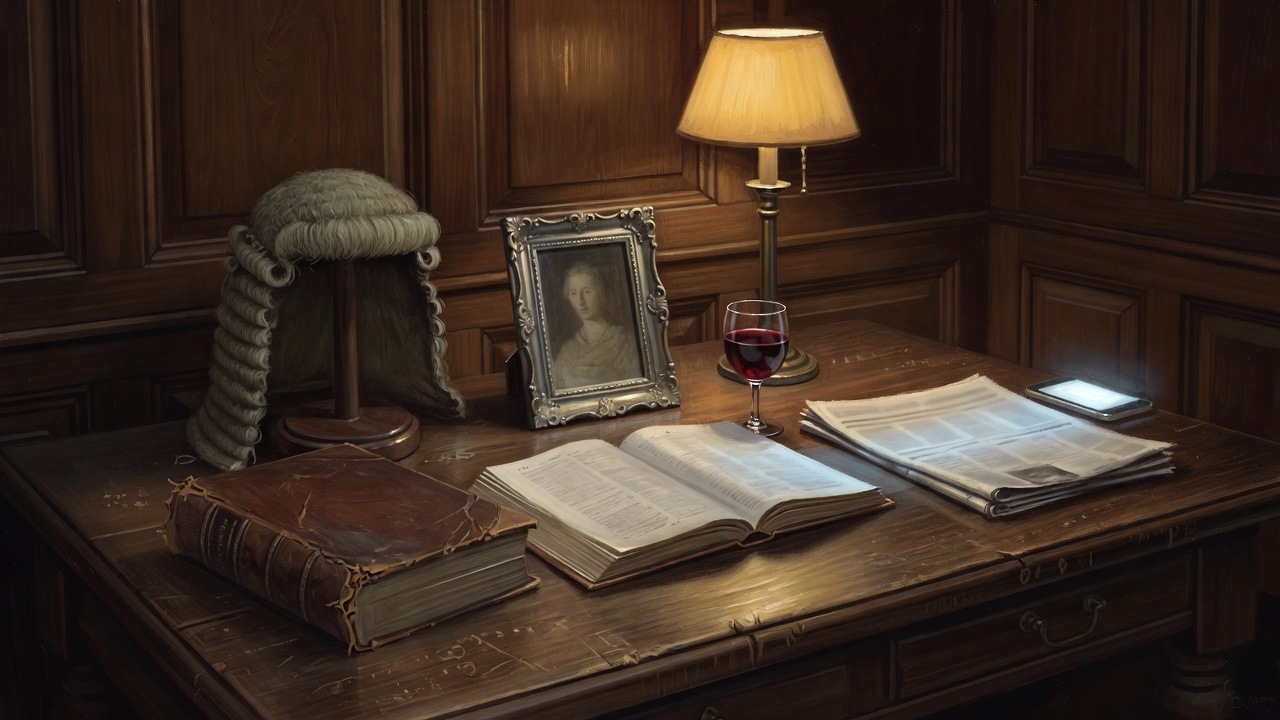
The Eleven-Second Man
Content notes
mild language, alcohol, references to bereavement
There has stood, since some forgotten and presumably penitent age, in the imagination of every Englishman who has ever felt the urge to see a neighbour suffer for the good of the parish, a low wooden frame of two uprights and a hinged plank, drilled with three holes — one for the neck and one for each wrist — set up on the green or in the market square where the crowd might gather; and into this frame, called the pillory, were locked the cheat, the libeller, the seller of short measure, and the keeper of a disorderly house, that the assembled town might pelt them, at their leisure and according to their lights, with whatever the season had made cheap. Rotten fruit, chiefly. Mud, when the year was wet. Dead cats, when a man had been particularly disobliging. And, when the offence had truly stirred the public bosom, stones; for the pillory, you understand, was not in strictness a sentence of death, but the crowd was never bound by the strictness of the sentence, and a man locked into the frame by the magistrate for an hour was at the mercy, for that hour, of every grievance the parish had been nursing since Michaelmas, whether it concerned him or not.
We abolished the pillory in 1837, in a fit of progress, on the enlightened ground that a punishment ought to be administered by the law and not by the mob, and that a man's sentence ought to bear some proportion to his crime, and ought, above all things, to end. I had supposed, in the comfortable manner of a man who has read his history and concluded that the disagreeable parts of it are safely behind him, that we had done with the thing for good.
We had not done with the thing for good. We had merely mislaid the timber. And while I was looking the other way — which, where the modern world is concerned, is the only way I have ever consented to look — some bright spark of the new century built the pillory again, out of glass and light, and set it up not on one green but on every green at once, in every pocket in the land, and threw open the holes not to the parish but to the world entire; so that a man may now be locked into the frame by a stranger he will never meet, for an offence he never committed, before a crowd of forty thousand who have gathered in the time it takes to boil a kettle, and be pelted — not for an hour, the merciful Tudors having at least understood that the human arm tires — but for as long as the crowd's appetite holds, which is to say forever, the modern mob having been relieved by the machine of the ancient and blessed necessity of going home for its tea.
I learned all this from a young woman of eight-and-twenty, in a damp room, against my will, in the matter of a man named Daniel Quist; and I set it down first because the pillory is the whole of the case, exactly as it was last time and the time before — for I am beginning to suspect, in my superannuation, that there is only ever one case, and that it puts on a different coat each season and comes round again to see whether I have learned anything, and finds, with a patience I can only call saintly, that I have not.
Sefton brought me the brief at half past four on a Thursday, which is the hour at which my clerk's conscience and my clerk's avarice hold their daily parley, and laid it upon my desk with the expression of a man setting down a thing he would rather have left in the street.
"It's a bad one, sir," he said.
"You said that of the lost-property man, Sefton, and the lost-property man was a saint, and we sent him home to his clocks. Your bad ones are the best work I do. What is it?"
"Assault, sir. Actual bodily harm — though it's less the charge that's the trouble than what's grown up round it." He paused, and did the thing he does, the careful setting-down of the papers that means his conscience has carried the day over his avarice, which with Sefton is rarer than a wet August. "You'll not have heard of the man, sir. On account of." He made, with one long grey hand, a small gesture toward the window, by which I understood him to indicate the whole of the modern world, a thing Sefton refers to chiefly by gesture, as the devout refer to the deity.
"I have not heard of the man," I agreed, "on account of, as you so precisely put it, of. I have made it the settled policy of my life not to have heard of anyone whom I might otherwise have heard of through a telephone, a screen, or a young person at a dinner party saying you must have seen it. I have never seen it, Sefton. I have made a vocation of never having seen it. Who is he?"
"His name's Daniel Quist, sir. Forty-six. A quantity surveyor — that's a man who measures buildings and tells you what they'll cost, sir, a respectable dull trade, no previous, no enemies that anyone can find. A widower. Lives alone in Lewisham." Sefton drew breath. "Six weeks ago he was on the platform at a Tube station — Embankment, sir, the District line, the evening rush — and a thing happened, and a person standing near filmed it on their telephone, eleven seconds of it, and put it up on the — " the gesture again — "and by the next morning, sir, four million people had watched it, and by the evening it was — there's a word for it, sir, I had it from Miss Nair — it had gone viral. Which I take to mean it had spread like a sickness, the word being, I'm told, chosen on purpose."
"It is the one honest word the whole apparatus has produced," I said. "And the eleven seconds. What do they show?"
And here Sefton did not answer at once, which is itself an answer, Sefton being a man who has spent forty years finding the briefest possible form of words for the worst possible facts and laying them before me without ornament, so that when he hesitates I know the fact has got past even his defences and gone in.
"They show a man, sir," he said at last, "take hold of a small woman by the arm — an elderly woman, frail-looking, frightened — and haul her backward off her feet and throw her down onto the platform, hard, and then step over her where she's lying, and walk away. Without a backward look, sir. He walks off and leaves her on the ground, and the clip ends. Eleven seconds. That's the whole of it." He looked at me. "They've called him the Embankment Brute, sir. There's a — Miss Nair showed me, I wish she hadn't — there's pictures of his face, his real face, with his eyes done red, like a devil. There's people found out where he lives. His firm let him go — stood him down pending, they called it, but they let him go. Someone put a brick through the window of a man two streets over who's also called Daniel Quist and never went near a Tube in his life. And the Crown's charged him with ABH, sir, six weeks on, when there was — " Sefton stopped, and I watched him choose the word, and choose it true — "when there was nothing else left to do with him. The trial's the last bit, sir. The verdict's been in for six weeks."
I did not say anything for a moment. I have been at the criminal Bar for the better part of fifty years, and I have defended men the newspapers had hanged before the jury was sworn, and I had thought I understood the thing — the inflamed public, the prejudiced pool, the cause that must be tried in a tainted town — for it is as old as trial itself, and there are rules for it, weary serviceable rules, about reporting and contempt and the cleansing passage of time. But the thing Sefton was describing was not the old thing in a new coat. The old thing had been the newspaper, which is to say a small number of men, identifiable, employable, occasionally suable, writing for a public that read in the morning and lit fires with the page by night. This was something else. This was the parish grown to the size of the species, and the hour of the pillory grown to the length of a man's remaining life, and the magistrate who locked him in the frame turned out to be no one at all — a stranger with a telephone, eleven seconds, and a caption.
"What does the man say," I asked, "that he did?"
"That's the thing, sir." Sefton's hands turned over, palms up. "He won't say. Same as — well. Same as the keeper, sir, near enough, only worse, because the keeper at least denied the act. Quist won't even do that. The solicitor's tried everything. He'll say I didn't assault that woman, flat, just the once, and then he shuts like a drawer. Won't explain the footage. Won't say what he was doing there. Won't say why he walked off. There's reporters camped on his step and his name's a curse in every house in England and the one thing that might save him — his side of it — and he won't give it. Not to the solicitor, not to anyone. The solicitor says it's like defending a stone, sir. A stone that's already been thrown at."
"And the woman?" I said. "The frail elderly woman flung to the ground and stepped over and abandoned by the Embankment Brute. What does she say?"
Sefton looked at me, and a thing moved at the back of his funereal eyes.
"Nobody knows, sir," he said. "Nobody's found her. The clip doesn't follow her. It follows him. Eleven seconds of the man, and the woman's just — the thing he did it to. She gets up, in the last half-second, you can just see it, she's getting herself up off the platform, and then it cuts. Nobody filmed her after. Nobody asked her name." He paused. "Four million people have watched that woman thrown down, sir, and not one of them has the first idea who she is or what became of her. She was never the point. The point was him."
I sat for a while with the brief unopened under my hand, and I thought, as a man my age thinks, of the past — of the days when a defence began with a knock on a door and a face, and a story told badly in a front room, and the slow patient work of finding the one true thing inside the false. And I thought: they have built a machine that can show four million people the throwing-down of a woman and never once trouble to learn her name, and they have called this information, and they have reached, on the strength of it, a verdict no court would let stand for thirty seconds; and they are very, very proud.
"Sefton," I said. "Pour me something with a spine to it, and bring me the brief, and find out which of my learned friends has drawn the Crown, so that I may begin to dislike them in good time. We are going to defend the most hated man in England."
"Yes, sir." He paused at the door. "There's no money in it, sir. Legal aid, and the man's a pariah, and Mr Aldous —"
"Mr Aldous," I said, "may take his views on the matter and file them in the server, where I am given to understand all the truly important documents of the age now go to be forgotten with the greatest possible efficiency. Bring me the brief."
I read it that night, in chambers, alone, with the lamp low and a glass at my elbow, and I will tell you what the brief contained, because the brief is the heart of the horror, and the horror is the point.
It contained a transcript — for they had transcribed it, with the dreadful literalness of the law — of the eleven seconds. Male, dark coat, seizes female by L. arm. Pulls female backward. Female falls to platform surface. Male steps across prone female. Male exits frame R. Eleven seconds rendered into the prose of a property inventory, every verb a hammer.
It contained still photographs, printed off, of the eleven seconds: the man's hand on the woman's arm; the woman's face, mouth open; the woman on the ground; the man's back, walking away. Four pictures. A passion play in four stations, and every one of them, taken alone, the very image of cruelty.
And it contained — this is what I had not been prepared for, and I am not often unprepared — a thing the police had themselves gathered up and put into the evidence, as though it were evidence, which in a sense the poor blind machine of the law could not help but suppose it was: pages and pages, reams, of what Priya later taught me to call the response. The things the forty thousand had said. The things written under the clip and beside it and on top of it, in their tens of thousands, by people who had watched eleven seconds of a stranger and discovered, in those eleven seconds, the entire contents of his soul. Animal. Coward. I hope he rots. Find him. Found him — works at Dalgliesh & Roe, here's the number. This is what's wrong with this country. He should be put down. Imagine being his wife.
Imagine being his wife.
I read that one twice, not knowing yet why it caught at me, the way a nail in a doorframe catches at a sleeve you cannot at the moment see; and I went on, because I am a thorough old fool, and read more of it than any man should read of the inside of his own species, until I came to understand a thing about the modern pillory that the Tudors, for all their cruelty, had never achieved. The Tudor crowd, pelting a man in the square, knew it was a crowd. Each man saw the men beside him, smelt their breath, felt the press of the mob, and knew himself to be one fist among many — and the knowledge shamed some of them, a little, sometimes, enough. But the man with the telephone, alone in his kitchen at midnight, typing I hope he rots to a stranger, believes himself to be one quiet reasonable voice speaking a private truth; he cannot see the forty thousand around him, each as quiet and reasonable and private as he; and so the crowd has performed the one trick the old crowd never could. It has learned to stone a man while each stone believes itself the only stone, and feels, therefore, no shame at all. The pillory used to require a town with the courage to gather. The new one runs on the cowardice of men who would never gather, and never have to.
I put the brief down. I drank what was in the glass and poured what was not.
And then I read the one document in the whole obscene mass that had been written by Daniel Quist himself — the record of his single police interview, conducted six weeks after the eleven seconds, when they had finally come for him.
DC HALLORAN: Mr Quist, I'm going to show you a video. Do you recognise the man in this video?
QUIST: Yes. That's me.
DC HALLORAN: And do you accept that the man in the video — that you — takes hold of this woman and pulls her to the ground?
QUIST: I accept that's what it shows.
DC HALLORAN: Did you assault that woman, Mr Quist?
QUIST: No. I did not assault that woman, and I never would.
DC HALLORAN: Then can you explain to me what's happening in this video? Because I have to tell you, it doesn't look good.
QUIST: No. It doesn't. [pause] I've nothing to add.
DC HALLORAN: Mr Quist, this is your chance to tell your side —
QUIST: I've nothing to add.
I read it, and I felt the floor of the case shift under me in the dark, the way it had shifted once before in a different room over a different log, and I heard, rising up off the dry transcript page, a voice I had heard exactly twice in fifty years: the flat, serene, locked refusal of a man denying the crime and guarding something else entirely; the voice of one who has done a thing that is against every appearance and entirely right, and who would sooner be condemned than let the thing be spoken aloud and spoiled. I did not assault that woman, and I never would. Not it wasn't like that. Not let me explain. The bolted front door, and behind it a man standing very still, guarding a room.
I had heard that exact shape of silence before. And the last time I had heard it, the man behind the door had been guarding a kindness from people who would only break it.
I closed the brief, and I sat a long time in the lamplight, and I did not feel, as a younger man might, the lift of the chase. I felt something heavier and older. Because I knew, with the cold completeness that comes to me perhaps twice a year and that I have never learned to welcome, two things at once: that Daniel Quist was innocent, and that there was no living human being in England who would believe me when I said so, the whole of England having already watched, with its own eyes, eleven seconds of him being guilty.
I went to Verey's the next evening, because a case of this weight cannot be carried up the stairs of chambers; it must be carried down the stairs off Fleet Street, into the small amber room, and set on the counter, and looked at over a glass.
Mr Verey the younger took one look at me and produced, without a word, the bottle from beneath the counter — the one with no label, which he keeps for the nights when the labelled bottles will not do — and poured, and waited, which is the whole of his genius.
"You've got the worst of all the faces tonight, Mr Fenwick," he said at last. "Not the murder face, nor the innocent-client face. The face you had the night they sent that boy down in — when was it — eighty-one."
"They did not, in the end, send the boy down," I said. "But you are right about the face. Verey, I have taken on a man the world has already convicted, and the world is not a newspaper this time, nor a town, nor a jury that may be discharged and a venue that may be changed. The world is — everyone. Everyone at once, Verey, with a thing in their pocket that lets each of them throw a stone and feel, while they throw it, like a single thoughtful voice murmuring in an empty room."
"The Quist business," said Verey, and I looked up, and he had the grace to look apologetic. "I've seen it, Mr Fenwick. I'm sorry. You can't not. My boy showed me, weeks back — the eleven seconds. Before I knew you'd have anything to do with it." He shook his head slowly. "Ugly thing. He pulls that poor old dear down like a sack of coal and steps over her and off. My boy said, Look at that, Dad, what kind of animal. And I'll be honest with you, sir, because you've never wanted anything else off me — I thought it too. What kind of animal. For about a day, I thought it. Then I stopped thinking about it, the way you do, because there was another one by then. There's always another one by the next day."
"There's the disease entire," I said, "named in one breath by an honest wine merchant who didn't know he was diagnosing it. You stopped thinking about it. Of course you did. The pillory of the square at least required the crowd to keep standing there, to keep its arm raised, to look the man in the face for the whole of his hour. The new one asks nothing of you. You throw your stone in the morning, and by the evening the machine has brought you a fresh man to stone, and you have forgotten the first one entirely — but the first one, Verey, has not forgotten. The first one is still in the frame. The crowd has gone home to its tea, and the man is locked in the holes forever, and the worst of it, the very worst, is that no single soul in that crowd believes itself to have done him the smallest harm. I only watched. I only shared it. I only said what anyone could see." I drank. "How does a man defend himself, Verey, against a verdict that was reached by everyone and pronounced by no one? Whom do I cross-examine? The crowd cannot be put in the box. There is no witness. There is only the eleven seconds, and the eleven seconds are true. That is the horror of it. The footage is real. He did take her arm. He did pull her down. He did walk away. Every frame of it is true."
Mr Verey topped up the glass, and considered, and said the thing that turned the whole case, though neither of us knew it then.
"My old dad," he said, "had a way with a difficult bottle. A bottle a customer swore had gone — corked, oxidised, off. And nine times in ten my dad would taste it and agree, the customer being right more often than the trade likes to admit. But now and then he'd taste it and say, There's nothing wrong with this wine. You've just caught it at the wrong moment. And he'd put the cork back and lay it down another hour, and bring it up again, and it'd be singing. Same bottle. Same wine. Nothing changed in the glass at all." He set the bottle down. "It wasn't the wine that was wrong, sir. It was when they tasted it. They'd caught it in the middle of opening up and called the middle the whole."
I set my glass down very slowly.
"Say that again, Verey," I said.
"They caught it in the middle," he said, "and called the middle the whole."
"Eleven seconds," I said. "Eleven seconds out of — out of how long, Verey? What came before the eleven seconds? What came after? A man does not, as a rule, walk up to a frail stranger on a crowded platform and fling her to the ground for no reason whatever, in front of three hundred witnesses, and then stroll off. That is not a thing that happens. It is barely a thing that could happen. And yet four million people have watched eleven seconds of the middle of something, and called the middle the whole, and never once asked what the bottle tasted like before they pulled the cork." I was on my feet, I found, with no memory of having risen. "Verey, there is no such thing as eleven seconds. There is a thing that took eleven seconds to be the part somebody chose to keep. The crop, Verey. The crime is not in the eleven seconds. The crime is in the crop — in the twelfth second, and the tenth-before, that some stranger cut away and threw in the gutter because they spoilt the story. I have been staring at the part of the footage they kept. I must go and look at the part they threw away."
"And how," said Mr Verey, with the gentle wickedness of a man who knows exactly where I am going and means to enjoy watching me get there, "does a gentleman who's never owned a telephone go looking for the part of a video that was thrown away?"
I sat back down. I drank.
"There is," I said, with the dignity of a deposed monarch arranging the terms of his return from exile, "a young person."
"There's always a young person, Mr Fenwick," said Verey, and poured.
But I went to see the man before I went to the young person — for I have never in fifty years believed a defence could be built upon the papers, and I had less faith than ever in papers now that the papers had become pixels; the truth of a case being almost never in the disclosure and very nearly always in a front room, in what a man keeps on his mantelpiece, and, more tellingly, in what he has lately turned to face the wall.
Daniel Quist lived in a small flat on the third floor of a low brick building in Lewisham, and getting to it was an education in the new pillory I would gladly have foregone. There were two men with cameras on the pavement opposite, eating sandwiches with the settled air of men at a long siege, and they photographed me going in, on the reasonable theory that anyone visiting the Embankment Brute was himself worth a stone or two. I gave them my profile, which is the better one, and went up.
He had heard the buzzer and the steps and had braced for it, I could see, as he opened the door — braced for a brick, or a curse, or a camera; and when it was only a fat old man in a good coat asking civilly whether he might come in, something in his face came apart very slightly and then, with an effort I felt in my own chest, knit itself shut again.
The flat was clean and bare and ordered in the particular way of a man living alone who has decided that order is the last form of self-respect available to him. He made tea. He set out, on a tray, a small jug of milk and a plate with four biscuits, two each, which is the etiquette of people who have known want or grief and have resolved that it shall not be seen by visitors; and I have learned, over a long life, that the four biscuits are very nearly never about the biscuits.
And on the wall, over a small fireplace that did not work, there was a row of photographs — and one of them, the largest, in a silver frame, was turned to face the wall. Not removed. Not put away in a drawer. Turned to face the wall, so that the visitor saw only the grey card backing and the little brass clip; and the dust told me, as dust always tells me, that it had stood the right way round for years and been turned only lately, in the last few weeks, by a hand that could neither bear to look at it nor bear to put it away.
I noticed it. I said nothing of it. You do not, in the first ten minutes, turn round a man's grief to read its face. You note that the grave is fresh, and you go on admiring the garden.
"Mr Quist," I said. "I am Augustus Fenwick. I am to be your counsel, if you'll have me, and I shall begin by doing you a discourtesy that is so rare in my trade you'd best savour it, which is to tell you the truth. The truth is that I cannot abide the machine that has done this to you. I have never owned a telephone. I have never, in the cant of the day, been online. I do not know how to watch the thing they've all watched, and I'll tell you frankly I do not want to learn. And you may well think a man who refuses even to look at the world that's condemned you is the worst possible champion you could be handed by a Lord Chancellor too mean to find you a better." I took the tea. "But I have been defending the condemned for fifty years, Mr Quist, and I have learned one thing in that time that I'd lay against the whole of the new science, which is this: that the most damning fact in a case is very nearly always the one that exonerates the man, if only you can find the person who'll tell you what it meant. So I am not here to ask you whether you assaulted that woman, because I have read your interview and I know that you did not. I am here to ask you a different question, and I'll ask it once, and then I'll respect your silence as long as I'm able, which I'll warn you is not very long, it being the one quality my wife has been trying to teach me for forty-one years without the slightest return on her investment."
The ghost of something crossed his face — the place where a smile would go, in a man who still had any.
"Ask it, then," he said.
"Why did you walk away?"
He went still. I had not asked him what the footage showed, nor whether he took her arm, nor why there was no assault — I had asked him the one thing the whole crowd had damned him for, the one fact that no context about platforms or trains could ever quite explain away, the thing that turned a frightening clip into the portrait of a monster: that having put a frail woman on the ground, he had stepped over her and gone, without a backward look. The crowd had decided that the walking-away was the soul of the man. And I had a growing and terrible suspicion that the crowd was right about exactly one thing — that the walking-away was the soul of the man — and wrong, as completely as it is possible to be wrong, about what the soul contained.
"I've nothing to add," he said. But his eyes had gone, for just a moment, to the photograph turned to the wall, and then away from it, fast, the way you look away from a grave.
"Mr Quist," I said gently. "I noticed when I came in. The photograph. You needn't tell me who. But I'll tell you what I think I already know, and you may stop me whenever I'm wrong, and I shall be glad to be stopped, because I'd rather be wrong about this than right." I set the tea down. "I think you walked away because you could not bear to stay. I think there were telephones already up — there are always telephones already up — and I think being looked at, in that moment, by all those little glass eyes, was a thing you could not do for one second longer, whatever it cost you. And I think the reason you cannot tell anyone why — the reason you'll go to prison sooner than explain the kindest thing you ever did — is that the explaining of it means handing her —" I did not point at the photograph; I did not need to — "to the same machine. And you've watched that machine take somebody once already. And you will not, whatever it costs you, watch it take her twice."
The room was very quiet. Somewhere below in the street one of the camera-men laughed at something, an ordinary sound, obscene in that room.
Daniel Quist did not weep. He looked at me for a long moment with an expression I have seen perhaps a dozen times in fifty years and never grown used to — the expression of a man who has been carrying a stone alone for so long that the offer to share its weight is itself almost more than he can bear.
"You've not seen the video," he said at last. "You said. You've never even watched it."
"I have not, and I shall not."
"Then how," he said, and his voice was not steady, "do you know I didn't do it?"
"Because," I said, "you have just spent six weeks in the pillory and never once, to gain your liberty, reached for the one thing that would free you. And a guilty man, Mr Quist, reaches for everything. Only an innocent man with something to protect keeps his hands at his sides while the stones come in. I do not yet know what you were doing on that platform. But I know it was not an assault, because a man does not guard the memory of an assault. He guards a kindness. And he guards it hardest of all from people who would only break it." I rose, because I had said enough, and because the room could hold no more. "I'm not going to ask you to turn that photograph round. Not today. But I'll tell you what I'm going to do, with your leave and without it if I must, because I'd rather be forgiven than refused. I'm going to send you a young woman — the cleverest person I know, and the only one I'd trust within a mile of this — and she is going to do a thing I cannot do, which is to go and find the parts of those eleven seconds that the stranger threw away. And then you and I, Mr Quist, are going to decide together how much of the truth this case truly needs, and not one ounce more, because I have no intention of saving you by feeding her to the thing that took her. There is a way to win this, I begin to think, that keeps her name out of it altogether. But I shall need yours. Will you give me yours?"
He looked at the photograph, turned to the wall, for a long time.
"Her name was Ellen," he said.
"I shan't use it," I said. "Not in court. Not anywhere. You have my word, which is worth a great deal more than my fee, the fee being legal aid."
And the ghost of the smile came again, and this time very nearly held.
I found Priya Nair in the room they have given her, which is the worst room in chambers, which is how I know it is occupied by the best junior in chambers; and she looked up from her tablet with the expression she has perfected over the years for my arrival, which is roughly the expression of a lighthouse keeper watching a familiar fog roll in.
"You've got Quist," she said.
"How does everyone in this building always already know?"
"Because Sefton tells me everything, on the theory that I'll find out how to make it work, and Aldous tells me everything, on the theory that I'll find out how to make it his." She set the tablet down. "It's the worst brief I've ever seen you take, Mr Fenwick. And I include the lost-property keeper, which I genuinely thought was unwinnable until you and I won it. This is worse. The keeper was condemned by a log eleven people had read. Quist's been condemned by a clip eleven million people have watched and enjoyed. There's a difference between a jury that doesn't understand the evidence and a jury that's already cried over it. You can teach the first one. You can't un-cry the second."
"You assume," I said, "that the eleven seconds they cried over are the evidence. I have come to your terrible room — the damp is in the law reports again, I see, Archbold is positively perspiring — to put to you a proposition I had from a wine merchant, which is the source of all my best law. The proposition is this: that there is no such thing as eleven seconds. There is only a thing that lasted longer than eleven seconds, of which a stranger chose to keep eleven, and threw the rest away. Verey calls it catching the wine in the middle and calling the middle the whole. I want the whole, Miss Nair. I want what came before the eleven seconds, and I want, far more, what came after — the twelfth second, and the thirteenth, and every second the crop cut off. Can it be found?"
She looked at me for a moment, and I watched the professional in her wake up, which is a thing I never tire of seeing, the moment the foreman of her own internal jury bangs the gavel and the real work begins.
"Maybe," she said slowly. "Probably. It depends how it was shot and how it spread. Tell me what you think happened, and I'll tell you what I'd have to find to prove it."
"I think," I said, "that a frail woman did something on that platform — swooned, staggered, I don't know what — that a man saw, and that the man took hold of her and pulled her, hard, away from something. And I think the crop begins at the grabbing, with no hint of why he grabbed, and ends at the walking-away, with no hint of where he walked, so that an act of — of whatever it was — is made to look like an assault, by the simple surgery of removing its cause and its consequence. And I think the stranger who did the cropping may not even have meant a great wickedness by it. I think they very possibly cropped it to make a better story, the way a man trims an anecdote at the dinner table, and never once felt the weight of the thing they were doing, because the machine relieved them of feeling it. The crop is the lie, Miss Nair. The frames are all true. The lie is in the scissors."
"Then I need the original," she said, already reaching for the tablet. "The clip everyone's seen is a copy of a copy of a copy — re-shared, re-uploaded, re-compressed ten thousand times, the edges worn off it like a coin that's been in too many pockets. But somewhere there's a first upload, the one all the others came from, and that one might be longer than the eleven seconds — people often post more than ends up being clipped, and the eleven-second version is what got cut down later by someone who wanted it punchier. If I can find the original poster's first upload, I might get more frames than the crowd ever saw. That's one thing." She was making notes now, fast, in the silent way she has. "Two: the station. Embankment's TfL — Transport for London. Every platform on that network is on CCTV, multiple angles, recording continuously, kept for a statutory period and absolutely not eleven seconds long. If we move fast enough that the footage hasn't been wiped, there'll be a continuous record of that platform from minutes before to minutes after — the whole bottle, not the middle. The crop can't touch it, because TfL doesn't crop; it just records the platform, dumbly, for as long as the platform exists." She looked up. "The CCTV is the what. The full original upload is what the crowd could have seen and didn't. And then —"
"And then there is the why," I said, "which is on neither of them, and never will be, because there is no instrument anywhere that measures why; and the why, Miss Nair, is mine, and you are not to go looking for it, and I shall explain that condition to you in a moment, but first I want to be clear that I understood you. You can give me the platform. You can give me the seconds the crowd never saw. You can prove, perhaps, the what."
"I can prove the what," she said. "If it's there. If he really did what you think, the CCTV will show it, and the crop will stand exposed as a crop. But Mr Fenwick —" and here she stopped, and chose her words, which she does when she is about to say a true thing I will not like — "even if I prove the what, even if I show the whole platform and the train and the swoon and the rescue, plain as day — it might not be enough. Because the jury have all seen the eleven seconds. Months ago. With their own eyes. They've already felt it. And you can show a person the truth and the truth and the truth, and a part of them goes on believing the lie they felt first, because the feeling came before the fact and got there first and bagged the best seat. That's not a flaw in the evidence. That's a flaw in people. The crop doesn't just hide the truth. It inoculates them against it."
"You have just described," I said softly, "the single oldest problem in my trade, in the newest possible language, and you are entirely right, and it is the precise reason the what will not be enough and the why will have to win it. You give me the platform, Miss Nair, and the seconds they threw away. I shall give the jury something the eleven seconds cannot inoculate them against, because it is not a frame and not a fact and not a thing the machine can show — it is the human heart of a man, and the only place that has ever been admitted in evidence is the place we are about to admit it, which is the one room left in England where twelve strangers are made to sit still and look at the whole man before they throw their stone." I leaned on her desk, and the desk, like all the furniture in that room, complained. "Now. The condition. There is a why, and I have it, and it is not going in your tablet, nor your notes, nor your application, nor anywhere a machine can hold it, because the why is a woman, Miss Nair, and the whole of this defence — the whole of it — is that I will not save Daniel Quist by handing that woman to the same machine that destroyed his peace. You'll get me the platform. You'll get me the crop laid bare. And you'll leave the why to me, and you'll trust me with it, the way I am, with the very greatest reluctance and the deepest gratitude, learning to trust you with the rest. Agreed?"
She looked at me for a long moment.
"Agreed," she said. "But you have to actually do it, then. The why. You can't get to the door on my evidence and then quote The Prelude at the cornice and hope the jury feels something. You'll have to find a way to put the human truth in front of them that doesn't put her in front of them. That's hard, Mr Fenwick. That might be the hardest thing you've ever tried to do in a courtroom."
"It is," I agreed, "very probably the hardest thing I have ever tried to do in a courtroom, and I am sixty-nine years old, and I find I have been waiting the whole of my career for it without knowing its name. Get me the platform, Miss Nair. I'll see to the man."
She got me the platform, though it took an emergency application, a chase against the clock of TfL's retention schedule, and a hearing at which the Crown fought the disclosure with a vigour I found, in the circumstances, instructive.
For here was a thing I had not expected, and it deserves recording. The Crown did not want the platform CCTV. The Crown had built its case upon the eleven seconds — upon the clip, the very clip the world had seen, certified and produced as the central exhibit — and the Crown's young and able junior stood up at the disclosure hearing and submitted, with a straight and earnest face, that the full continuous CCTV was irrelevant, that the offence was complete within the footage already in evidence, that to range about in hours of unedited platform recording was a fishing expedition designed to confuse the jury with extraneous material. The offence, said the junior, is on the clip.
I rose to reply, and I confess I rose with some heat, the heat of a man who has glimpsed, in a single submission, the whole disease of the age wearing a wig.
"My friend says the offence is on the clip," I said. "My friend says the continuous record of the entire platform — what occurred in the seconds before my client laid a hand on that woman, and what occurred in the seconds after — is irrelevant to whether my client committed an assault. I have practised at this Bar for the better part of fifty years, and I have never before heard it submitted, in a court of this country, that the cause of an act and the consequence of an act are irrelevant to the question of whether the act was a crime. We do not, in this jurisdiction, try the eleven seconds. We try the man, and a man is not eleven seconds long. My friend wishes the jury to see the middle of the bottle and call it the whole. I wish the jury to taste the whole bottle. If, when they have tasted it, the wine is still corked — if the full record shows an assault — then I shall have done my client no service and the Crown no harm. But if the full record shows something else, then the Crown has spent six weeks prosecuting eleven seconds it never troubled to set in their own context, and would now, having declined to look, prefer that the jury not look either. The application is for the truth, My Lord, in its entirety and its proper order, and I had not thought, until this morning, that I should ever have to argue for the truth against a representative of the Crown."
I got the CCTV. And I noted, filing it away for the trial, that the Crown had fought to keep the jury looking at eleven seconds — and that a Crown which fights to narrow the frame is a Crown which has, somewhere in its honest official heart, a fear of what the wider frame contains.
It was Priya who watched it first. She came into my room without knocking — which, in the whole of our acquaintance, she has done a handful of times, each of them meaning she has found the case — and she stood in the doorway with her tablet held against her, and her face was not the face of triumph. It was something quieter and more shaken, the face of a person who has seen a true thing and understood, in the seeing of it, the full size of the lie it had been buried under.
"I've got the platform," she said. "And the original upload — I found the first poster, and their first version's nineteen seconds, not eleven; somebody cut it down to eleven later, for pace, I'd guess, and the eleven-second one is what spread, because it was punchier. And the TfL CCTV, three angles, continuous." She came in and set the tablet on my desk, and turned it to face me, and did not at once play it. "Mr Fenwick. Before I show you. I want to tell you that I'm sorry."
"For what, in heaven's name?"
"Because I watched the eleven seconds, weeks ago, before any of this. Like everyone. And I thought what everyone thought. And I'm a person who knows — I know about crops, I know about context collapse, I literally do this for a living — and I still felt it, the first feeling, the what an animal feeling, and it took this —" she touched the tablet — "to undo a thing I should never have let do itself up in the first place. I just want you to know that, before you watch it, so that when you go into that courtroom you understand exactly what you're up against. Because if it got me —"
"If it got you," I said gently, "then I understand precisely what I am up against, which is everyone, including the wise. Show me, Miss Nair. I said I'd never watch the eleven seconds, and I shan't. But I'll watch the whole bottle. There's all the difference in the world."
And she played it.
I will not describe to you, frame by frame, what the continuous record of Embankment platform showed in the ninety seconds the crop had cut down to eleven, because I am going to describe it, in due course, to a jury, and a man should not spend his best material twice. But I will tell you the shape of it, because the shape of it is the case.
It showed a crowded platform in the evening rush. It showed, at the far edge of the frame, a small elderly woman standing too near the yellow line, swaying — not dramatically, not in a way that any of the three hundred people around her marked at all, for they were all looking down the tunnel for their train, which is what one looks at on a platform; swaying the small, terrible, private sway of a person whose legs are quietly going out from under them, whose head has gone light, who is, in the most undramatic way imaginable, about to faint. And it showed Daniel Quist — eight feet away, the only soul on that platform who happened to be looking at her and not at the tunnel — see it. You could mark the instant he saw it. His whole body changed. And it showed the woman take one drifting half-step toward the edge, toward the drop, toward the place where the rails were, as the lights of the train came up bright in the tunnel mouth and the rush of it began to push the warm dead air up the platform —
And it showed Daniel Quist cross those eight feet in something under two seconds, and seize her by the arm, and haul her — yes; hard; brutally hard; there was nothing gentle in it, there was no time in the world for gentle — haul her bodily backward off her feet and down onto the platform, away from the edge, as the train came in. That was the grab the crowd had seen. That was the eleven seconds' beginning: a man violently flinging a frail woman to the ground.
And then — and this was the twelfth second, the second the scissors had cut away — the train was there, filling the frame, roaring through the exact stretch of platform-edge air where the woman had been standing one second before; and Daniel Quist was on his knees beside her on the ground, his hand still on her arm, his head bowed; and you could see, even in the grey grain of the CCTV, his shoulders heaving, the great helpless shudder of a man who has done a thing on pure instinct and is only now, a heartbeat too late, being told by his own body what it was he so nearly failed to prevent.
And then he got to his feet. And he stepped over her — there it was, the stepping-over, the very image of cruelty, frozen into a thousand memes — except that the continuous record showed what the crop did not, which was why he stepped over her and not round: because a station guard and two other passengers had finally, finally registered that something had happened and were converging on the woman from the other side, kneeling to her, taking her into their hands, so that the woman was being attended to, she was in good hands, she was safe; and Daniel Quist, seeing her safe, seeing the cluster of help close over her, did the thing the crowd had damned him for. He walked away.
But the continuous record showed the walking-away too, in full, all of it, every second the crop had thrown in the gutter; and the walking-away was not the unhurried saunter of a brute leaving his victim. It was the walk of a man barely holding himself upright. He got perhaps twenty feet, into the thinning crowd, before he put one hand flat against the curved white-tiled wall of the platform and stopped, and stood there, bent, his head down against the tiles, for the better part of a minute — a man being, quietly and privately and at the wall, as near to coming apart as a man can come in a public place; and the people streamed past him onto the just-arrived train and never saw, because by then the show was over, the eleven seconds were spent, and the crowd, as the crowd always does, had already turned its eye to the next platform of its endless attention.
The clip ended at the stepping-over, in triumph, with a caption.
The truth ended a full minute later, with a broken man holding himself up against a wall, and not one telephone in all of England pointed at that.
I sat for a while when it had finished. I am not ashamed to say that I sat for a while.
"They had it," I said at last. "Miss Nair, they had it. The longer one. Nineteen seconds — and even that one, even the original, still cut off before the train, did it?"
"It cut off at the stepping-over too," she said quietly. "Two seconds before the train comes into shot. The original poster had the rescue — they were standing right there, they must have seen the whole thing with their own eyes — and they posted nineteen seconds that ended exactly half a heartbeat before the one frame that would have explained everything." She looked at me. "I don't think they did it on purpose, even. I think they just — stopped filming when the drama looked over. When he walked off. They got the story and stopped. And then someone trimmed their nineteen down to eleven for pace, and someone put a caption on it, and four million people watched a man save a life and called him an animal for it, and the one frame that would have told them the truth was lying in the gutter the whole time, two seconds past the end of the clip, where nobody ever looks. The truth was two seconds long, Mr Fenwick. And they cut it."
"They caught the wine in the middle," I said, "and called the middle the whole. And now, Miss Nair, you and I are going to take the whole bottle into a courtroom — and even then, even with the train in the frame and the shoulders heaving and the man at the wall, you've told me, and you're right, it may not be enough, because they've all felt the eleven seconds, and the feeling got the best seat. So I'll give them the platform, on your evidence, in your name, the what of it laid bare to the second. And then I'll do my half. I'll tell them why a man who'd just saved a stranger's life walked away from her without a word — and I'll do it, Miss Nair, without once turning round the photograph on his wall, because that woman has been fed to the machine once already, and I'd sooner lose the case than let it happen twice, and I begin to think — I begin to think — that I shan't have to choose."
The trial came on before His Honour Judge Wickstead, which I had by now come to regard less as bad luck than as the deliberate arrangement of some celestial listing officer with a sense of humour as dry as my own.
Wickstead, you will recall if you have followed these reminiscences, is a circuit judge of the modern school — humourless, technically literate, and possessed of an unshakeable faith, which he repeats at every opportunity and several at which there is none, that digital data is the best evidence we have. He thinks me a relic. I think him a man who would take the affidavit of a stopwatch over the testimony of an archangel. And yet across the years and a series of cases we have arrived at a wary regard of the kind that exists between a lighthouse and a rock; and I confess I was not entirely sorry to see him, for a man who worships the clip is exactly the man who can be made, before twelve jurors, to confront what the clip leaves out — provided one is willing to take the long way round, and I am always willing to take the long way round, the long way round being, between you and me, the only road I have ever been able to find at all.
The Crown was led by a Mr Aldous Penhaligon QC — no relation, I should say at once, to my own dear head of chambers, the name being a coincidence I found so distracting that I shall hereafter call him simply my learned friend, lest the reader spend the trial as I did, flinching. He was a sound, careful, decent silk, and he had a problem, and he knew he had it, which is the worst kind of opponent, because a frightened able man is more dangerous than a confident one. His problem was that he had inherited a prosecution that everyone — the police, the public, the press, the whole forty thousand — had treated as already won, and he had, somewhere in the careful machinery of his lawyer's conscience, begun to suspect that a case everyone has already won is a case nobody has actually examined.
He opened it well, all the same.
"Members of the jury," he said, "you may have seen, before today, a piece of footage connected with this case. I am going to ask you to do a very difficult thing, which is to set aside whatever you saw, and whatever you felt, and try this case only on the evidence you hear in this room. I make no bones about the difficulty of it. But that is your oath, and I trust you to keep it." A good beginning — an honest beginning, and I marked him up for it. "Now. The evidence in this room will include that footage, properly produced and proved. And it will show you the defendant, Daniel Quist, take hold of a frail, elderly woman on a crowded Underground platform, pull her violently from her feet, throw her to the ground, step over her where she lies, and walk away. The Crown's case is that this was an assault — an unlawful application of force that caused this woman actual bodily harm, for she was bruised and shaken and treated at the scene. The defence may seek to explain it. I invite you to watch what the defendant did, and to ask yourselves whether any explanation can change the fact that a man laid violent hands on a vulnerable stranger and left her on the floor. Watch what he did, members of the jury. The rest is words."
Watch what he did. It was, I will allow, the perfect opening for the case the Crown believed it had, and the perfect opening to walk into, for it had told the jury to do the one thing — watch — that I now intended to make them do far more thoroughly than my learned friend could possibly desire.
The Crown's case went in, brisk and clean. The officer in the case produced the eleven seconds, and it was played in court, and I did not watch it; I watched the jury watch it, which is the only screen I have ever consented to look at, and I saw it land on them exactly as it had landed on four million before them — the small recoil, the hardening of the mouth, the glance at the dock, the verdict reaching their faces a full two days before they would be asked to give it. The arresting officer described the response, the pile-on, the campaign, in the flat voice of a man reading from a screen. And a doctor proved the woman's bruises, which were real; for she had been thrown to a platform, hard, and bruised in the throwing, and I had no intention of pretending otherwise, the bruises being, in fact, the truest thing in the Crown's case and very nearly the proof of my own.
And then it was my turn, and I rose to cross-examine the officer in the case, and I did the thing I had promised Priya I would do, which is to put the what before the jury in her name and on her evidence, through the mouth of the Crown's own witness, before ever I came to my half.
"Officer," I said. "You produced for the jury a clip of eleven seconds."
"Yes, sir."
"Where did that clip come from? Did the police film it?"
"No, sir. It was — it came from social media. A member of the public posted it. It was widely circulated."
"Widely circulated. By the time it reached you, how many times had it been copied, shared, re-posted, passed from hand to hand?"
"I couldn't say, sir. Many thousands."
"Many thousands. So the clip in evidence is not the original recording. It is a copy of a copy of a copy, the eleven seconds that happened to survive the journey."
"I — yes, sir, I suppose that's right."
"Did you, Officer — did anyone in this investigation — seek out the original recording? The first upload, from the person who actually stood on that platform and held up the telephone?"
A pause. "I don't believe we did, sir, no. The clip we had was — it was clear enough. It showed the offence."
"It showed eleven seconds," I said. "Tell me, Officer — did anyone in this investigation obtain the continuous closed-circuit television from Embankment station? The Transport for London cameras, which record that platform, all of it, all the time, and do not crop?"
The longer pause. "Not initially, sir, no."
"Not initially. In fact, Officer, the continuous platform CCTV was obtained, was it not, not by the Crown, but by the defence, on an application the Crown resisted — the Crown's position being that what occurred on that platform in the seconds before and the seconds after the eleven you have shown the jury was irrelevant. Is that a fair account?"
"I believe there was an application, sir. I wasn't party to the legal —"
"Of course. Thank you. I shall trouble the jury with the legal argument myself in due course." I let that sit. "Officer, I have one last question, and I ask it not unkindly. When you watched those eleven seconds — at the very start of this investigation, before you knew anything else — did you believe you were watching an assault?"
He was honest. The honest ones are the gift. "Yes, sir. I did."
"So did four million people," I said. "So, I have no doubt, did each member of this jury, if they're honest with themselves, the very first time they saw it, before they swore their oath. The eleven seconds are extraordinarily persuasive, Officer, are they not? They persuaded you, a trained investigator, instantly, before a single further inquiry was made."
"They — yes. They did."
"That," I said, "is precisely the danger I shall be asking the jury to weigh. No further questions of this witness."
I called Priya Nair to give her evidence, and I called her by name, and I made certain the whole court understood whose evidence it was, because I had learned — late, and at the cost of more pride than I care to itemise — that the data half of a case is real and considerable and belongs to the person who found it, and is not the old man's to wear.
She gave it as she always gives it — clear, exact, wholly unshowy. She proved the original upload: nineteen seconds, not eleven, and the chain by which the nineteen had been trimmed to the punchier eleven and then loosed upon the world. She proved the provenance of the TfL CCTV, the three angles, the continuous record, the single master clock to which everything stamped. And then, with the court very still, she played the whole bottle.
She played the ninety seconds the crop had cut to eleven.
And I watched the jury watch it, and I watched the thing happen that I have lived my whole life to watch happen, the thing that is the entire and undignified reason I have never hung up the wig: I watched twelve people see the train.
The swaying woman. The one man on the platform looking at her and not the tunnel. The drifting half-step toward the edge. The lights coming up bright in the tunnel mouth. The man crossing eight feet in under two seconds, the brutal necessary haul, the woman down and safe and the train — the train, roaring through the exact air where she had stood — and the man on his knees beside her with his shoulders heaving; and then the help arriving, the guard and the passengers folding round the woman; and then the walking-away, in full, all of it, every second the world had thrown in the gutter, until the man fetched up against the white-tiled wall twenty feet on and stood there bent and shaking and entirely alone in a crowd that had already lost interest, holding himself upright against the tiles, for the better part of a minute, while London streamed past him onto its train.
The clip the world had seen ended in triumph at the stepping-over.
The truth ended with a man at a wall, and there was not a sound in that courtroom.
My learned friend rose to cross-examine, because he had to, and he did it as well as it could be done, which was not well enough, because there is no good way to cross-examine a train.
"Miss Nair. You can't tell us, can you, what the defendant was thinking at any point in this footage?"
"No," said Priya. "I can't tell you what anyone is thinking. No record can. I can tell you what happened, and when, and in what order, on three cameras and one clock. The footage shows a woman about to fall in front of a train, and a man pulling her clear of it. What he was thinking is a question for him, not for the cameras. That's exactly why it's your turn to ask him, and not mine to guess."
"You'd accept that pulling someone violently to the ground is — violent? That's force?"
"It's force," she said. "Saving someone's life is very often force. You can't pull a fainting person back from the edge of a platform gently and in time. The force is in the footage. So is the reason for it. They cut the reason out and kept the force. That's what a crop is."
He sat down. I have seen many a cross-examiner sit down over the years, but I do not think I have ever seen one sit down so plainly relieved to have it over, the cross-examination of the truth being a thing that costs an honest advocate more than he can comfortably pay.
Wickstead was looking at the frozen last frame of the platform footage — the man at the wall — over the top of his spectacles, with the particular expression of a man who has trusted a clip all his life and has just been shown, in open court, that a clip is a sentence with the verb cut out.
The jury had seen the train. They had the what. They knew now there had been no assault, that the eleven seconds were a lie made of true frames.
And it was not enough. Priya had told me it would not be enough, and Priya was right, as she has the increasingly tiresome habit of being. For I watched them, and beneath the relief and the dawning shame, I saw the thing she had warned me of still working in them — the thing the crop had inoculated them with, the first feeling, sitting in its stolen best seat — and I saw it gather itself round the one fact the train did not explain, the one frame the rescue did not account for, the splinter the eleven seconds had driven in so deep that even the truth could not quite work it loose:
He saved her. Very well. But then he walked away. He saved a woman's life and walked off and left her on the floor and didn't look back, and stood at a wall, and never said a word — not then, not after, not when the whole world called him a monster. What kind of man saves a life and then refuses, for six weeks, to so much as say he did it?
That was the splinter. That was the last of the lie, the part the platform CCTV could not reach. And it could not be answered by a camera, or a clock, or a clip, or all of Priya's overlaid logs, because it was not a question about a platform at all. It was a question about a man. And it was, therefore — at last, and entirely — mine.
I called Daniel Quist to give evidence in his own defence, which is the most dangerous thing a defence advocate can do, and which I did with my heart in my mouth, because everything I had promised an old man in Lewisham now had to be kept in front of twelve strangers and a worshipper of clips, and I had to surface the deepest truth of the case without once turning round the photograph on his wall.
He came into the box, the most hated man in England, and he stood very straight, the way a man stands who has decided that whatever else they take, they will not have his spine; and he took the oath in a steady voice, and looked at me, and I saw in his eyes the question we had not settled — how much? — and I answered it with the smallest nod, which meant: trust me; her name does not enter this room.
"Mr Quist," I said. "You've heard the footage described, and you've now seen, as the jury have seen, the whole of what happened on that platform. I'm not going to take you back through it. The cameras have done that, better than any words of ours. I'm going to ask you about the one thing the cameras couldn't show, which is the only thing I think this jury still needs to understand. Will you do your best to answer it?"
"I will," he said.
"You crossed that platform and pulled that woman back from the edge of a train. The jury have seen that you did. And then — when she was safe, when others had come to her — you walked away. You didn't wait. You didn't give your name. You didn't tell a soul what you'd done. For six weeks, Mr Quist, the whole of this country has called you a monster, and you have had in your hands, the entire time, the proof that you saved a woman's life — and you said nothing. You let them call you an animal rather than say I saved her." I let it land, gently, the way you set down a full glass. "I'm going to ask you why. And I'm going to ask you to take your time, because it's the only question that matters, and I think it's a hard one."
And here I had arranged a thing, with his leave, in the small room beforehand — a thing I shall now confess, because the casebook is for confessing. I had told him: You needn't speak of her. You needn't say her name, nor what became of her, nor where, nor when. I'll ask you why you walked away, and you may answer with the truth of how it felt, and not one fact more than you can bear, and I'll do the rest. Tell them what the cameras did to you. Not what they did to her. They needn't know it was her. They need only know it was you.
And Daniel Quist stood in the box, the most hated man in England, and he answered.
"There were phones," he said. "When I — when she was safe, when the others had her — I stood up, and I looked, and there were phones. People holding up their phones. Filming. Six, seven of them, all round, pointed at — at her on the ground, at me, at the — " His voice was steady but it cost him; you could hear what it cost. "And I couldn't. I want to tell you I had some fine reason, but I didn't. I just — I couldn't be looked at. Not by those. Not by the little glass eyes, all round, the way they —" He stopped. His hands were on the rail of the witness box, and they were white. "I've stood on a platform before," he said, very low, "and watched people hold up their phones at something terrible, instead of helping. I've stood on a platform and watched a whole crowd film a person — film a person dying — and not one of them put the phone down to help. I know what those phones are. I know what they're for. And when I stood up and saw them all pointed at me, I — something in me just — I had to get away from them. That's the whole of it. That's the not-fine reason. I saved her, and then I ran from the cameras, because I have seen what cameras do, and I could not stand in front of them for one more second, and I was wrong, maybe, to run, but I —" His voice did, at last, break, once, and he mastered it. "I would rather the whole of England think me a monster than stand still and let those eyes have me. That's why I walked away. And that's why I never explained. Because to explain it, I'd have had to tell you — what I'd seen. Before. And I —" He looked at me, and the question was in his eyes, how much, and I gave him the smallest shake of the head, no further, that's enough, stop there, and he stopped. "And I couldn't. I couldn't give that to them, too. So I gave them my silence instead. They were welcome to it. It was the only thing I had left that they couldn't crop."
The court was utterly still.
I did not ask him another question. I had what I needed, and a hair more would have spilled it. "Thank you, Mr Quist," I said, and sat down, and left him there, and my learned friend rose to cross-examine, and looked at the man in the box, the broken honest unhated-for-the-first-time-in-six-weeks man, and looked at his notes, and looked at the jury, and made, in the end, the only decision a decent advocate could make.
"I have no questions for this witness, My Lord," said my learned friend, and sat down; and I have always held it the mark of the finest prosecutors that they know the precise moment at which the further pursuit of a conviction becomes the pursuit of an injustice, and stop, the law being served not by the verdict a man can wring out but by the verdict the truth will bear.
It fell to me to make the closing speech, and I am vain enough to have wanted it, and old enough to know the case was already won — won by a young woman with a tablet who had hauled the train back out of the gutter, and a quantity surveyor with a turned-round photograph who had stood in a box and told twelve strangers the truth he'd sooner have died with — and that my one remaining task was the hardest an advocate is ever set, which is not to lose, through eloquence, a verdict the truth has already handed him. So I kept it short, for me, which is to say it was merely long.
"Members of the jury. My learned friend, when he opened this case, told you to watch what the defendant did. It was good advice, and I'm going to give you the very same advice, with all my heart — only I'm going to ask you to watch the whole of what he did, and not the eleven seconds a stranger chose to keep.
"Because that's the case. That's the whole of the case. A man did a brave thing on a railway platform — he saw, when nobody else was looking, a woman about to fall under a train, and he crossed the ground and pulled her clear, hard, the only way there ever is to pull a falling person clear, which is hard, and fast, and not at all gently, there being no gentle way to save a life in two seconds. And a stranger filmed eleven seconds of it. Not the swoon before. Not the train after. Not the man on his knees, shaking. Not the man at the wall. Eleven seconds — the grab and the fall and the walking-away — and they put a caption on it, and four million people watched a rescue and called it an assault, and not one of them was lying, members of the jury, and not one of them saw the truth, because the truth had been cut off two seconds past the end of the clip, and lay in the gutter, where nobody ever looks.
"There is an old punishment in this country called the pillory. You'll have read of it. A man was locked into a wooden frame in the market square, and the crowd was let at him, to pelt him with whatever was cheap and rotten, for the space of an hour. We abolished it in the reign of the young Queen Victoria, on the enlightened principle that a man's punishment should come from the law and not the mob, should fit his crime, and should end. And I had thought we'd done with it. We have not done with it. We have built it again — out of glass and light, in every pocket in the land — and we have made it worse than the Tudors ever dreamed, for the new pillory needs no crowd brave enough to gather, no arm that ever tires, and no hour that ever ends. Daniel Quist was locked into that frame six weeks ago by a stranger with eleven seconds, and he has been pelted ever since, by a crowd of forty thousand of whom not one believes itself to have thrown a single stone. And he could have let himself out of the frame at any moment, members of the jury, with four words. I saved her life. He had the proof. He has had it the whole time. And he would not say it.
"And the Crown invites you to find, in his silence, the proof of his guilt. What innocent man, they wonder, stays silent for six weeks while the world calls him a monster? I'll tell you what man. A man who has stood on a platform once before in his life and watched a crowd hold up its telephones at something unbearable — watched the little glass eyes turn a private agony into a thing to be shared, and watched no one put the phone down to help — and who, standing on a platform a second time with those same eyes all round him, found that he would rather the whole world think him a monster than feed it one more thing to crop. His silence is not the silence of guilt. You've heard guilt's silence, perhaps, in your lives; it's a furtive, calculating thing. This is the other silence — the silence of a man guarding something from people he has good reason to believe will only break it. He kept his silence the way another man keeps a grave: not because there's something shameful in it, but because there's something sacred, and he will not have it pawed.
"My learned friend told you the footage shows what the defendant did, and the rest is words. He was right about the first part, and I've taken him at it: the footage — the whole footage, the bottle and not the middle — shows you exactly what the defendant did. It shows you a man save a stranger's life. As for the rest being words — yes. It is. The why is always words, members of the jury, because there has never been built, and there never will be built, an instrument that can film the inside of a man. No camera caught why he walked away. No clip could. The clip is very good at the what — too good; it persuaded four million people and a trained police officer in a single instant, and it very nearly persuaded the cleverest person I know, who studies these things for her living. But the why — the why has only ever had one court in all the world that could try it, and you are sitting in it.
"That is what a jury is for. The crowd of forty thousand reached its verdict in the time it takes to boil a kettle, on eleven seconds, having looked at none of the rest and known the name of no one but the man it wished to stone — it never even learned the name of the woman whose life he saved; she was never the point; the point was him. That is the verdict of the pillory. It is instant, and it is unanimous, and it is unappealable, and it is wrong. You are the other thing. You are the twelve who have been made to sit still, for days, and look at the whole man, and hear him, and weigh not the eleven seconds but the life, before you say a word. You are everything the crowd is not. You are slow, where it was fast. You are few, where it was numberless. You have heard him, where it never asked. And you alone, of all the millions who have judged this man, have been shown the twelfth second.
"Show it back to them. Acquit him. Let him out of the frame."
They were out for under an hour, which is exactly long enough for twelve sensible people to be quite certain, and to feel, out of respect for the gravity of the thing, that they had not simply done it on the way to the door — though they had, and rightly.
Not guilty.
Daniel Quist did not weep, in the dock, when it was read. He closed his eyes, once, for rather longer than a blink, the way a man does who has been holding his breath for six weeks and is only now permitting himself to let it go; and then he straightened the front of his jacket with both hands, the gesture of a man composing himself before something formal, and he looked across the court — not at the gallery, where there were, I am told, a great many people with telephones, for the crowd had at last sent a delegation to the actual trial, having exhausted the eleven seconds and developed, too late, a flickering interest in the twelfth — he did not look at them. He looked at Priya. And then he looked at me. And he did a thing I have seen perhaps a dozen times in fifty years and have never managed to grow used to: he mouthed, across the well of the court, thank you — and then, with the smallest motion, no more than a tilt of the head, he indicated something, and I understood that he was telling me a thing he could not say aloud, which was that the photograph, when he got home, was going to be turned back round to face the room.
Wickstead discharged him. And then Wickstead — Wickstead, who is not a warm man, who has spent thirty years being the coldest fixture on the circuit and the most devout communicant of the church of digital data — leaned forward, and addressed not the lawyers but the man, in a voice plainly meant for the record and, I rather think, for me.
"Mr Quist," he said. "You have been acquitted, and rightly. I shall add only this, since it seems no one outside this courtroom troubled to. I have spent the better part of my career on this bench saying that the best evidence we have is the evidence that machines provide — the recording, the clip, the timestamp, the thing that cannot misremember and has no friends to favour. I have believed it, and I believe it still, within its proper compass. But I have been obliged, in this case, to reckon with a thing I had not sufficiently weighed: that a recording can be perfectly true and perfectly false in the same breath — true in every frame and false in every frame it does not contain — and that the deciding of which it is requires a faculty no machine has ever possessed and, I begin to suspect, no machine ever will. The court is obliged to you for the lesson, Mr Quist, and to your counsel, and to your counsel's junior, Miss Nair, whose reconstruction of the full record was a model of its kind. The court rises."
And he was gone before any of us could thank him, which is the Wickstead way, and which I have come, late and slowly, to understand is not coldness at all, but a sort of terrible English shyness about being caught in the very act of having a heart.
Aldous — my own Aldous, Quentin Aldous KC, head of chambers, all teeth and lanyard and the bright pitiless future — was waiting in the corridor, of course. The corridor is his native country, the corridor being the place where credit is apportioned before the facts have had a chance to settle and spoil the apportioning.
"Augustus," he said. "Magnificent. No — genuinely, magnificent. I've been on my phone the whole afternoon, it's already turning, the whole thing's turning, they're calling it — there's a word going round — they're saying he was exonerated by the full footage, the tide's completely —" He stopped, and recalibrated, and arrived, as he always arrives, at himself. "Augustus, this is enormous for the set. Do you see it? This is a whole practice area. Digital reputation litigation. The wrongly-cancelled — the cropped, the context-collapsed, the people the internet's got wrong — they're a market, Augustus, an enormous and underserved market, and Hazlitt Court has just won the case that proves we can defend them. Priya runs the forensic side, the footage reconstruction, the takedown work — I'll build her a team — and we badge it Hazlitt Court: Justice in the Age of the Clip, and the work, Augustus, the work will simply pour —"
"Quentin," I said. "It was not a digital reputation case. You may put Priya's work in your wretched deck in letters a yard high — it is hers, and it was magnificent, and I'll sign the page. But it carried the case only to the door. What walked the man through it cannot be billed, reconstructed, or badged, and there is no slide for it in any deck of yours, I notice. There never is."
He blinked, reaching, as he always reaches, for the old comfortable binary in which I am the relic and he is the future and the two of us need never trouble each other again. "So you didn't really need the data after all. The old way won it."
"I'm saying," I said, "that I needed Priya's data entirely, and that it was not enough, and I'll thank you not to make me choose between the two, having just spent a fortnight proving in open court that the choice is a fool's choice and always was."
And I left him there in the corridor, holding his telephone in both hands and looking at the screen, where the tide, I do not doubt, was indeed turning — for the crowd, having stoned the man for six weeks, was now discovering the splendid feeling of defending him, with the very same machine, in the very same numbers, with the very same serene conviction that it had seen the truth at last; and I did not stay to watch them garland the man they had pilloried, because I have never been able to decide which is the worse thing to be at the mercy of, the crowd's contempt or the crowd's sudden love, the two being, when you examine them, the identical thing — the verdict of a pillory, reversed, but never once appealed.
I found Priya by the great doors of the court, her tablet held against her chest like a hymnal, looking out at the wet grey London afternoon.
"You found the train," I said. "You hauled it back out of the gutter where they'd thrown it. There was a moment in there — when you played the whole platform, and I watched twelve people see the train at once — that I would not trade for any verdict I've ever won, and I've won a few, though you'll not get me to itemise them, modesty being a vice I practise only in the presence of witnesses." I cleared my throat, which had developed, inconveniently, a small obstruction. "It took the two of us, Miss Nair. The what and the why. I find I'm too old to go on pretending otherwise, and too fond of being right to keep insisting on it alone, which is a contradiction I appear to have lived inside for fifty years without once noticing the walls."
She almost smiled, which from Priya Nair is a standing ovation with the house on its feet.
"You didn't quote Wordsworth in the closing," she said. "I had money on Wordsworth."
"I considered the pillory speech sufficiently ornamented without him," I said, "and besides, the one poet I wanted was a wine merchant's father, who taught me that you can catch a sound thing at the wrong moment and call it spoiled. Come along, Miss Nair. I'm going to buy you a glass of something at an establishment that has never in its history owned a single device capable of cropping anything, and present you, again, to Mr Verey, who will pretend to disapprove of you and will in fact produce the bottle with no label, which is the highest honour in his gift, and we shall talk about the next one, there being always a next one, and I find — to my very considerable inconvenience — that I should like you on it."
I told the Home Secretary about it that evening, over dinner, which is the truest court I am ever tried in, and the only one whose verdicts I have never once contrived to appeal.
Bea was doing the crossword in ink, which she does to intimidate me, and listening with one ear, which is more than the generality of my arguments are accorded. I told her the whole of it — the eleven seconds and the nineteen and the ninety, the train hauled back out of the gutter, the man in the box who'd sooner be a monster than feed the machine, the photograph turned to face the wall. I did not tell her the woman's name. I had given my word, and a man's word is the one document in his life that ought never to be cropped.
She finished a clue. She set down the pen — which she does perhaps twice a year, and which I have learned to regard the way other men regard a comet.
"He turned the photograph to the wall," she said. Not a question.
"He turned the photograph to the wall."
"Because he couldn't bear to look at her while the whole world was looking at him." She was not looking at me; she was looking at nine across. "And he'd sooner go to prison than tell them why, because telling them why meant giving her to them. And you got him off without making him do it." She picked the pen back up. "You found a way to put the man's heart in front of the jury without putting her in front of the crowd. That's the case, Augustus. That's the whole of the case, and it's the kindest thing you've done in court in years, and I shall never hear the half of it, because you've given the man your word, which means even I only get the version with the holes in, after forty-one years, which I shall choose, on this one occasion, to find almost endearing."
"It's the version with the one hole that matters left in it," I said. "Which is the only version that was ever mine to tell."
She was quiet a moment, the pen still.
"The crowd," she said. "Forty thousand of them. And not one ever learned the woman's name. Not one ever asked what became of the person he saved — only what to do with the man." She did nine across, in ink. "You've spent fifty years defending the slow boring thing they've no patience for. I shouldn't say so, because you're insufferable enough, but it was worth defending. Mind you, so was the man."
This is the trouble with the Home Secretary. She arrives, by a shorter road and in a quarter of the words, at the place it takes me a whole closing speech and a wine merchant's father to reach, and she does it while filling in nine across. I did not tell her she was right. One-and-forty years of marriage have taught me that telling the Home Secretary she is right merely confirms her in a habit already long past the reach of correction.
I poured us each a glass of something the Cobbs had sent round in tribute, which was almost certainly stolen and was, as the Cobbs' offerings invariably are, very nearly undrinkable — and which I drank anyway, the occasion calling for a toast and the cellar offering, that evening, nothing finer than larceny.
"To the twelfth second," I said.
"And to the man who'd rather be a monster than a coward," said Bea, "which is the rarest thing there is, and which not one of your forty thousand would recognise if it pulled them off a platform. Mind it stays unanimous." And she finished the crossword, in ink, and rose to clear the plates, and told me not to sit up.
I sat up. I poured the last of the bottle, and I thought of a small flat in Lewisham where, that evening, against every caption in every pocket in England, a photograph in a silver frame was being turned, by a man's two careful hands, back round to face the room — so that he could look at her again, in private, in the one place the little glass eyes have never been let in, and never will be while the law keeps a single slow boring room where a stranger must be looked at whole before he is condemned.
That is what the pillory was for. That is what a jury is for. And the whole of my long, outdated, claret-soaked life has been spent, I find, in the narrow and shrinking ground between the two — which is, I am no longer too proud to say, the only ground I have ever wished to stand on, and I intend to go on standing there until they crop me.
Enjoyed this story?
Read next
 A developer's scaffold went up over a dead neon sign at the wrong end of our own street, and my wife of one-and-forty years climbed it at ten past seven in the morning with two flasks of tea and would not come down; and because a man cannot defend his own wife, the finest advocate of his generation sat at the back of a magistrates' court with his hands in his lap and no standing to say a single word, and there learned — at the same moment as the bench, the usher, and a bored young man from the Crown — what she had been quietly paying for since the year before we met.
The Light She Kept On
 The store's flawless system said the ring was checked in, logged to his counter, and never logged out — so by the machine's own perfect record only Albert Sturrock could have taken it; and to save him, Fenwick must win the one way he cannot stand, with his junior's data, and supply the one thing no machine has a column for: that the keeper carried a frightened girl's lost heirloom home by hand, off the books, because a lost-property office exists to reunite, not to hoard by the rulebook.
The Keeper of the Reunions
 A nineteen-year-old Cobb is caught with the dock-workers' burial fund and will not say one word in his own defence — and the silence everyone has read as guilt is in fact the only act of love his family has left, and the one thing standing between the boy and the truth.