
The Camera Never Asks Why
Content notes
mild language, alcohol
I have defended the guilty, the foolish, and the merely unlucky for the better part of fifty years, and I have concluded that the law has very little to do with justice and a very great deal to do with lunch.
I commend that proposition to the young, who arrive at the Bar each autumn freshly persuaded that the law is a cathedral of reason, and who learn, at roughly the speed at which their first overdraft matures, that it's in fact a public house with very strict opening hours, run by people who would rather be elsewhere, in which the truth is occasionally served but never on the wine list. I have spent my professional life in that establishment. I have grown stout in it. I intend, if the good Lord and the Bar Standards Board permit, to die in it, ideally mid-sentence, ideally a sentence of some length, with a glass to hand and a jury still — just — listening.
I begin with the watch because the watch is where it ended, and a casebook, unlike a life, may be told back to front for effect.
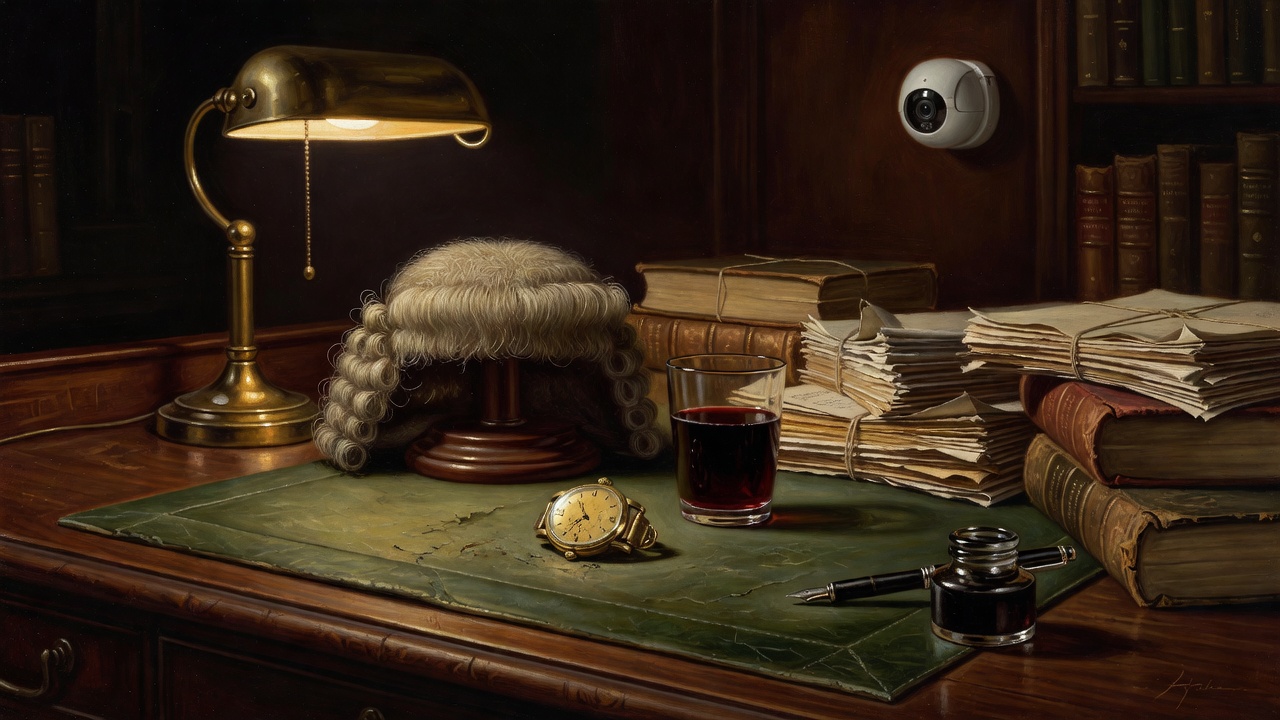
It was a gentleman's wristwatch, gold, of a Swiss make that announces itself by saying nothing at all — the sort of object whose entire purpose is to be recognised by the three people in any room who would never dream of mentioning that they had recognised it. It had a small inscription on the back, which I shall come to, because the inscription is the whole of the story and the prosecution never read it, having too much faith in things that light up and not nearly enough in things that are engraved. The watch was said to be worth eleven thousand pounds. It was said to have been stolen. It had been, the Crown maintained, and they had it on camera — on three cameras, in point of fact, plus a telephone, plus a small plastic card that opened doors — that a woman named Maureen Cobb had taken it.
I should explain about the Cobbs, since they'll recur, the Cobbs being to my practice what weather is to farming: a constant, an affliction, and, on balance, the reason the crop comes in at all.
The Cobbs are a South London family of small-time and almost entirely affectionate villains, whom I have defended across three generations on charges ranging from the receiving of dubiously-provenanced televisions to an affray outside a christening that I still maintain was a misunderstanding about a buffet. They aren't, taken as a whole, a clever family. They are, however, a loyal one, and loyalty in a client is a rarer and more nourishing thing than cleverness, cleverness being available by the hour from any chambers in the Temple, while loyalty can't be bought at all and must instead be earned, slowly, over decades, principally by getting people off.
Maureen Cobb was loyal in this larger sense without being, strictly, a Cobb. She had married into them — had married Stanley Cobb, the steadiest of a famously unsteady clan, a man who had got through forty years of marriage and three of mine without once troubling the Crown Prosecution Service, and who had then inconsiderately died of a heart in a betting shop, leaving Maureen a widow of sixty-one with a small pension, a smaller flat, and the family name, which in the relevant postcodes opens some doors and slams a great many others. She had taken a job cleaning offices at night, because that's the work the world keeps for women of sixty-one with the wrong surname, and one of the offices she cleaned belonged to a firm called Aurelian Fine Timepieces, of Hatton Garden, dealers in exactly the sort of watch I have described.
And then, one wet Tuesday in February, on three cameras and a telephone and a swipe card, Maureen Cobb stole one.
Sefton brought me the brief, which is his function and, I sometimes think, his vocation. Sefton is my senior clerk. He's a narrow, mournful man of indeterminate age who dresses like an undertaker who has had a disappointing quarter, and he runs my professional life with the gentle ruthlessness of a man walking a large and beloved dog that he privately considers past its best. He doesn't approve of me. He has never approved of me. This is the foundation of one of the great working relationships of my life.
"It's a bad one, sir," he said, by way of greeting, setting the papers on my desk between the inkwell I use and the telephone I don't. "CCTV, phone data, the lot. Open and shut, the solicitors say."
"Solicitors always say open and shut," I told him. "It's how they justify their fee for opening the envelope and shutting it again. Whose is it?"
"Mrs Cobb. Stanley's widow." He let that settle, knowing exactly what it would do. "Theft. Eleven grand. They've got her dead to rights, sir, on every machine going. Frankly I'd have sent it on, only —" He stopped, and did the thing Sefton does perhaps twice a year, which is to look almost human. "Only she asked for you by name. Said Mr Fenwick will know I never."
There's a particular weight to I never in my line of work. The guilty say I didn't do it, which is a statement about facts and may be tested. The innocent — the genuinely, helplessly innocent, the ones the system grinds finest — say I never, which isn't a statement about facts at all but about character, and which means, roughly, whatever your machines have recorded, you have recorded the wrong woman, because the woman in your machines did a thing, and I'm a person, and a person is the part you have failed to film.
"What does the brief pay?" I asked, because I'm not a charity, whatever the Home Secretary may tell you, and a barrister who works for nothing is shortly a barrister who works from a bench by the river.
"Legal aid, sir. Buttons."
"And the prospects?"
"Hopeless."
"Excellent," I said. "Send Miss Nair in. We shall need someone who understands the machines, since I refuse on principle, and the prosecution understands them too well, which is a different and more dangerous defect."
I should, in fairness, account for my refusal, since it'll otherwise seem mere affectation, and while I'm not above affectation — affectation, properly aged, becomes character, in much the way that a young and impudent wine becomes, if you leave it alone, something worth opening — my quarrel with the machines is genuine and, I think, principled.
I don't own a computer. I don't own a mobile telephone. I have never sent what I'm told is called an email, and I take a quiet, unworthy pride in the fact that I can't be reached, that there exists, somewhere out there in the buzzing dark, a great net cast over every other man of my acquaintance, and that I alone of my generation have declined to swim into it. My head of chambers regards this as a disability. I regard it as the last freedom.
His name is Quentin Aldous, KC, and he's everything I'm not, which is to say he's the future, and he knows it, and he wears the knowledge the way other men wear aftershave — a little too much of it, applied with confidence, detectable at a distance. Aldous is modernising Hazlitt Court. He says this often, in the manner of a man announcing a diagnosis he expects you to be brave about. He has installed a thing called a server in what used to be the second-best conference room, a windowless box that hums, into which, I'm given to understand, the entire history and dignity of our chambers has been poured like soup into a thermos. He has views about my "footprint," by which he doesn't mean my shoes. He has, on more than one occasion, used the word productivity to my face, in chambers, where my late master would have had a man horsewhipped for less, or at the very minimum not stood him lunch.
"The thing is, Augustus," Aldous said to me that very week, having materialised at my door in the way he has, all teeth and lanyard, "we can't have a set where one silk is essentially analogue. The solicitors won't wear it. They want digital case management. They want to be able to ping you."
"I have no desire to be pinged," I said. "I'm sixty-eight. At my age a man should be pinged only by his cardiologist, and then only with cause."
"It's about being match-fit for the modern market."
"Quentin," I said, "I have been called many things in fifty years at the Bar, several of them by judges, but I have never once been called fit, and I should be alarmed if I were, fitness in a barrister being a sign that he's spending insufficient time at lunch and is therefore not properly applied to his clients' affairs. Now. I have a widow to acquit. Was there something?"
There wasn't something. There never is, with Aldous. There's only the future, hovering, wanting to know your footprint.
Miss Nair, when she came, came with a tablet.
I have made my peace with Priya Nair's tablet in the way that one makes one's peace with a colleague's faith — by not looking at it directly, by declining to discuss it at meals, and by acknowledging, in the privacy of my own conscience, that it appears to give her comfort and to do no one any harm. She's my pupil, or was; she's now what's called a junior tenant, which means she's paid almost nothing to be cleverer than people who are paid a great deal, an arrangement the Bar has refined over four centuries and isn't about to abandon merely because it's monstrous. She's twenty-eight. She's sharper than I am, which I wouldn't admit to her on the rack, and which I have, on precisely one occasion, admitted to the Home Secretary, who said I know, dear, everyone is, do try the fish.
"I've been through the disclosure," Priya said, sitting, swiping, frowning. She frowns at the tablet the way I frown at a corked bottle — with the personal disappointment of someone who expected better and has been let down by an old friend. "It's not good, Mr Fenwick. They've got her on Aurelian's internal cameras going into the safe room at 2:14 in the morning. They've got her coming out at 2:19. Five minutes. The watch is logged present at the last stock check on Monday and missing at the Wednesday check. Her phone pings the Hatton Garden cell mast across exactly that window, so they can place the handset in the building. And her swipe card opens the safe-room door at 2:13 and again at 2:19. It's —" she put the tablet down, which from Priya is the equivalent of another woman bursting into tears — "it's airtight, sir. Honestly. It's the cleanest evidential package I've ever seen. There's no gap in it."
"And what does it show?" I asked.
"That she went into the safe room at quarter past two in the morning and came out five minutes later, and that a watch worth eleven thousand pounds was there before and gone after."
"No," I said. "What does it show?"
She looked at me. This is the look I live for, the look I have spent fifty years cultivating in the young, the look of a clever person discovering that they have answered a question other than the one that was asked. It's the most hopeful expression in the world, and almost no one over the age of forty is capable of it any longer, the over-forties having mostly settled, with relief, into believing that the question and the answer are the same size.
"It shows her going in and coming out," Priya said, slowly. "It doesn't show what she did in there."
"It doesn't show what she did in there," I agreed. "It shows that she was in there, which isn't the same fact, though it stands very close to it and is frequently mistaken for it in poor light. A camera, Miss Nair, is a magnificent witness and a hopeless one. It records, faithfully and forever, exactly what happened. It has never once, in the whole sorry history of its kind, recorded why. It's the perfect modern witness — total recall, no understanding — and the prosecution loves it precisely because it has the one virtue they prize above all others, which is that it can't be cross-examined. Well. We shall see about that."
"You can't cross-examine a camera, Mr Fenwick."
"No," I said. "But I can cross-examine everyone who believes it."
I went to see Maureen Cobb at her flat, because I don't believe in conducting a defence through the post, and because the truth of a case is almost never in the papers but very often in the front room, in what's on the mantelpiece and what isn't, in the smell of the place and the set of the client's hands.
She made me tea I didn't want and apologised for the biscuits, which were excellent, and she sat very straight on the edge of an armchair in a flat so clean it rebuked the eye, a flat cleaned by a woman who cleans for a living and brings the work home as other people bring home the office in their shoulders. There was a photograph on the mantelpiece of Stanley Cobb in a brown suit at somebody's wedding, looking like a man who had been told to smile and had decided to oblige out of politeness. And there was, I noticed, a small pale rectangle on the mantelpiece beside it, where the dust hadn't gathered, where something had stood for a long time and had recently been removed.
"I never took it, Mr Fenwick," she said. "I know how it looks. I know what they've got. My Stanley always said if you want to know what a person's done, ask the cameras, and I used to say that's a terrible way to look at the world, Stan, and he'd laugh. But I never took that watch."
"Mrs Cobb," I said, "I have been doing this a very long time, and I'm going to ask you to do something that every fibre of you will resist, because you're a respectable woman who has been called a thief, and a respectable woman who has been called a thief wants above all to say the words I'm not a thief over and over until somebody believes her. I'm going to ask you not to tell me you didn't take the watch."
She stared at me.
"I'm going to ask you instead," I said, "to tell me what you did do at quarter past two on that Tuesday morning, in that room, with that watch. Because you did do something. The cameras are quite right about that. You did do something, Mrs Cobb, and you haven't told your solicitor what it was, and I rather think you haven't told anyone, and I think you'd go to prison sooner than tell it, and I should like very much to know what a woman would rather go to prison than say."
And then — this is the part of my trade I wouldn't exchange for the Lord Chancellorship — she looked at the pale rectangle on the mantelpiece, where the thing had stood that was no longer there, and she began, very quietly, to cry.
I shall not set out everything she told me, because some of it's hers and not mine to retail, and a casebook should keep faith with its clients even when the clients are dead and the case is closed. But the bones of it were these.
Stanley Cobb had owned a watch. Not a Cobb sort of watch — not the sort that falls off the back of anything — but a real one, a good one, the gold Swiss watch of which I have spoken, with the small inscription on the back. He hadn't stolen it and he hadn't bought it, not exactly; he had won it, decades before, in a card game of the kind the Cobbs no longer quite admit to, off a man who could afford to lose it and did, and Stanley had been so ashamed of how he came by it and so proud of having it that he had never worn it once, had kept it in a drawer for forty years, had taken it out only to look at it, the way some men keep a thing too good to use and too loved to sell. And on his deathbed — in the betting shop, in point of fact, which is as close to a deathbed as Stanley ever lay — he hadn't been thinking of it at all, and Maureen had been left with it, and with no idea what to do with a thing she couldn't wear, couldn't sell without questions, and couldn't, for his sake, throw away.
So she had taken it, three months after the funeral, to a dealer in Hatton Garden. Not to sell it. To find out what it was — to understand, finally, the one mysterious treasure of her married life, the gold thing in the drawer her husband had loved and never explained. She had taken it to Aurelian Fine Timepieces, where, as it happened, she also cleaned the floors at night, and she had handed it across the counter to the proprietor, a smooth and prosperous man named Marcus Aurelian, who wasn't born Aurelian and not, I suspect, born smooth, and who had taken it into the back, and examined it, and come out wearing the expression I have spent my life learning to read on the faces of men across counters.
He had told her it was a fake.
A clever fake, he said, a good fake, but a fake — the movement wrong, the gold plated, the inscription added later, worth a few hundred pounds at most for the case, and would she like him to dispose of it for her, he could give her two hundred and save her the bother. And Maureen Cobb, who knew nothing of watches, who had cleaned that man's floors for two years and trusted him as the poor are trained to trust the prosperous, had been about to say yes — had been, by her own account, reaching for the relief of it, the closing of a door on a thing too sad to keep — when something in his face, some smoothness too smooth, had stopped her, and she had said no, she'd keep it, thank you, and had taken it home and put it back on the mantelpiece beside Stanley's photograph, where it had stood ever since.
Where it had stood until the Tuesday before she went into the safe room.
"He kept it," she said. "That's the thing, Mr Fenwick. I gave it him back, I took it home, and then about a fortnight later I'm dusting and I think, I'll have it cleaned, the real way, get it looked at proper, and I go to take it down — and it's not mine. It's the right watch, looks the right watch, but the scratch is gone. Stanley dropped it once, years back, drunk, there was a little scratch by the number twelve, I'd looked at that scratch a thousand times. And the scratch is gone. He'd swapped it. When he had it in the back. He'd given me back a different one — a real fake, this time, a proper worthless one — and kept Stanley's, because Stanley's was never a fake at all, was it. It was real. That's why he wanted to dispose of it for me. He'd told me it was rubbish so I'd hand him the real one for two hundred quid, and when I wouldn't sell he just — swapped it anyway and gave me back the dud and banked on me never knowing the difference. Because who'd believe the cleaner? Who'd ever believe the cleaner over Mr Aurelian of Hatton Garden?"
"And so," I said, "on the Tuesday morning, you let yourself into the safe room with your cleaner's card, at quarter past two, and you opened the safe to which, I imagine, after two years of cleaning, you had long since learned the combination, because people who don't see you don't trouble to hide things from you. And in the safe you found Stanley's watch, the real one, the one with no scratch by the twelve because the scratch was on the other one, the fake — no, forgive me —"
"The real one had the scratch," she said. "Stanley's. He gave me back the one without."
"The real one had the scratch," I said. "Thank you. I'm old and the machines have made me lazy. So. In the safe you found the real one, your Stanley's, with the scratch by the twelve. And you took out of your coat the worthless one he had fobbed you off with, and you put that in the safe, and you took yours away. You didn't steal a watch, Mrs Cobb. You returned one, and reclaimed one. The cameras saw a woman put her hand in a safe and take a watch out, which is precisely what a thief does and precisely what an honest woman reclaiming stolen property also does, the two acts being, to a camera, identical, the camera being incapable of the one distinction that matters, which is the distinction between mine and not mine, that being a distinction of the heart and not of the lens."
She nodded, and wiped her eyes, and said the thing that I have carried with me ever since, the thing that is, in the end, what the whole of the law is supposed to be for and so seldom is.
"I didn't take his watch," she said. "I took back my husband's."
I did what any sane advocate does at such a moment, which is to go to Verey's and think.
Verey's is a wine bar off Fleet Street, beneath a barber's, down a stair that has defeated abler men than I, and it is, in the truest sense, my chambers — the chambers of the soul, as opposed to the chambers of Hazlitt Court, which are merely the chambers of the rent. It has a low ceiling, a long mahogany bar gone black with age and worse with use, and a proprietor, Mr Verey the younger, who has been the younger for thirty years on the strength of a father none of us can remember, and who keeps a Burgundy under the counter that he produces for me when the case is hard and the cause is good, as a doctor produces the better morphine for the patients he has given up on.
I sat with a glass of it and turned the thing over.
The trouble, you understand, wasn't the truth. The truth I now had, entire and shining, the way you do once or twice a year if you're lucky and you ask the right woman the right question in the right front room. The trouble was that the truth was, on the evidence, invisible. Maureen Cobb's whole defence rested on the proposition that the watch in the safe had been hers — had been Stanley's, stolen by Aurelian in the swap across the counter — and there wasn't one atom of proof of any of it. There was no receipt. There was no witness to the swap; she had handed the watch over and Aurelian had taken it into the back room alone, off camera, the one place in his shop he had thoughtfully neglected to film. There was no record that Stanley had ever owned such a watch, it having lived in a drawer for forty years precisely so that no record should exist. There was, against her, a wall of machines. There was, for her, a widow's word and a missing scratch by the number twelve, and the word of a Cobb and the scratch on a watch the prosecution now held in an evidence bag and would produce, in due course, as the very article she had stolen.
The footage was real. That was the thing I kept returning to, the way the tongue returns to the broken tooth. I have built many a defence on bad evidence — on a witness who couldn't have seen what he swore to, on a confession beaten out of a frightened boy, on an identification made through frosted glass in failing light by a man who had left his spectacles at home. Bad evidence is the bread and butter of the defence Bar; we are, in a sense, professional doubters of the visible. But this evidence wasn't bad. It was perfectly, beautifully good. Every machine had done its job. The cameras had filmed truly. The phone had pinged honestly. The swipe card had logged the door with the dumb fidelity of a thing that can't lie because it can't mean. The evidence was entirely correct, and it pointed, with the awful confidence of the correct, at exactly the wrong conclusion, because between the act it recorded and the crime it was offered to prove lay the whole of a human being, and the machines had filmed straight through her as though she were glass.
"You've got the face on, Mr Fenwick," said Verey, refilling the glass I hadn't noticed emptying. "The murder face."
"Worse, Verey," I said. "The acquittal face. I have an innocent client. It's the most dangerous thing that can happen to an advocate. A guilty client one can lose with a clear conscience. An innocent one keeps you up at night."
What I needed — and I knew it, sitting there, in the way one knows a thing some hours before one is willing to say it — was the machines. Not against me. For me. I needed to take the prosecution's own gleaming evidence, the evidence they had laid down so proudly and called airtight, and turn it, like a glove, so that the inside showed. And to do that I'd need someone who understood the wretched things from the inside, who could read a cell-mast log and a door-access record the way I read a wine list, and there was only one such person within my reach, and she carried a tablet, and she frowned at it like a friend.
I finished the Burgundy. It's wonderful what Burgundy will do to a man's principles.
"I need your machines, Miss Nair," I said the next morning, and watched her not gloat, which is among her finest qualities and the chief reason I keep her.
"I beg your pardon, Mr Fenwick?"
"You heard me perfectly, and you're making me say it twice for the good of my soul, which is impertinent and entirely correct. I need the machines. I need you to take the prosecution's evidence and read it to me as a sommelier reads a cellar, and tell me everything it says, and then — this is the difficult part, and the part you're better suited to than I — tell me everything it doesn't say, every gap and silence and place where the record stops, because that's where my client lives, in the silences of the record, and I can't hear them, being deaf to the language. Will you do it?"
She was already swiping. "What am I looking for?"
"I don't know," I said. "That's the honest answer, and I give it to you because you're clever enough to be insulted by any other. I have a true story and no proof of it. I need the proof to be hiding in the prosecution's own evidence, because there's nowhere else for it to hide. So I need you to go into their case the way Mrs Cobb went into that safe, and bring out the thing that's ours."
It took her three days. I know it took her three days because I billed for none of them and she slept, I gather, for very few of their attendant nights, and because at the end of them she came into my room without knocking, which she has never done before or since, and put the tablet down in front of me with the air of a woman laying down a winning hand.
"The swipe card," she said.
"What of it?"
"Aurelian's case is that she went into the safe room with her cleaner's card. Her own card. And she did — the access log shows her card opening the safe-room door at 2:13 and again at 2:19. But the access system logs every door, Mr Fenwick, every swipe in the whole building, and I pulled the full log, not just the safe room, because you told me to read the silences." She swiped. "Two weeks earlier. The night of the swap — the night she says she handed Aurelian the real watch across the counter and he took it into the back. There's a card swipe into the rear strongroom at 11:40 that night. After closing. After she'd gone home. Aurelian's own card. He went into the strongroom after hours, alone, the night he had her watch in the back. And then — here — three days later, his card opens the strongroom again, and that's the day the eleven-thousand-pound watch first appears in the stock system. He logged it into stock himself. A walk-in valuation, he wrote. No vendor named. No receipt. A gold Swiss gentleman's watch, entered into stock by Marcus Aurelian, with no provenance, three days after a widow handed him exactly such a watch across his counter and he told her it was a fake."
I sat very still. It's a feeling I get perhaps twice in a year, and it is, I'm not ashamed to say, the reason I have never retired, never will, will have to be carried out: the feeling of the lock turning.
"And the scratch," I said. "Can your machines tell me about the scratch?"
"No," she said. "Machines can't tell you about the scratch. But the watch can. It's in evidence. We can have it examined. And if there's a scratch by the twelve —"
"Then it's Stanley's," I said, "and the worthless one with no scratch is sitting in Aurelian's safe where she left it, if he hasn't had the wit to throw it away, which men of his stamp never do, because they can't bear to part with anything, even the evidence of their own dishonesty. Miss Nair." I stood, which at my weight is an event. "You have read the silences. You have done the thing I can't do. I shall now do the thing you can't do, which is to stand up in a public courtroom and make twelve tired strangers care about a scratch. We're going to win this. Send Sefton in. And — Priya." I don't often use the name. "Thank you."
She did the thing she does, which is to look at the tablet so I shall not see her face. "It's just the machines, Mr Fenwick. You said you hated them."
"I hate," I said, "what people believe about them. The machines themselves are quite innocent. It's faith I can't abide. Now go away, I have an opening to write, and I write it the way God intended, with a pen, on the back of a brief I have lost."
The trial came on before His Honour Judge Wickstead, which I shall not pretend was good news.
Wickstead is a circuit judge of perhaps fifty, humourless as a cheese, who has embraced the digital courtroom with the unsettling fervour of a convert, and who presides over a screen-lit bench from behind a battery of devices, taking his note electronically, displaying the evidence electronically, and regarding those of us who still rise with a sheet of paper in our hands as visitors from a poorer and more primitive country whom it would be uncivil to deport but tedious to entertain. He calls the CCTV the best evidence we have, by which he means the evidence that requires the least thought, and he's precisely the sort of judge before whom my client should have been convicted by lunch on the first day.
Prosecuting was a young woman named Miss Hollis, brisk, able, and entirely persuaded of her case, as well she might be, since her case was a wall and she had only to lean on it. She opened it beautifully. She showed the jury the footage — the safe room, the dim figure, the hand in the safe, 2:14 to 2:19, the clean undisputed five minutes of it. She showed them the cell-mast data placing the phone in the building. She showed them the access log, the card at 2:13 and 2:19. She showed them the watch, in its bag, gold and accusing. And then she said the sentence I had been waiting three weeks for her to say, the sentence the prosecution always says in these cases, the sentence that's at once unanswerable and the whole of my opening:
"Members of the jury, the cameras don't lie."
I wrote it down. I underlined it. And when, two days later, it came to my turn, I rose, and I let the silence sit for a moment, the way you let a cork breathe, and then I said:
"My learned friend is quite right. The cameras don't lie. I shall say that again, members of the jury, because it's the truest thing that has been said in this courtroom and I intend to spend the next hour agreeing with it. The cameras don't lie. They cannot lie. A camera is the only perfectly honest witness in the history of justice, because it has no interest, no malice, no faulty memory, no axe to grind, and — this is the point, members of the jury, this is the whole of my client's case — no understanding whatever. The cameras don't lie. The cameras also don't know. They never have. They record the act and they're blind to the reason, and a human life, members of the jury, lives entirely in the reason."
Wickstead looked up from his screen, which for Wickstead is a standing ovation.
I took them to the footage. I didn't dispute one frame of it. I'm too old to dispute a thing the jury can see with their own eyes; it's the surest way to lose them, and besides it was true. I agreed that the woman in the footage was Maureen Cobb. I agreed that she had entered the safe room at 2:14 and left at 2:19. I agreed that her hand had gone into the safe and that when it came out it held a watch.
"And the prosecution invites you," I said, "to conclude from this that she took a watch. And so she did. I make them a present of it. She took a watch out of that safe. The question — the only question, the question the camera can't answer and I'm going to ask you to answer for it — is not did she take a watch. It is whose watch did she take."
Then I had the safe footage played again, slowed right down, to the moment her hand went into the safe, and I asked the jury to watch not the hand that came out but the hand that went in.
"Watch the left hand, members of the jury. The prosecution has shown you this fifteen times and asked you to watch the watch coming out. I ask you to watch the other hand going in. There. Did you see it? She puts something in. Before she takes anything out, she puts something in. A camera records both motions with perfect fidelity and tells you the meaning of neither. The prosecution saw a hand come out full and stopped looking. I'm asking you to notice that a hand also went in full — that this woman didn't arrive at that safe empty-handed and leave it richer. She arrived carrying something and she left carrying something, and that, members of the jury, isn't the behaviour of a thief. A thief brings nothing and takes much. This woman brought a watch and took a watch, and the entire case turns on the difference between the two, which the camera filmed and couldn't see."
And then I called the scratch.
I had had the watch in evidence examined by a horologist, an elderly gentleman of exquisite precision who had spent fifty years inside the backs of watches and regarded the front of them as vulgar, and he gave evidence that the watch recovered from Maureen Cobb — the watch the Crown said she had stolen — bore a small impact scratch adjacent to the twelve numeral, old, oxidised, consistent with a drop some years prior. And I produced Maureen Cobb, who told the jury, in a voice that didn't shake until the very end, about a drunken Christmas and a dropped watch and a husband who never wore the thing and loved it anyway, and a scratch she had looked at a thousand times across forty years of marriage.
And then I called for Aurelian's access logs.
Miss Hollis objected, of course. She said it was a fishing expedition. I said it was the Crown's own evidence, disclosed by the Crown, and that I was merely proposing to read the parts of it the Crown had found uninteresting, which is the defence's ancient and honourable trade. Wickstead, to his eternal credit and visible discomfort, let it in, because it was data, and Wickstead can't resist data, and so I had Priya's reading of it put before the jury: the after-hours swipe into the strongroom the night of the swap; the gold watch entered into stock three days later by Aurelian's own hand, no vendor, no receipt, a walk-in valuation that had walked in on no one's legs but his own.
And I put it to Marcus Aurelian, when he stood in the box, smooth and prosperous and quite sure of himself, that he had told a grieving widow her husband's watch was a fake, and swapped it for a worthless one in the privacy of the one room in his shop he had neglected to film, and entered the real one into his own stock as a windfall, and that his only miscalculation — the single thing he had failed to film, the one fact no machine in his gleaming shop had been built to record — was that the cleaner he had robbed had cleaned his floors for two years and knew the combination of his safe, and had gone back in the dark to take back what was hers and leave him the very fake he had fobbed her off with, which was at that moment, I suggested, still sitting in his safe, where the police might care to look.
He said it was an outrage. He said the watch was a walk-in. He said no one had been named because no one wished to be named, that this was common in the trade. He said a great many things, smoothly, and then I asked him one question, the question I had been saving, the question I ask when I have a man on the hook and want the jury to feel the line go tight.
"Mr Aurelian," I said. "You have told this jury that the watch in that evidence bag is a fine genuine timepiece, worth eleven thousand pounds, which walked into your shop in the hands of a stranger you can't name. And the Crown says it's the very watch this woman stole. You agree it's a genuine watch?"
"Of course it's genuine. I don't deal in fakes."
"You don't deal in fakes," I said. "Then perhaps you'd read to the jury the inscription on the back of it. The one engraved before any of us in this room was at the Bar. Take your time."
He turned it over. I watched him read it. I watched the smoothness go, all at once, the way a wine goes when it has turned — there one moment, gone the next, and unmistakable. Because the inscription on the back of that watch, the inscription the prosecution had photographed and bagged and never once thought to read, the inscription that had been there for sixty years, said: To Albert Cobb, for forty years' service, from the Bermondsey & Rotherhithe Stevedores' Friendly Society. Albert Cobb. Stanley's father. The man who hadn't lost it across a card table at all, I learned later — Stanley had invented the card game out of shame, it being easier for a Cobb to admit to winning a thing dishonestly than to admit that his own father had been given it honestly, for forty years of breaking his back on the river, and that the family had simply never had a single other thing worth keeping. To Albert Cobb. Engraved sixty years before, in a name no walk-in stranger had ever borne, on the back of the watch Marcus Aurelian had sworn, on his oath, in that courtroom, walked into his shop in a stranger's hand.
The cameras don't lie. But they had never once read the back of the watch. Only an old man with a pen had thought to do that, because an old man with a pen has nothing better to do than turn things over.
The jury were out for forty minutes, which is the length of time it takes twelve sensible people to agree about something they already knew and to drink the tea the usher brings. They acquitted her. The foreman, when he gave the verdict, looked at Maureen Cobb and not at the judge, which is the only verdict that has ever meant anything, the verdict given face to face. Wickstead said something brisk about the matter being referred to the appropriate authorities, by which he meant Aurelian, and made a note, electronically, of the great truth he had learned, which was, I suspect, nothing at all.
Maureen Cobb shook my hand outside the court, in the cold, with the gold watch back in her possession at last — the real one, Albert Cobb's, with the scratch by the twelve, that her Stanley had loved in a drawer for forty years and never worn. She didn't thank me extravagantly. The genuinely innocent never do; it's the guilty who weep on your gown. She just held the watch a moment in her two hands and said, "He'd have hated all this fuss, Stan. He never wore it because he said it was too good for him. And it wasn't. It was exactly good enough." And she put it in her bag, and went home, to a flat too clean, to a mantelpiece with a husband on it, and I didn't see her again, which is how it should be; a barrister who's remembered by his clients has generally done something to deserve it.
The Cobbs sent me, the following week, a case of wine. It was terrible wine. It was, I have every reason to believe, stolen wine. I drank all of it, slowly, over a month, in tribute, because it was given in loyalty, and loyalty is the only thing the Cobbs have ever had worth keeping, and they keep giving it away, which is the whole of what's wrong with them and the whole of what's right.
I told the Home Secretary about it that evening, over dinner, which is the truest court I'm ever tried in and the only one whose verdicts I can't appeal.
Bea — for that's her name, Beatrice, though I have called her the Home Secretary in the privacy of my own skull for so long that I sometimes fear I shall do it aloud at her funeral or, more likely, she at mine, she being built to last and I being built largely of claret — Bea was doing the crossword in ink, which she does to intimidate me, and listening with one ear, which is more than most of my arguments receive.
"So you won it on a scratch," she said, "and a clever girl, and the fact that the man was too greedy to read the back of the thing he'd stolen."
"I won it," I said, "on the simple and eternal truth that a machine sees everything and understands nothing, and that the one thing no camera has ever filmed, in the whole history of the art, is the inside of a human being, which is the only place a crime actually happens or fails to."
"You won it on Priya," she said, not looking up, filling in a clue. "You'd have been sunk without those logs and you know it. You old fraud. You stood up there and made a speech about hating machines and you won the case with one."
This is the trouble with the Home Secretary. She's right. She's always right. She has been right for forty-one years, with a consistency that would be unbearable in anyone I loved less, and she's right in this small particular way that contains, as her observations generally do, the whole humiliating truth of a man.
"I didn't win it with a machine," I said, with what dignity the second glass permits. "I won it with a young woman who can read a machine and an old man who can read a jury, which between them make one tolerable advocate, and I shall be retiring the moment she can do both, which God grant isn't soon."
"You'll never retire," said Bea, in ink, finishing the crossword. "They'll have to carry you out. Mid-sentence."
"A sentence of some length," I agreed.
"A sentence of interminable length, Augustus."
"With a glass to hand," I said.
"With a glass to hand," she allowed, which from the Home Secretary is a full pardon, a knighthood, and the love of forty-one years, all of it folded into five words and a crossword done in ink, and she got up and cleared the plates and told me not to sit up, and I sat up, and I poured the last of the bottle, and I thought, as I do at the end of every case I have been lucky enough to win and a good many I haven't, about the cameras, and the watch, and the scratch by the twelve, and the great blind faithful machines humming in the dark all over this buzzing city, recording everything, every hour of it, faithfully, forever — and understanding not one single thing about why any of us do what we do, which is the last freedom, the only one, and the one I intend to keep until they carry me out.
The machine records the hour. It has never once asked the time of day.
Enjoyed this story?
Read next
 A developer's scaffold went up over a dead neon sign at the wrong end of our own street, and my wife of one-and-forty years climbed it at ten past seven in the morning with two flasks of tea and would not come down; and because a man cannot defend his own wife, the finest advocate of his generation sat at the back of a magistrates' court with his hands in his lap and no standing to say a single word, and there learned — at the same moment as the bench, the usher, and a bored young man from the Crown — what she had been quietly paying for since the year before we met.
The Light She Kept On
 Eleven seconds of telephone footage had shown the whole of England a man seize a frightened woman, fling her to a railway platform, and step over her and walk away — and the whole of England had tried him, named him, and condemned him before luncheon; so that by the time the Crown of England got round to charging Daniel Quist with assault, there was nothing left to do but the trial, the verdict having been handed down weeks before by a jury of forty thousand strangers who had each seen the same eleven seconds and not one of them the twelfth.
The Eleven-Second Man
 The store's flawless system said the ring was checked in, logged to his counter, and never logged out — so by the machine's own perfect record only Albert Sturrock could have taken it; and to save him, Fenwick must win the one way he cannot stand, with his junior's data, and supply the one thing no machine has a column for: that the keeper carried a frightened girl's lost heirloom home by hand, off the books, because a lost-property office exists to reunite, not to hoard by the rulebook.