
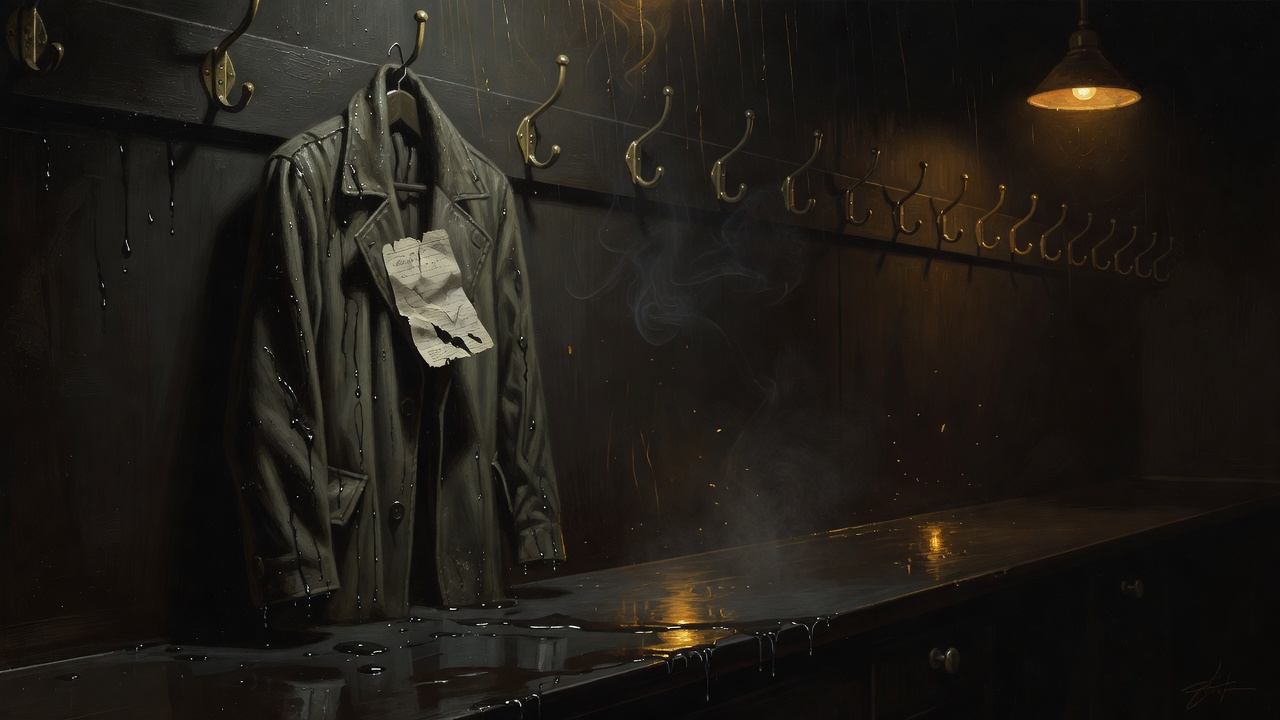
The Number That Was Never Called
Content notes
violence
One
A torch singer hired me to find her kid sister, and I found her, which is the part of this work nobody warns you about — that finding can be the cruelest thing you do all year, and you don't know it until you're standing there holding the answer and watching it bite the hand that paid for it.
But that came later. First there was the bar with no name, and the rain, and the woman at the end of it who sang like a window left open in November.
Iris's place doesn't put up a sign because the people who need it already know the way, and the people who don't have no business in out of the weather. I had my booth in the back, the one Iris keeps for the parts of a man's life he won't say in a report, and I was nursing a coffee gone to room temperature when the singer finished her last set and the few who'd stayed to hear it forgot to clap. That's the thing about a torch song done right. It doesn't ask for applause. It asks you to remember somebody, and then it leaves before you can.
She came down off the little riser still wearing the song the way you wear weather, and she didn't go to the bar for what singers usually go to the bar for. She came to me.
"You're Mercer," she said. Not a question. "Iris says you're the one who doesn't stay bought."
"Iris talks me up. It's a public service. Keeps the rent from feeling lonely."
She didn't smile. She had a face that had been beautiful in a way the city had been steadily borrowing against for fifteen years, and a voice, even off the stage, that had three more cigarettes left in it and knew it. She sat without being asked, which I liked, and folded her hands on the table like a woman setting something down she'd been carrying a long way.
"My name's Della Voss. I sing here Thursdays and wherever else'll have me." A breath. "My sister's gone. Three weeks. The police took down the spelling of her name and went back to their coffee. You're the last thing I can afford and the first one I've found who might give a damn. So." She looked at me straight on. "How much, and what do you need from me?"
I did the part of the job I hate, which is the looking. You learn to read what a person can pay by the things they've stopped buying, and Della Voss had stopped buying a lot. The good coat was three winters old at the shoulders. The ring she kept turning had a place where a stone used to be.
"Tell me about your sister first," I said. "The price comes after, and it'll be smaller than you think. I take payment in things besides money. Ask Iris."
So she told me, and outside the rain kept its standing appointment with the gutter, and I let her talk the way you let a wound bleed a little clean before you look at it.
Two
The sister's name was Cora. Twenty-two, nine years younger, which made her more daughter than sister to a woman who'd raised her after their mother went the way the poor go in this city, quietly and on schedule. Cora worked the coat-check at the Empire Ballroom — the big gilt barn on the good side of the bridge, the one with Councilman Verrick's money in the walls and his name nowhere on the deed.
I kept my face where it was when she said Verrick. It's a name I've learned to receive the way you receive bad weather on the radio: you don't argue with it, you just start closing windows.
"Good girl," Della said, and I believed her, because nobody lies that plain. "Saved her tips in a coffee tin. Wanted secretarial school. Wrote me a postcard every week even though we lived a mile apart, just so I'd have something in the box." She turned the ringless ring. "Three Thursdays back she finished her shift and didn't come home. The other coat-check girl says she clocked out normal, a little before two, said good night, walked out the staff door. And then it's like the street swallowed her between the door and the corner. Her room's still rented. Her coffee tin's still under the bed with the money in it." Her voice didn't break. It just went very flat, which is worse. "Cora wouldn't leave the money, Mr. Mercer. You don't know what that money was. She wouldn't leave it for anything in the world."
"Anything except being made to," I said, gentle as I could make it, which isn't very.
"That's why I'm here." She met it without flinching, which told me she'd already lived in that thought for three weeks and worn the floor of it smooth. "Find her. Find her and tell me where she is and I'll go to her myself. I don't care if she's in trouble. I don't care what she did. I just want my sister at the same table again." She put a small roll of bills on the wood, mostly singles, the kind of money that takes a long time to make in a coat-check at two in the morning. "It's what I've got. There's more Thursdays."
I looked at the singles and I thought about the coffee tin under the bed I'd never seen, and I did the arithmetic I always do, the one that never comes out in my favor.
"Put your money away," I said. "You'll buy me a coffee here when it's done. That's the fee." I took out my notebook. "Now. The Empire. Tell me everything you know about that room, down to the carpet. And Della — " She stopped with the money half gone into her bag. "Whatever's at the bottom of this, you hired me to find your sister. Hold on to that. Some nights it's the only honest thing in the whole transaction."
I should have heard myself. I was already telling her, three Thursdays in, the lie I'd spend the rest of the case earning.
Three
The Empire Ballroom by daylight is a kept woman with the lights off. All that gilt the night swears is gold turns the color of an old tooth, and the carpet that drinks champagne so prettily after midnight shows every cigarette it ever took. I went in the front like a man who belonged there, which is ninety percent of belonging anywhere, and I asked for the manager, and while I waited I learned the only thing I really came to learn, which was the coat-check.
It sat off the lobby like a confessional with a half-door — a long narrow room behind a counter, walls hung four-deep with brass numbered hooks, and a roll of tickets on a spindle. Each ticket tears in two. Half goes on the coat, half goes to the customer, and the numbers match, and that's the whole machine — the oldest, simplest trust in the city. You hand a stranger your coat and he hands you a number and the number is your faith that you'll get the coat back. Numbers in this town don't usually mean what they say. But a coat-check number is the one number that has to. It's the one place the city can't afford to lie, because everybody from the alderman to the chorus girl wants their own coat back at the end of the night.
The manager was a smooth article named Pell who told me three times he'd already told the police everything and clearly hoped the repetition would make it true. Cora was a fine girl. No trouble. They were all just sick about it. He said "sick about it" the way you'd report the weather in a city you'd never been to.
"Mind if I look at the coat-check?" I said. "Sentimental. I lost a hat in a place like this once. Changed my whole philosophy."
Pell minded, but Pell was the kind who'd rather grant a small thing than be remembered refusing it, so he walked me back and stood in the doorway radiating the patience of a man counting the seconds till I left. The girl on duty — not Cora's friend, a new one — pressed herself into the corner the way the young do around trouble they can smell but can't name.
I asked to see the ticket roll. Pell started to say no, then did the arithmetic of his own — what's a roll of cloakroom tickets — and let me. And the rolls are kept, see, that's the thing nobody thinks about. The Empire keeps the torn house-halves in a box by the date, banded by the night, because the cloakroom is a cash business on the tips and Pell's kind of operation counts everything. The numbers run in order. They have to run in order. That's the whole point of a number.
I found the band marked with the Thursday three weeks gone, and I sat on an upturned crate Pell pretended not to see, and I did the dullest, holiest work there is. I counted.
I counted to where Cora's last night should have ended, a little before two, and the numbers ran clean and unbroken, hook after hook, stub after stub, the way a thing runs when nobody's touched it.
Clean except for one.
One number, near the end of the night, that had no house-half torn off in the box and no claim against it in Pell's tidy ledger. A coat checked. A ticket torn. A customer-half handed across the counter into somebody's hand — and then nothing. Never claimed. And here's the part that sat down cold in my chest and stayed: never reissued. In a cloakroom that counts its tickets the way Pell counts everything, a missing number is a missing nickel, and a missing nickel gets chased. Somebody had reached into the machine that can't afford to lie, and made one number disappear, and made sure it stayed disappeared.
"Find what you came for?" Pell said from the doorway.
"A hat," I said. "Wrong color. Story of my life." And I put the band back exactly where it was, with the one ghost number sitting in it like a held breath.
I won't tell you it solved the case. It didn't. A gap in a ticket roll isn't an answer; it's a question that's finally been asked right. But I'd been chasing my whole life the difference between a girl the city took and a girl who walked, and a gap in a number you can't fake is the difference, hanging on a brass hook, with no coat on it.
Four
Dooley took his supper in the same chop-house booth he's eaten in since the courthouse across the street was telling its first lie, and I bought him the gray meat he likes and let him get to the bottom of it before I spent a fact to buy one.
"The Empire," I said. "Three Thursdays back. Anything large happen near it that the papers got told to walk past."
He set his fork down the way he does when a question costs more than the meal. "You do find the warm spots, son." He wiped his mouth, slow. "Three Thursdays back, a city auditor named Brandt went off the top of the Cordwell Building, four doors down from your ballroom, sometime after midnight. Inquest sat for an afternoon and called it a fall. Despondent man, late hours, a low railing. Very tidy." He looked at me with the eyes that have read forty years of tidy. "Brandt was three weeks into auditing where the harbor-improvement money actually went. Which is to say, three weeks into a long walk toward a short railing."
"Verrick's money."
"Everybody's money is Verrick's money. That's what makes it the city's." He turned his coffee cup a half-turn, the way I do, the way men in this town learn to fidget with the truth. "Brandt fell on the same block, the same night, that a coat-check girl walked out a staff door and into the river of rumor. And you've come to my booth asking after both. I'd say that's a coincidence, but I've outlived every coincidence this city ever sold me."
I gave him his fact, because that's the toll. "There's a coat-check number from that night that was never claimed and never reissued. One ticket. Reached into the till and lifted out clean."
The old engine turned behind his eyes. "A coat nobody came back for," he said softly, "and the Empire still has it on the hook." He almost smiled. "A man who goes off a building doesn't stop for his overcoat. But a man who walks Brandt to the railing — a man doing the councilman's tidying — he comes in out of the rain like anybody, and he checks his good coat like anybody, because he's a professional and he doesn't ruin a coat doing wet work. And then he's got a problem, hasn't he. A torn ticket. A number. A girl who looked him in the eye when she took his coat and looked him in the eye when she didn't give it back, because by then he had reasons to leave the way he came in — fast, by the stair the customers never see."
"The private stair," I said.
"The Empire's got one. Goes from the manager's landing down to the alley. The kind of people Verrick entertains don't always want to be seen arriving, and they never want to be seen leaving." Dooley sat back. "Your missing number's not a number, son. It's a witness. Whoever that coat belonged to went down the private stair the night the auditor learned to fly, and the coat-check girl is the one soul in the building who could put a face to a ticket. So somebody made the ticket disappear." He let that sit. "The only question worth your fee is whether they made the girl disappear with it, or whether she had the wit to disappear herself first."
And there it was, landing in my chest, the cold clean weight of it — the difference I'd been chasing since the cloakroom. A girl the city takes doesn't leave a gap. The city is thorough; it reissues the number, squares the ledger, makes the night look like every other night, because a tidy night is the whole product. A gap left standing — a number nobody bothered to paper over — that's not the work of the people who take girls. That's the work of a girl who took herself, and ran, before they could make her tidy.
"Cora saw who he was," I said. "She gave him the coat and took a good long look at the man Verrick sends to walk an auditor to a railing, and somewhere in that look she understood exactly what she'd seen and exactly what it was worth to know it." I turned my own cup. "And she didn't faint and she didn't scream. She finished her shift normal, said good night normal, walked out the staff door normal — and then she didn't go home. She left her sister's money in a coffee tin and she ran on the only thing she had, which was a head start nobody knew she'd taken."
"Brave," Dooley said. "Brave the way the lucky never are." He looked at me with no price on his face for once, only the tiredness. "And now an honest man's gone and found the one thread out of that whole ballroom. The thread the girl risked her life to cut clean behind her." He pushed his plate away. "Be careful what you mean by finding her, Mercer. There's a kind of finding that's just pointing."
Five
A girl with a head start and no money leaves a trail anyway, if you know that the trail of the poor is made of favors, not tickets. She doesn't buy a train fare; she gets walked to a relative's couch by a friend who owes her. She doesn't wire a forwarding address; she sends one careful word through one careful person and prays the wire stays dry.
I won't bore you with the legwork. It's the part nobody pays for and the part that does the whole job — three days of standing in doorways and buying coffees and being the kind of patient that looks like laziness to anyone who's never done it. I worked it the way you tail a routine, because that's the other thing a torch song teaches you: people are made of the things they can't stop doing.
The thing Cora couldn't stop doing was the postcards.
Della had said it herself, back in the booth, and I'd written it down because I write everything down: a postcard every week, even from a mile away, just so her sister would have something in the box. Three weeks gone, terrified, broke, on the run from the people who own the courts — and I'd have bet my office that somewhere in the city a girl raised to put a card in the mail every week was fighting the urge to do the one thing that would put a postmark on her like a hook through a fish.
But there was a doorman, too, and the doorman is where it broke open, and it broke open the way the real ones always do — on a man's routine, not his secret.
There's a doorman at the Empire named Geddes, an old proud man who's stood under that gilt awning so long he's part of the building's weather. A doorman sees every soul that comes and goes, and the smart ones train themselves to remember nobody on purpose, because a doorman who remembers the wrong arrival doesn't grow old under the awning. Geddes had made himself a clock that tells no faces. But a clock still keeps time, even when it's sworn off naming the hours.
I didn't ask Geddes who came down the private stair that night. He'd have forgotten me on principle, and rightly. I asked him about his routine, which is the one thing a proud man will always defend, because his routine is his dignity and his dignity is the last thing the city hasn't bought off him.
"You lock the alley door at the stroke of two," I said, "every night, regular as the church."
"Two sharp," he said, drawing up. "Forty years, two sharp. You could set the river by me."
"So a man leaving by the private stair after two finds the alley door locked."
A flicker. Just a flicker, the kind a man gives when his own pride has walked him one step past where he meant to go. "A man leaving late," he said carefully, "would have to come back through the lobby. Past me. Like a gentleman." And then, because the proud can't help correcting the record even when the record is the gallows: "Except that night the alley door was unlocked at half past two, and I hadn't unlocked it, and I don't make mistakes about my door, mister, so somebody had a key they oughtn't, and went out the way the door swears nobody went."
He'd told me everything and named no one, which is the only kind of brave a doorman can afford. A man went down the private stair, found the alley locked by Geddes's forty-year routine, and used a key only the house keeps — went out the one door that proves he was somebody the house protects. And the only person on the staff who'd have been standing where she could see the manager's landing, who'd have seen a checked coat go down a stair that has no cloakroom at the bottom of it, was the girl at the counter. Cora. Who handed a killer his number and then watched him need to leave by a door that wasn't for leaving.
She hadn't just seen a face. She'd seen the whole machine work — the locked door, the wrong key, the private stair — and understood in one cold breath that she was now the one loose number in the city's tidy night.
I tipped Geddes more than the question was worth and less than his dignity was, and I went to find a girl who'd done the smartest, loneliest thing a person in this city can do, which is to vanish on purpose and trust no one, not even the sister who'd raised her.
Especially not the sister. Because the sister would come looking. And looking, in this town, is just a slower way of pointing.
Six
I found Cora Voss on a Tuesday, in a rooming house two parishes over the river, in a part of the city so far down the city's list it almost qualifies as somewhere else. I won't tell you how, exactly — the postcards she didn't send and the favor she did call in, the friend of a friend who owed her and broke for the price of a kind word, the things that make up the trail of the poor. It took me four days and it would have taken the people who own the courts about four hours, if they'd cared to look, which is the only reason she was still breathing. They thought the gap was enough. They thought the number was the witness. They'd buried the ticket and figured the girl had run somewhere small to die of being poor, and the city had moved on to its next tidy night.
She opened the door on the chain, and she had her sister's straight gaze and none of the wear, and behind it she had the look I've come to know — the look of someone who's done the arithmetic to the penny and isn't going to argue the total with you.
"You're Mercer," she said, before I'd said a word. "Della hired you. Of course she did." She didn't open the chain. "I knew somebody would find me. I just hoped it'd be the wrong somebody, so they'd kill me before they made me lead them to her."
I want to tell you I had a clever line. I always have a clever line; it's the channel of me that's for the room. But the room had gone out of me standing in that hallway, and what was left was the other channel, the quiet one, the one that does the real arithmetic, and it had just finished a sum I didn't like.
"Let me in, Cora," I said. "Not to take you anywhere. To tell you something, and then I'll go, and you'll never see me again if that's what you want. But you need to hear it from a man who counted the tickets."
She let me in because I'd said tickets, and the chain came off the way it comes off when somebody's been alone with a secret so long that a stranger who knows the shape of it feels almost like company.
The room was the size of my honesty and about as comfortable. She sat on the edge of the cot and folded her hands the exact way her sister had folded hers in the booth, and the resemblance went through me like the draw bridge going up.
"I saw him," she said, flat, to the floor. "I don't even know his name. I gave him his number and I watched him go up to Pell's landing and not come back down the front, and I heard the alley door that's supposed to be locked, and I knew — I don't know how I knew, but I knew, the way you know a thing your whole life was practice for. The next morning the paper said an auditor fell. And I understood I was the only person in that whole gold room who knew the difference between a man who fell and a man who was walked." She looked up. "If I go to the police, I'm a girl who made a fuss about a coat. If I stay, I'm the loose number. So I left the money. I left Della's money in the tin because I couldn't carry the weight of it and run, and because — " here her voice finally caught, the only time it did — "because if I took it she'd know I left on purpose. As long as the money's under the bed, she can tell herself I was taken. She can hope. I'd rather she hoped."
And there it was, the whole case, sitting on the edge of a cot two parishes over the river. Not a girl the city took. A girl who'd looked at the same machine I'd spent a week counting, and had read it faster and braver than I had, and had spent the only thing she owned — her sister, her name, her place at the table — to buy herself out of being the next tidy fall. She hadn't run from Della. She'd run for her. She'd made herself a missing person so that her sister wouldn't have to be a grieving one. The cruelest, kindest arithmetic I ever saw, and a stranger had just walked in and put a postmark on all of it.
I'd come to find Cora Voss for the woman who loved her. I'd found her. And the finding was the one thing in the world that could get her killed.
Seven
You don't have a lot of time to be sick about a thing like that. The city doesn't grant intervals. While I sat in that rooming house, the fact that I'd found her was already a fact in the world, and facts in this town leak, and the only question was whether I could get out ahead of my own footprints.
Because here's the arithmetic, and I made Cora do it with me, out loud, both of us, until she stopped looking at me like a sentence and started looking at me like a calculation.
As long as the city believed she'd run off to die poor, she was safe in the only way this city allows: forgotten. The danger wasn't that she'd be found. The danger was that somebody would have a reason to look — and the loudest reason in the world was a torch singer with my card in her purse, asking everyone from Iris's bar to the property clerk where her baby sister went. Della's love was a lit window on a dark street, and the wrong people read lit windows for a living.
"If your sister finds you," I said, "they find you the next day. Not because she'd tell. Because she'd go. She'd take a streetcar across the river with her whole heart on her face, and somebody who watches streetcars for the councilman would watch that face go somewhere it had no reason to go, and follow it to this door. You'd both be loose numbers then. The city only has to tidy you once. It tidies twice for free."
She'd known it already. Of course she'd known it. She'd been living inside that sum for three weeks. But there's a particular mercy in hearing your private arithmetic said back to you by another voice, even a hard one — it means you weren't crazy, it means the cage is real, it means you did the brave thing and not the mad one.
"So you won't tell her," Cora said.
"I'll tell her I couldn't find you." The words came out of me like teeth. "I'll tell her the trail went cold at the bridge. I'll give her back her singles and I'll let her go on telling herself you were taken, because the lie that you were taken is the only thing keeping you alive, and the truth that you ran is a loaded gun pointed at both of you." I looked at the floor, because I couldn't look at her sister's eyes in her face and say it. "It's the worst thing I've ever been paid to do, and she paid me in advance, and I'll never tell her she got robbed."
Cora was quiet a long time. Outside, the river-side rain came down on a part of the city the city doesn't bother to lift it out of the way for.
"Tell me one thing about her," she said finally. "Just — how she looked. When she hired you. I haven't seen her face in three weeks and I'm starting to lose it."
So I told her. I told her about the three-winter coat and the ring with the missing stone and the way she sang like a window left open, and how she'd put her singles on the wood and asked only to sit at the same table again, and Cora listened with her hand over her mouth, taking her sister in through a stranger's eyes, which is a thin and terrible way to love somebody and the only way these two were going to get for a long time, maybe forever.
"Will you do something for me," she said, "since you won't do the thing I want." She went to a drawer and took out a postcard, blank, the kind they sell at every drugstore in the city, a tinted picture of a harbor on the front that no harbor ever looked like. She wrote three words on the back, slow, the way you write when the words are all you'll be allowed. Then she handed it to me with no address on it. "Don't mail it. Mailing it would be a postmark and a postmark would be a thread. But you'll see her, when you tell her the lie. And someday — years, I don't care how many — if it's ever safe, if that man's dead or that councilman's finally in the ground, you give it to her then. Not before. You'll know. You're the one who counts the tickets."
I took the card. I didn't read it. Some numbers you don't get to claim.
Eight
I told Della Voss the lie in Iris's bar, in my own back booth, where I'd taken the case, because a man ought to bury a thing where he dug it up.
I told her the trail went cold at the bridge. I told her I'd worked it three weeks of nights and the city had closed over her sister like water closes over a stone, and that sometimes a person in this town just becomes weather, becomes one more thing the rain takes, and that I was sorry, that I was more sorry than my work usually lets me be. I gave her back her roll of singles and I said the fee was off, that you don't charge a woman for a grave you couldn't even find.
She didn't cry. She did the thing that's worse, which is she nodded, slow, like a woman receiving a verdict she'd written herself weeks ago and only needed a man with a license to read aloud.
"I knew," she said. "I think I knew the first night. You hope anyway. Hoping's the cheapest thing in this city. It's the one thing they let you keep." She turned the ringless ring. "Thank you for looking. Most men wouldn't have looked."
And here is the part I'll carry in the private ledger, the one I don't show anybody, the column where I keep the cases I won wrong. She reached across the table and squeezed my hand, grateful, grateful to me, the man who knew exactly where her sister sat that very night two parishes over the river with her hand over her mouth — grateful to the man robbing her of the only reunion she'd ever asked the world for, and thanking him for the theft because the theft was dressed up as kindness and the kindness was the truth wearing the only coat that fit.
I am an honest man in a city that has no use for one, and I had just told the cleanest lie of my life, and I had done it to keep a brave girl breathing, and it was the right thing, the only thing, the thing the code demanded — and the code felt, for once, like exactly what the city always says it is: a way of feeling fine about a girl going home alone.
The city won. The city always wins. The auditor fell and stayed fallen, the councilman stayed somewhere beautifully else, the man who walked Brandt to the railing still has a good coat and never came back for the other one. The Empire still has it on the hook, I'd bet, brushed and waiting, a coat nobody will ever claim hanging on a number nobody will ever call. And two sisters who'd have crossed the river barefoot to sit at the same table again will live out their lives a mile and a world apart, one of them grieving a girl who isn't dead, the other one alive because her sister thinks she is.
I walked out into the rain the city couldn't be bothered to move out of my way, and I did the only thing the night left me. I talked to a girl I'd promised never to see again, out loud, like an idiot, like prayer for people who've forgotten the words and only kept the tune. I told her the card was safe in my breast pocket, against the weather. I told her I'd know the day, if it ever came, and I'd carry three words across the river the minute the city slipped and let me.
Then I went home and put the postcard in the drawer with Costa's watch and the rest of what this work pays a man — the evidence no court will hear, the numbers nobody will call, the small honest things you hold on to because holding on is the whole of what's left.
I never did read the card. It wasn't mine to claim. But I'll tell you what I'd have bet it said, the way I bet on everything in this town, which is to say against myself and hoping to lose:
Still your Cora. That's the size of it. Three words and a head start. The only message in this entire city that ran clean and unbroken and true — and the only one that was never, ever going to be delivered.
Enjoyed this story?
Read next
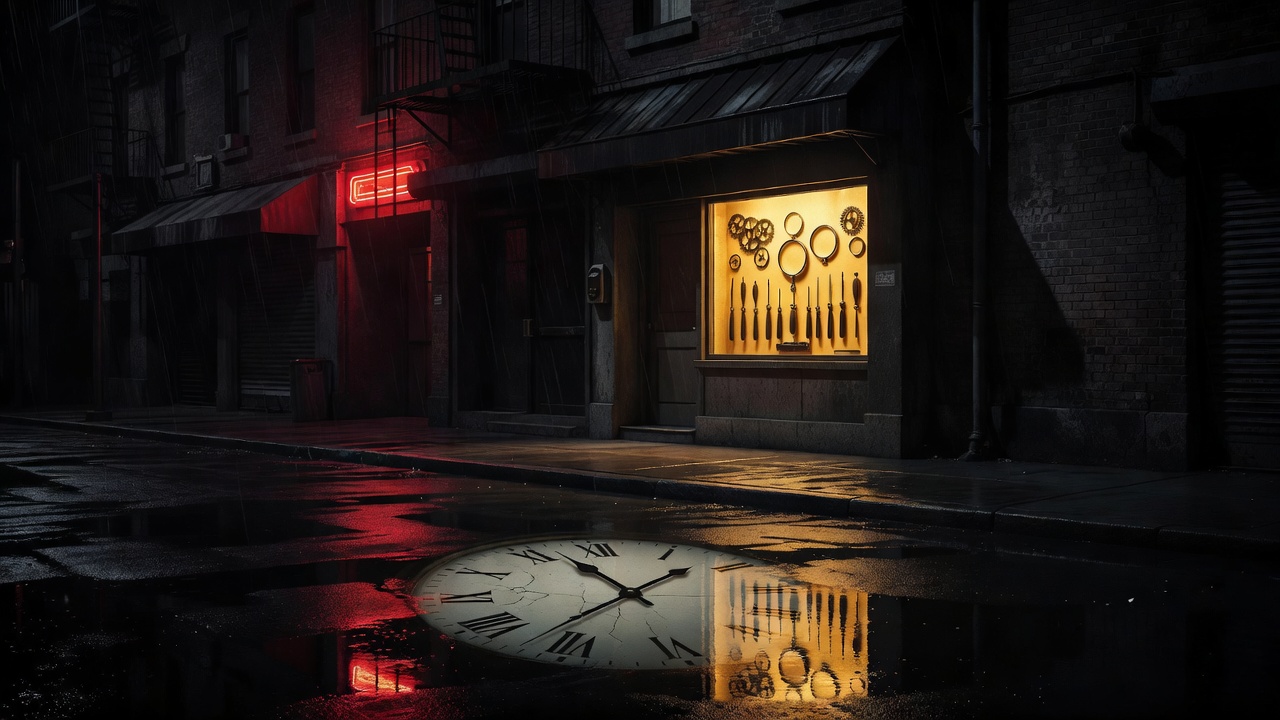 The clocks in Halloran's shop had all stopped at ten to twelve, which made them right twice a day and right about one thing forever, and I stood among them at ten to one being wrong about everything.
The Hour I Didn't Have
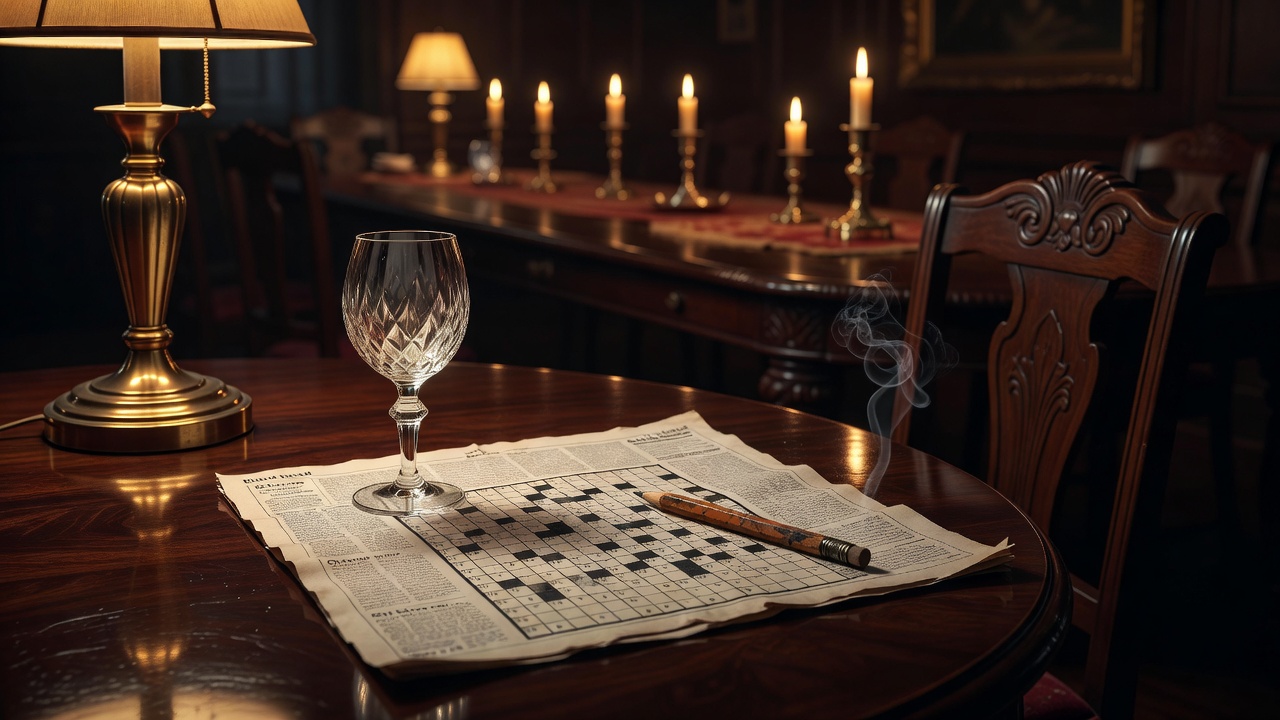 There were nine setters at the centenary table, and only one of them could have written the last clue in the dead man's grid — because only one of them already knew how the evening would end.
The Clue That Cut the Thread
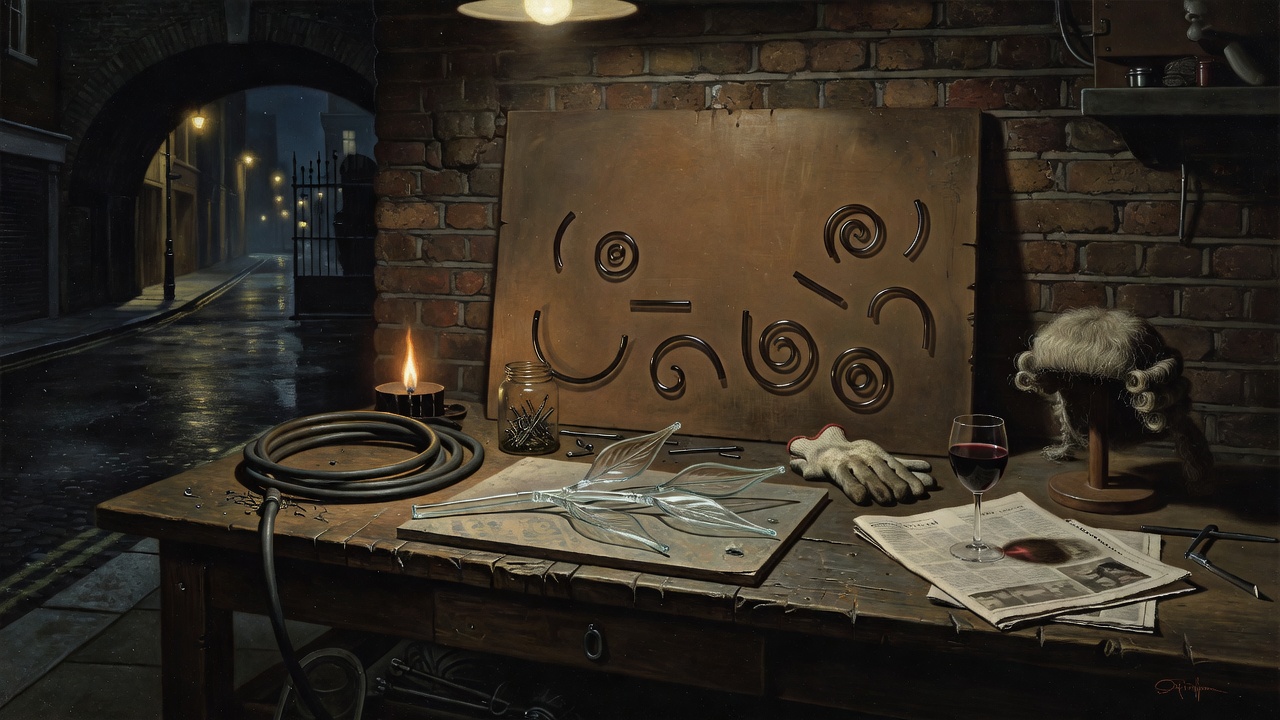 A developer's scaffold went up over a dead neon sign at the wrong end of our own street, and my wife of one-and-forty years climbed it at ten past seven in the morning with two flasks of tea and would not come down; and because a man cannot defend his own wife, the finest advocate of his generation sat at the back of a magistrates' court with his hands in his lap and no standing to say a single word, and there learned — at the same moment as the bench, the usher, and a bored young man from the Crown — what she had been quietly paying for since the year before we met.