
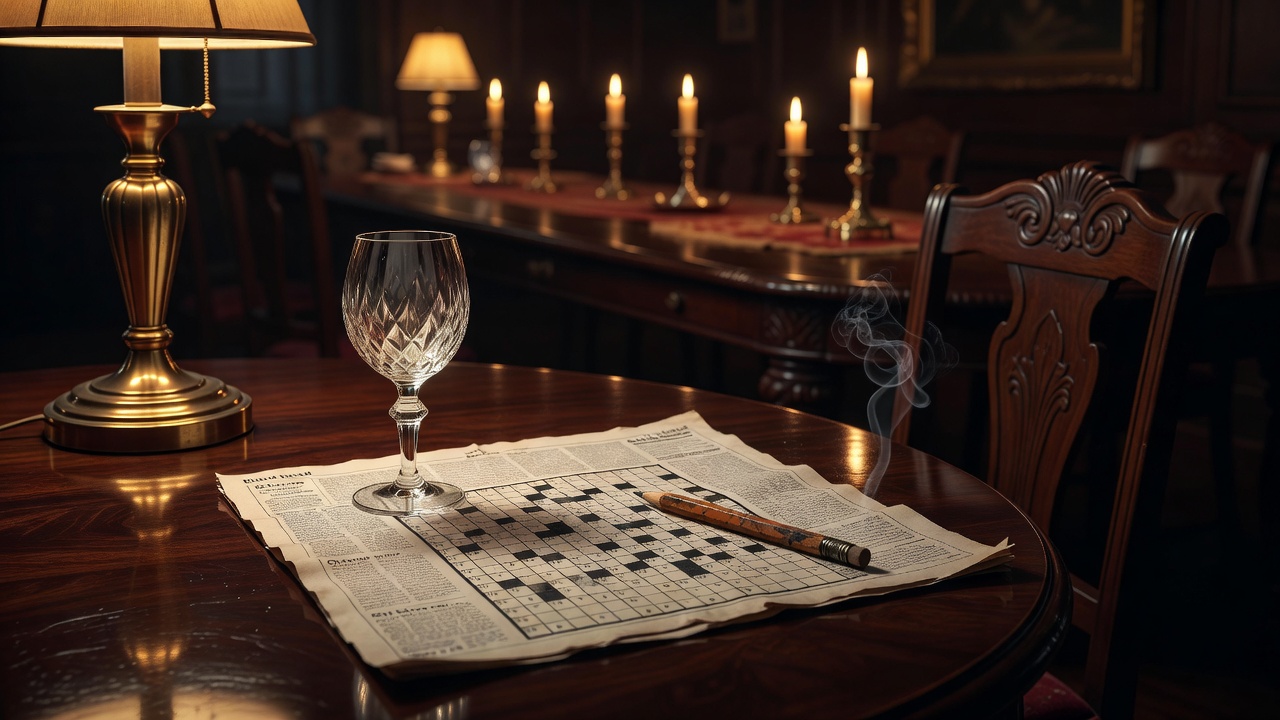
The Clue That Cut the Thread
Content notes
death, poisoning
There were nine setters at the long table the night Ambrose Thorne died, and only one of them could have written the last clue in his grid — because only one of them already knew how the evening would end.
Septimus Quill had not wanted to come. He said as much to the cab, which did not argue, and to the porter at the Caxton Club, who said it was a great honour, sir, the centenary, and only comes the once. A hundred years of the Sentinel, and a dinner for the men and women who had set its cryptic crossword across all of them — and Quill, who had set it for forty of those years under the name Caltrop, could no more decline than he could have declined his own retirement, which is to say he had declined it loudly and gone anyway. A man who has spent forty years hiding answers in plain sight, where ten thousand strangers might find them, develops, whether he wishes to or not, a particular cast of mind; and that cast of mind told him, on the slow climb up the Caxton's marble stair, that an evening got up to celebrate a craft would chiefly celebrate the crafty, and that the room would be three parts vanity and one part old wounds.
It would also, he allowed, have Ambrose Thorne in it. And there was the trouble.
For Quill had fought Ambrose Thorne — Hemlock, in the corner of the grid; Thorne signed his puzzles with a poison and made no apology — for the better part of forty years. They had never met above a dozen times and had been at war the whole while: a private, gentlemanly, absolutely murderous war, conducted in the letters page and the bar of this very club, over the single question of whether a clue might be unfair. Quill held that the contract between setter and solver was sacred: that everything the answer rested on must be there on the page, in view, for the willing eye. Thorne held that a solver who could be beaten deserved to be beaten, and had built a celebrated, infuriating, much-imitated career on clues that were dazzling, elegant, and — Quill would go to the stake on it — quietly cheating. The public adored him. The trade, to a man, could not abide him. He was the most famous setter in England and, by some distance, the most loathed, and Quill had spent four decades being told that he and Thorne were two of a kind, which was the unkindest thing anyone ever said to either of them.
So Quill went up the stair already cross, and was seated, by the malice of the placement, three down from his enemy.
The private banqueting room of the Caxton was panelled to the ceiling and lit by candles and a great hanging brass thing that had seen better reigns. The setters were nine, and the editor made ten, and a young sub-editor making notes against the wall made an eleventh who did not, in the end, signify. Quill knew them all, by their work if not their faces, the way one knows a correspondent's hand.
There was, at the head, Mr. Halloran, the puzzles editor — a tired, decent man who had spent thirty years standing between brilliant difficult people and a printing deadline, and who wore the look of one doing it still. There was Ambrose Thorne himself, Hemlock, large and beautifully dressed and already holding the table, a man who laughed at his own clues and expected you to be grateful for the chance. There was Miss Probyn, who set under the name Sibyl and had the driest tongue in the room. There was old Dauncey, Pangolin, who had set the Saturday prize puzzle since before the war and was deaf enough now to be dangerous in conversation. There was Mr. Verrall, Janus, a smooth City man who set as a hobby and reminded you of it. There was Wragge, Grimaldi, a melancholy comic who did the jokey bank-holiday specials. There was a Mrs. Esterhazy, Cassandra, swathed and theatrical. And there was the newest of them, a pale composed young man named Iverson who had taken the weekday Tuesday slot when Quill gave it up, and who set under the name Atropos — the Fate with the shears, a very clever, very showy choice for a man not yet thirty, as Quill had remarked at the time and been ignored for remarking.
Every soul at that table, the reader will observe, had two names: the one their mother gave them and the worked name, the name under which they hid their cleverness from the world and signed it at once. It is the setter's vanity and the setter's privacy together. Quill asks only that it be held in mind — that each of these decent people answered, in print, to a second self — for that, in the end, was the whole of it.
And there was Quill, Caltrop, three places down from Hemlock, watching his enemy eat.
The dinner was long and the speeches were longer. Halloran said the expected things about a hundred years and a noble tradition. Thorne, called on, rose and was magnificent and insufferable in exactly equal measure: he thanked the Sentinel for the privilege of having taught its readers, for forty years, that they were not as clever as they thought; he commended the younger setters present for their promise and managed to make it sound like a sentence; and he produced, to applause, the thing he had brought.
It was a crossword.
"For the centenary number," Thorne said, holding up a printed proof, a single broad sheet, the grid and its clues set in the Sentinel's own type. "My gift to the paper and to the dozen people in England fit to solve it. Halloran has the block already; it runs Saturday. I'd not let any of you see it early" — a smile around the table that did not warm it — "but tonight, among colleagues, I'll allow that it is the best thing I have done. There is one clue in it" — he tapped the sheet — "that not a person in this room will get before the solution prints. Including," he said, looking, of all the table, straight down it at Quill, "Caltrop."
"How kind of you to say so," said Quill, "of a puzzle I have not read."
"You'll read it," said Thorne, "and you'll be beaten by it, and you'll write me one of your letters." And he laughed, and sat, and laid the proof beside his plate, and the dinner moved on to the brandy.
Quill would remember that the proof lay there through the brandy. He would remember a great many things about the brandy, afterward, because afterward he had to.
The brandy came round in the club's good balloons, poured by the steward from the club's own decanter at the sideboard, and then the decanter was left on the table among the candles for the gentlemen to help themselves, as is the way, and the talk loosened and forked into the small arguments that setters have, which are the only arguments setters enjoy. Old Dauncey, Pangolin, told a story about a misprint in 1931 that had run three columns of correspondence; he told it to Mrs. Esterhazy, who could not hear it either, so that the two of them conducted a conversation at cross-purposes of great length and apparent satisfaction. Verrall, Janus, explained the City to anyone within reach. Miss Probyn said three things, each of which closed a subject; one of them, dropped dry over the soup and let go again, was that the Sentinel meant for its second century to put a single name above the puzzle — its own face for the next forty years — and that the board had two names before it, which she did not give, and looked, when she said it, at no one in particular and therefore at everyone. The young man Iverson said almost nothing, which Quill noted, because Quill was a connoisseur of the people who say almost nothing, having been one, professionally, for forty years. Once, in the thick of the brandy, the young man rose and proposed a graceful little toast — the new men to the old — and came up the table with his glass and leaned in over Thorne's place to touch the great man's balloon, colleague to colleague, and Thorne, who could never resist being toasted, lifted his glass to be clinked and set it down and drank. Quill thought it prettily done, and thought no more of it, there being nothing in a toast.
And Thorne held court, and drank, and grew, as the brandy went down, not merrier but heavier; and somewhere in the second half-hour of it he stopped talking, which was so unlike him that two people laughed before they understood.
He had a hand to his collar. His colour, which had been high, had gone wrong — a flush turned waxy, the eyes too bright and then not bright at all, the mouth dry; he reached for water and knocked the glass, and reached for the proof beside his plate, of all things, and drew it to him, and his other hand went to his breast pocket, fumbling, and came out with the stub of pencil that setters carry the way other men carry a watch. And for perhaps a quarter of a minute, while the table was still deciding whether this was theatre, Ambrose Thorne bent over his own crossword and wrote.
Then Dr. — there is always a doctor; it was Verrall's neighbour, a club member dining apart, summoned across — then the doctor came, and the table stood, and the candles were got out of the way, and Ambrose Thorne, Hemlock, the most famous and least loved setter in England, died on the floor of the Caxton Club with his enemy kneeling beside him, which neither of them, Quill thought, would have predicted at the start of the evening.
"His heart," said the doctor, rising, when there was nothing further to be done. He was a kind man and a club man and he said it kindly. "I'm afraid it was very quick. The flush, the collapse — he was a heavy man, and not a temperate one, and we are not as young as the Sentinel." He looked at the wreck of the dinner with professional regret. "These big full-blooded men. The brandy will not have helped, but one cannot say it caused it. His heart, gentlemen. I'm very sorry."
And the table, to a soul, took it up with relief. His heart. Of course. A weak heart, a heavy dinner, a long life of rich living and richer enmities — what else, in a panelled room full of decent people, could it be? Halloran the editor said it twice, settling it. Mrs. Esterhazy wept theatrically and with evident enjoyment. Verrall said something about a life well lived that no one believed and everyone was grateful for. Even Miss Probyn, the driest of them, said only, "Well. He'd have set a clue on it," which was as near to an epitaph as Hemlock got.
Nobody said the other word. They were far too well bred to say the other word. To have said murder, in that room, among those people, over the body of a man who had merely, after all, had a heart and a great deal of brandy — it was unthinkable; it was vulgar; it was the sort of thing one's own people did not do.
Quill said nothing either. He was looking at the proof.
It lay where Thorne had pulled it, half off the table, the pencil fallen beside it. And on the printed grid, in the margin of one clue, in the dead man's own cramped urgent hand, there were eleven words and a number that had not been there an hour before; for Quill had watched, across the loosening dinner, the way a man watches an enemy, and he was as certain as he was of his own name that the last thing Ambrose Thorne did on this earth was set a clue.
He picked the proof up. No one stopped him. To them it was a dead man's doodle; to Quill it was a letter, addressed, as it happened, to him.
He read the grid that night in his room at the club, and he read it again at breakfast, and by the time the sensible young man arrived he had the whole of it.
The sensible young man was Sergeant Probert. Quill had asked, the night before, with great mildness, whether someone might telephone the police "as a formality"; and Probert, who had been a constable in the shires when Quill first read a model like a clue-grid and had risen since on the strength of having known, that day, what he did not know — Probert had come up to town for it himself, on the strength of the name, and arrived deferential and notebook in hand and frankly delighted to see the old man.
"They're all still here, sir," said Probert. "Held for your formality. The editor's spitting about deadlines and the City gentleman's spitting about his diary, and the deaf old party's quite happy, and nobody — begging your pardon — nobody believes there's anything in it. The doctor's signing it a heart. Is there anything in it?"
"Sit down, Sergeant," said Quill, "and I'll show you a thing I have waited forty years to be shown, which is Ambrose Thorne playing fair."
He spread the proof on the breakfast table between the toast and the marmalade.
"This is his centenary puzzle. He brought it last night, half to be admired and half to crow, and it is — I have read it three times — the best thing he ever did, exactly as he said, and the most flagrantly unfair, exactly as I should have predicted. It is full of his old sins. Here" — a long finger — "is a clue that depends on a slang term no solver under sixty knows; here is one that uses a definition so loose you could drive the Sentinel's vans through it; here is one that is simply, elegantly, a lie. This is Hemlock entire. Forty years I told him a clue must be solvable from what is shown, and forty years he set me clues that were not, and laughed. I knew his hand the way I know the back of mine, Sergeant, because I spent my life arguing with it."
"Now." He turned the sheet so Probert could see, and laid his finger beside one clue in the down column — a clue, the Sergeant saw, with a pencilled scrawl crowding its margin. "Read me twenty-three down, as it was printed. As Thorne set it, weeks ago, for the block."
Probert read, slowly, in the careful voice of a man reading aloud a foreign language: "Twenty-three down. A poison, we hear, for the listener (7)."
"And the answer," said Quill, "is HEMLOCK — no. Look at the count. Seven letters." He smiled, a small dry private smile. "The answer is atropos, but he has not yet — no, I run ahead. Forgive an old man. Solve it with me. A poison, we hear — Thorne's signature, you understand; he could never set a grid without a poison in it somewhere, it was his joke and his name. For the listener — that is the homophone indicator, we hear; it tells you the clue is a thing that sounds like the answer. And for the listener is also the definition, after a fashion: a thing for the ear." He shook his head. "It is a Thorne clue to the bone — over-clever, slightly cheating, the indicator doing two jobs. The answer is a poison that sounds like something else. I shan't keep you: it is HEMLOCK, his own signature, hidden as a homophone of hem and lock, a seam and a fastening, a thing for the ear being the loosest definition you ever saw. Pure Hemlock. He signed his own death-warrant of a puzzle with his own name and thought it the finest joke in England, and so, God help me, do I."
"Then twenty-three down's answer is HEMLOCK," said Probert, writing it.
"As printed," said Quill. "As set weeks ago. Yes." And his face changed. "But that is not what he wrote last night."
He turned the lamp a little, though it was morning, from old habit.
"Last night, dying — while he was dying, Sergeant, in the quarter-minute the table took to understand that a man was leaving it — Ambrose Thorne did not call out, and did not point, and did not name his murderer in any way that a roomful of well-bred people would have heard, because he had learned across seventy years that this particular room does not listen; it talks across. He did the only thing he had ever been able to make the world attend to. He set a clue. He took his pencil, and beside twenty-three down — beside his own perfect cheating HEMLOCK — he wrote a second clue, in the margin, a clue for the same seven-letter light, a clue to be read instead."
He read it out, in the voice he kept for the Sentinel's subscribers, the voice that had lit ten thousand breakfasts:
"A French excess over a bone — and the thread is cut. (7)"
Probert wrote it down. "And that's — also seven letters."
"It is exactly seven letters," said Quill, "and here, Sergeant, is the marvel, and here is the whole of the case, so attend to me, because this is the only conjuring I shall do, and it is not conjuring at all, which is the point: every scrap of it is on this page in front of you, set fairly, where you might solve it before I do."
"A cryptic clue," he said, "is two clues for one answer. It gives you the answer twice — once straight, as a definition, and once sideways, as a little machine of letters, wordplay, that builds the same word from parts. A fair clue, a true clue" — the old war flickered in him — "lets you check your answer by getting it both ways. So. A French excess over a bone. That is the machine. A is A — the letter, given you plainly. French excess — what is excess, in French? What is the French for too much?"
"I don't — trop?" said Probert, who had a little school French and a quick ear.
"Trop. T-R-O-P. French excess. Good man. And a bone — the commonest bone in the setter's box, two letters, the anatomist's word, the Latin: OS. A bone is OS. So." He laid them out with his finger on the marmalade-edge of the cloth, A, TROP, OS. "A over trop over os — A-TROP-OS. ATROPOS. Seven letters, built fair, every part shown and labelled."
"Atropos," said Probert, getting it onto the page. "And the — the straight bit? The definition?"
"And the thread is cut," said Quill softly. "Atropos is one of the three Fates of the Greeks, Sergeant — the eldest, the smallest, the one with the shears. Her sisters spin the thread of a life and measure it; Atropos cuts it. And the thread is cut — there is your definition, plain as a gravestone. The word means, precisely, the one who ends the life." He sat back. "It is a perfect clue. It is fair — for the first and last time in his life, Ambrose Thorne set a clue I could solve from what was on the page, with no trick in it I was not given the key to. He spent his dying quarter-minute proving me right. I find I cannot quite forgive him for it."
Probert looked at the two clues, the printed and the pencilled, side by side. "So he changed the answer. From HEMLOCK to ATROPOS. From a poison to a — a Fate. But why, sir? He was dying. Why spend it on a riddle? Why not write a name?"
"Two reasons," said Quill, "and the second is the whole of it. The first is the man. He could no more die without setting a clue than I could; we are, curse him, two of a kind, and I shall hear about that in the next world. But the second reason, Sergeant, the reason he chose this answer and not some other Fate or fancy — the second reason is that ATROPOS is not a riddle at all. It is a name. It is two names. And both of them were at the table."
He held up one finger.
"The first. ATROPOS — atropine. The poison that comes from the deadly nightshade, the belladonna; the physician's drug and the murderer's; the thing that brings a high colour and a dry mouth and a racing then a failing heart, and a quick quiet death over the brandy that a kind club doctor, not looking for it, will sign as a weak heart every time. Thorne was a setter of poisons; he knew his poisons as I know my anagrams. He felt the flush and the dryness and the gallop in his chest and he knew, with the last clear part of his mind, what had killed him — not his heart, but atropine, deadly nightshade, in the brandy he had been drinking when no other man at the table was made ill. He told us the poison. A poison, we hear — he'd printed that weeks ago over HEMLOCK as a joke, and dying he reached for the same light and set the true poison in it. The grid told us it was murder, and told us the means, before any doctor had said a word. That is the first name in ATROPOS."
"And the second?" said Probert, very quiet now.
"The second," said Quill, "is a man — and you have already met him, Sergeant, though you did not know you had. For ATROPOS, you will recall, is also a pen-name. There is exactly one compiler in England who signs his puzzles Atropos — the Fate with the shears, the one who cuts the thread — and he was at the table last night, three places from me, saying almost nothing, which I noticed, because I am a connoisseur of the people who say almost nothing. He set the Sentinel's Tuesday puzzle; he took the slot when I gave it up. His name is Iverson." He let it lie a moment. "The dead man, naming his killer, named the poison and the pen at one stroke — atropine the drug and Atropos the by-line, folded into the same seven letters. It is the most economical thing Ambrose Thorne ever did, and the only generous one."
Probert sat back. Then, being a sound officer and not a credulous one, he leaned in again, frowning.
"It's beautiful, sir. But it's a dead man's doodle that spells a young fellow's by-line, and a King's Counsel would have it out of court before you'd finished saying Fate. Half the words in the language hide a name if you go looking. Where's the case? What says young Iverson — Atropos — poisoned the brandy, and not, say, the deaf old gentleman or the weeping lady or, begging your pardon, you?"
"Now that," said Quill, with great approval, "is the right question, and it is the question Thorne answered too, in the same seven letters, if you read the clue the way it was built and not merely the way it solves. Sit still, Sergeant. We come to the part that hangs a man, and it is not the spelling. It is the time."
He laid the two clues side by side again, the dead man's pencil scrawl beside the printer's type.
"Consider what the murderer had to do, and when. Atropine in the brandy — but whose brandy? Not the decanter; the decanter went round us all, poured by the steward, and stood among the candles for an hour and no one else sickened. It was Thorne's glass, then — Thorne's balloon, dosed in particular, at the table, after the steward had withdrawn. A heavy dose, to work that fast. Now: a man does not drop atropine into his enemy's glass under the eyes of nine watchful colleagues unless he has a moment when the watching slackens and a reason to be at that end of the table. There was such a moment. You will remember none of us were attending to anything but Thorne for the whole of the dinner, because Thorne saw to it that we attended to Thorne; and there was, in the thick of the brandy, a toast."
"A toast," said Probert.
"Young Iverson proposed it," said Quill. "I had forgotten it until this morning and then I could not stop remembering it. The new men, he said, drinking to the old — a graceful thing, prettily done, the sort of thing that makes an editor warm to a junior. He rose, and he came up the table with his glass — toward the head, toward Halloran, toward Thorne — and he leaned in over Thorne's place to clink the great man's balloon, colleague to colleague, Atropos to Hemlock, and Thorne, who could never resist being toasted, lifted his glass to be touched and set it down again and drank from it within the minute. I saw it. I thought it charming. I thought, there is a young man who knows which side his career is buttered. It did not cross my mind — why should it? — that a man leaning in to clink a glass is a man with his hand for one instant over that glass, in the one half-second of the evening that no one was watching the brandy because everyone was watching the gesture."
"That's still only opportunity, sir," said Probert, doing his duty. "A pretty toast and a lean. It's not proof he doctored it."
"No," Quill agreed, "and on its own I would not hang a cat on it. But the clue, Sergeant — the clue gives us the thing that opportunity cannot, which is foreknowledge. Read it once more and ask yourself a setter's question, the only question that matters: who could have written it?"
He read it a third time, slowly. "A French excess over a bone — and the thread is cut."
"This is a clue," said Quill, "with a definition that depends on the death. And the thread is cut — it defines ATROPOS by what Atropos does: she ends the life. The clue does not merely contain a name; it describes a killing in progress. Now consider when it was made. It was made at the table, in pencil, in the last minutes of Thorne's life — we are agreed; you watched him write and so did I. But here is the setter's point, and it is decisive. Thorne, dying, knew he was being killed. He built into his clue a definition that only makes sense if the answer is the killer — the thread is cut. He was not solving a puzzle. He was accusing. And a man does not accuse a name unless he knows the name. So the question is not could Iverson have been at the glass — many of us passed Thorne's chair across a long dinner. The question is: who had Thorne already marked, in his own mind, as the one who would cut the thread tonight? For the clue is not a guess made in extremis. It is a confirmation. Thorne felt the atropine and was not surprised by who. The flush, the dryness — he knew the drug; and the instant he knew the drug, he knew the hand, and the hand had a name he had been turning over all evening, and the name, by the black joke of the world, was the name of the drug. ATROPOS. He had only to write down the word that was already in his head."
"Why was it already in his head?" said Probert. "What had young Atropos to do with him?"
"Ah," said Quill. "For that I had to leave the grid and read the man, and the room, which is the other half of my trade. Consider the young man's position, and consider Thorne's tongue. Iverson is the newest setter at the Sentinel, the Tuesday man, my own successor in the slot, and ambitious — you could read it in how little he said and how carefully. Last night Thorne, rising to speak, commended the younger setters' promise and made it a sentence — I heard the room hear it. And there was a thing going about the trade these six months, which I had from Miss Probyn over the soup before any of this: that the Sentinel meant, for its second century, to name one setter as its principal, its public face, its 'Hemlock' for the next forty years — and that the two names before the board were Thorne, who was Hemlock and meant to die in the chair, and young Iverson, Atropos, who meant to have it while he was young enough to enjoy it. The old king and the impatient prince. And Thorne, who would relinquish nothing, had been blocking the boy at every turn — there is a letter, Halloran will have it, in which Thorne calls Iverson's clueing 'facile' in print. To a setter, Sergeant, facile is a knife. The young man wanted the chair, and the only thing between him and forty years of it was a heavy full-blooded man with a famous weak heart, at a dinner, over the brandy, where a quick collapse would surprise nobody and a kind doctor would oblige."
He spread his hands.
"There is your motive, plain and old as Cain. The succession. The chair. And there is your means, atropine, which a man who sets poisons for a living can come by and dose, and which mimics the very heart-failure everyone expected of the victim. And there is your opportunity, the toast, the lean, the half-second's hand over the glass. And there, in the dead man's last fair clue, is your proof of mind — that Thorne, dying, did not cast about for a culprit but wrote down a name he already held, the name that was the poison and the man at once. Means, motive, opportunity — and a dying witness who, denied his voice all his life, used the only language no one at that table could talk across. He set it fairly. He set it for me. He knew that of the eleven people in that room, exactly one had spent forty years insisting that a clue must be solvable from what is shown — and would therefore try to solve it, instead of folding it into a dead man's pocket and calling it a doodle."
Probert was quiet a long moment. Then: "It'll want more than the clue, sir, in front of a magistrate. You know it will."
"It will," said Quill, "and it shall have it, because a murderer who trusts a poison to imitate nature gets careless about the things nature does not imitate. Atropine, Sergeant. Where did it come from? Belladonna is the eye-drop man's friend and the chemist's poison-book is a stern register; a young setter does not buy deadly nightshade across a counter without a name in a ledger. Ask your colleagues to walk the chemists near his rooms with his photograph and the poison-book open. Ask, too, what he carried last night — these young men with their cigarette cases and their pocket flasks; a drop in a glass comes from somewhere, and somewhere will have a residue. And there is the toast itself: nine witnesses saw a graceful young man lean over the dead man's chair, and not one of them, until I say the word, has thought twice about it — but they saw it, and they will remember it once it is named, and a thing nine people saw is not so frail as a magistrate thinks." He tapped the proof. "The clue does not hang him, Sergeant. The clue tells you whom to hang the evidence on, which is precisely the labour Thorne saved us, and precisely the labour the rest of that table, with their weak heart and their good breeding, would have spared the murderer entirely. Hemlock has done a generous thing exactly once, and it would be a pity to waste it."
They went down together, and the thing was done with very little noise, which is how such things are done in such places.
Iverson — Atropos — was composed to the last, which Quill had expected, for a man cool enough to lean smiling over a poisoned glass does not lose his head over a Sergeant. He heard the clue read out and said it was an ingenious coincidence and that he should be obliged to consult a solicitor. He said it well. But Quill, watching — for Quill watched faces as he watched grids, the long lights first and then the crossings — saw the one thing that does not solve fair and cannot be set down for a magistrate, which is that when Sergeant Probert spoke the word atropine, the young man's eyes went, for the half of a half-second, not to the policeman but to the proof on the table, to twenty-three down, to the pencilled clue — went there to check the spelling, the way a setter cannot help going, to see whether the dead man had got him right. He had. The boy looked away too late, and met Quill's eye instead, and in that meeting was the whole confession that the law would never use and Quill would never need.
It was the chemist's poison-book, in the end, that did the law's work — a name in a ledger three streets from his rooms, belladonna bought for a fictitious eye-complaint a fortnight before the dinner; and the flask in his coat with the residue in the seam; and the nine colleagues who, asked the right question at last, each remembered the toast and the lean. Atropos was committed before the centenary number ran, and the Sentinel held the puzzle out of respect, and printed it later, with twenty-three down restored to HEMLOCK, the way Thorne had set it weeks before he died, which Quill thought was the wrong choice and said so, in a letter, which was a habit he found, even now, he could not break.
For he had lost, you understand, an enemy; and a man may grieve an enemy as he never grieves a friend, because an enemy keeps faith with you in a way friends seldom trouble to. For forty years Ambrose Thorne had been the one man in England who took Quill's whole life as seriously as Quill did — seriously enough to fight it every Saturday, to needle it in the letters page, to cross a crowded club to crow at it. They had agreed on nothing and understood each other entirely. And at the last, with the dark coming up fast and a roomful of the well-bred deciding it was his heart, Thorne had not called for help and had not named the boy aloud; he had reached past all of them for the one mind he trusted to be looking, and set him a clue, and set it — for the first time in forty years — fair, every part shown, solvable from what was on the page, no trick in it that the solver was not given the key to.
He had proved Quill right, dying. It was the most enormous concession, and the most enormous insult, for it left Quill no possible reply.
Quill went up to his room to pack, the proof folded in his breast pocket where Thorne had kept it, and on the slow train home he took it out once and read twenty-three down a last time — both clues, the cheating printed one and the fair pencilled one, side by side, HEMLOCK and ATROPOS, the man and the Fate.
A young sub-editor's centenary booklet, he learned later, reprinted the story of the dinner without one word of the truth in it; the celebrated Mr. Thorne, taken from us by a sudden failure of the heart, among friends, at the height of his powers. Every clause of it false, and every clause of it the sort of thing one's own people say. Thorne would have hated it. Thorne had spent a quarter of his last minute making sure it could not stand.
Quill folded the proof away. He thought, watching the wet fields go by, that it was the finest clue he had ever been beaten to — for he had been beaten to it; the dead man had got there first, had known the answer before Quill had read the question — and that in forty years of the Sentinel he had set nothing to touch it, because he had never had Thorne's nerve to break, with his last breath, the one rule he had built his life upon.
"You owe me a letter," he told the window, drily, "and you have left me, you wretched man, with the last word, which is the cruellest thing you ever did to me."
Then he put on his spectacles, and took the booklet's own crossword from his coat, and began, as the train ran south, to find fault with it; for the dead must be honoured in the only language they would have understood, and Septimus Quill, who could not pass a closed door without wondering what word would open it, had a great many doors yet to come.
Enjoyed this story?
Read next
 There were eight people at the long table the night Aubrey Stint died, and only one of them had spent two years making a perfect little copy of the house — small enough to lie about, too honest to do it.
The House That Saw Everything
 A torch singer hired me to find her kid sister, and I found her, which is the part of this work nobody warns you can be the cruelest thing you do all year.
The Number That Was Never Called
 A developer's scaffold went up over a dead neon sign at the wrong end of our own street, and my wife of one-and-forty years climbed it at ten past seven in the morning with two flasks of tea and would not come down; and because a man cannot defend his own wife, the finest advocate of his generation sat at the back of a magistrates' court with his hands in his lap and no standing to say a single word, and there learned — at the same moment as the bench, the usher, and a bored young man from the Crown — what she had been quietly paying for since the year before we met.