
The House That Saw Everything
Content notes
death
There were eight people at the long table the night Aubrey Stint died, and only one of them had spent two years making a perfect little copy of the house — small enough to lie about, too honest to do it.
Septimus Quill had come for the model, not the murder. He had come, if he was honest, for the pleasure of being among people who took small precise things seriously, which is a pleasure that grows rarer with age and rarer still with retirement. For forty years he had set the cryptic crossword for the Sentinel under the name Caltrop, and a man who has spent forty years hiding answers in plain sight where ten thousand strangers may find them develops, whether he wishes to or not, a particular cast of mind. He noticed gaps. He noticed the shape of what was not said. He had been told, more than once and not always kindly, that he could not pass a closed door without wondering what word would open it.
The invitation had come because the dowager, Lady Maddingley, did her crossword in ink and had once written to Caltrop to complain, with enormous courtesy, about a clue she considered unsporting. He had conceded the point. They had corresponded ever since. So when she wrote that the famous Mr. Stint had at last finished his miniature of the Hall, and that there was to be a small unveiling, and that she should be glad of one guest who would look properly, he had taken the slow train down and arrived in time for sherry.
The model stood in the long gallery on a marble plinth, under a cloth, the way a portrait is kept under a cloth, and the dinner was got through with everybody pretending not to glance at it.
Stint himself was a small grey man with the steady hands of his trade and the manner of one who would rather be measuring something. He sat at Quill's left and spoke quietly, and only about his work, and on that subject he was unstoppable in the way of the genuinely devoted.
"People think the difficulty is the smallness," he said. "It isn't. Any fool can buy a tiny chair. The difficulty is truth. I do not make pretty houses, Mr. Quill. I make true ones. If a curtain hangs crooked in the real room, it hangs crooked in mine. If the third stair creaks, I cannot make it creak, more's the pity, but I can make it the worn one." He turned his glass without drinking from it. "I have been in every room of this house for two years — every room, even the locked one off the study, for a true model must show a house's true heart, and her ladyship gave me the run of the lot. I have measured the dust. I put down what is there, sir. Not what ought to be."
Down the table, Quill noticed, Hugo Maddingley had stopped laughing.
"A documentarian," said Quill, pleased.
"A witness," Stint corrected. "A house tells the truth about the people in it, if you'll only let it. They never think the furniture is watching."
Quill remembered that, afterward.
He remembered, too, the others at the table, because afterward he'd have to. There was Hugo Maddingley, the dowager's son and the heir, a handsome florid man of fifty who laughed a beat too soon at his own remarks and managed the estate, or said he did. There was Hugo's wife, Cynthia, brittle and beautifully dressed, who watched her husband the way one watches a kettle. There was the family solicitor, a dry man named Pferrers, down for the occasion with a despatch case he didn't let out of arm's reach. There was Dr. Aldous, the local man, florid in a different register. And there was the dowager herself at the head, upright as a fire-iron, ninety in the shade and missing nothing.
And there was Miss Vane.
Quill very nearly didn't count Miss Vane, which was the whole trouble, and he knew it later and was ashamed. Edith Vane was the dowager's companion — had been for thirty years — a colourless woman of sixty in grey, who saw to the medicines and the library fines and the answering of letters, and who sat at table and was spoken across as though she were a particularly reliable item of furniture. When she passed the salt no one thanked her. When she spoke, which was seldom, the conversation closed over the place where her sentence had been like water over a dropped stone. Quill, who had spent his career being the man behind the puzzle that everybody used and nobody pictured, felt for her a small private kinship, and said so, once, kindly, and watched her colour with the surprise of a woman not used to being addressed.
That was the dinner. The unveiling was to be in the morning, in proper light.
In the morning Aubrey Stint was dead at the foot of his own plinth, the cloth still half across the model, his head against the corner of the marble and his measuring spectacles flat on the floor a yard away.
Dr. Aldous knelt, and rose, and said what was wanted of him. "He came down early to fancy it up before we all trooped in, I shouldn't wonder. Stood on the stool there to get the cloth off the chimneys. Stool's gone over. Caught the marble going down." He spread his florid hands. "These finicking little men, Hugo, they'll fuss. A bad way to go, but a quick one."
"Misadventure," said Hugo Maddingley, rather too promptly for a man receiving the news. "Ghastly. Quite ghastly. Poor little chap. Well — we can hardly have the unveiling now, can we. Pferrers, you'll see to the — the arrangements. Best telephone the constable as a formality, but it's plain as day."
It was plain as day. The stool lay on its side. The man was old and small and had been reaching above his head in a cold gallery at six in the morning. There was a graze at his temple and a corner of marble to account for it and nothing whatever to say it hadn't happened exactly as the doctor described.
Quill said nothing at all, because he was looking at the spectacles.
A man falling from a stool flings his arms out. The spectacles should have been near the body, knocked from his face on the way down or under him where he lay. Instead they were a yard off, folded — folded — and set down. Stint had taken his spectacles off, folded them, and set them aside, the way a man does when he means to do something with his hands he can do better blind, or when he's interrupted and turns to face a person he knows. He hadn't been wearing them when he fell. He had been wearing them when he worked. And no man fusses with a cloth above his head with his measuring spectacles folded on the floor behind him.
"I wonder," said Quill mildly, to the room, "whether someone might telephone the constable now, after all. And ask him to come himself."
The constable, when he came, was a sensible young man named Probert who had the great virtue of knowing what he didn't know. He looked at the spectacles where Quill showed him and went a little still, and then he did a thing that decided the day: he asked Quill, quietly, in the gallery, what he made of it.
"I make of it," said Quill, "that we should look at the only witness in the house who can't be bribed, frightened, or muddled, and who was awake all night with its eyes open."
He drew the cloth from the model.
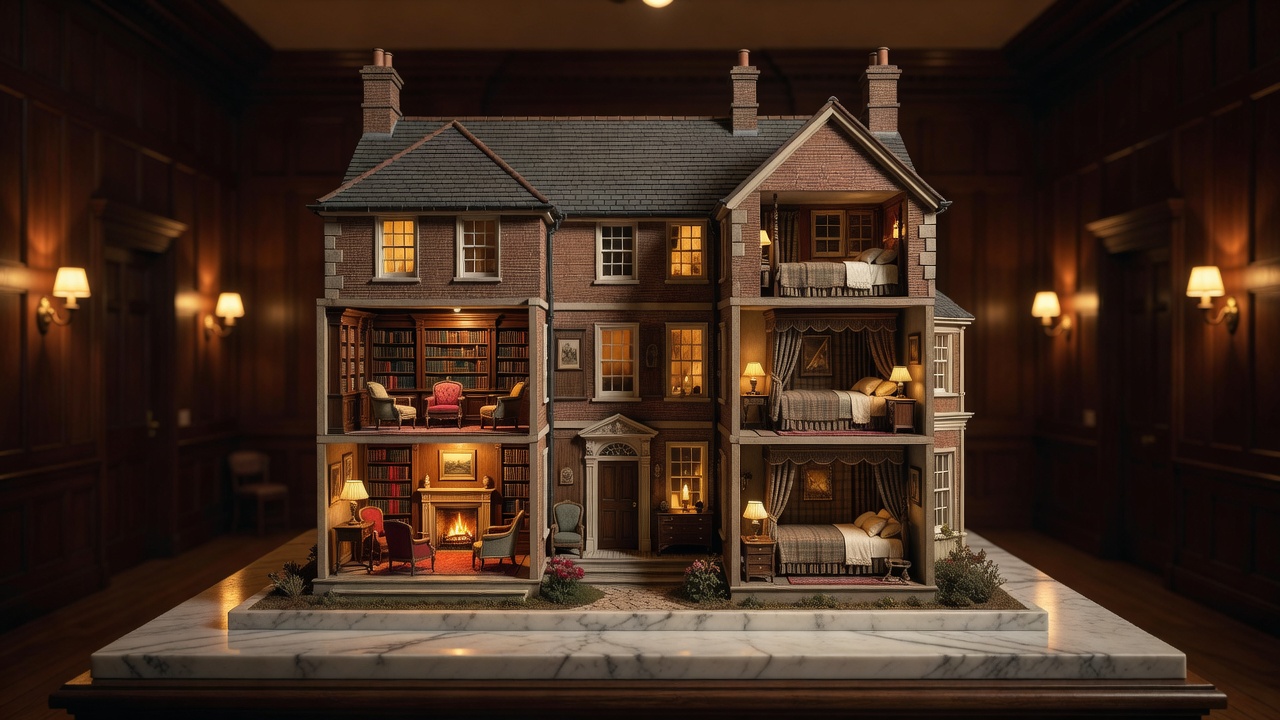
It was, even to a man braced for excellence, a marvel. Maddingley Hall stood three feet long on its plinth, hinged open at the front like a great doll's house so that every room lay bare at once — the long gallery they stood in, reproduced inside itself with a tiny model of the model upon a tiny plinth, which made Probert laugh once, sharply, and then stop. The library with its thread-fine books. The kitchens. The morning room where a minute Lady Maddingley sat upright in grey wool no bigger than a thumbnail. Every figure was there, each household member rendered to the half-inch and placed where Stint had decided to fix them: the dowager at her letters, Hugo at the estate desk with the green lamp, Cynthia at her glass, Pferrers in the blue room with his case, the cook at her range, a housemaid on the stair. The clocks were painted at twenty to eleven, every one, which Quill took to be the hour Stint had chosen to immortalise — the house, on an ordinary evening, settling toward night.
"He froze a moment," Quill murmured. "Twenty to eleven. The house as it was, on the last evening he watched it. He told me himself — he put down what was there."
"It's clever," said Probert, "but it's a toy, sir. It can't have seen anything."
"It saw what he saw. And he was the most careful observer in three counties." Quill bent to the little rooms, his hands behind his back, reading the model the way he read a grid — corner first, then the long lights, then the crossings. "Lady Maddingley at her letters — yes. The cook — yes. Master Hugo at the green-lamped desk in the study, going over the accounts." He paused. "He told us last night he was at the accounts until midnight and then straight up to bed. And there he is, at twenty to eleven, exactly as he says. The house agrees with him." He straightened. "So far."
"Then there's your alibi confirmed," said Probert, "if alibi's wanted."
"Mm," said Quill, and went on reading, and came to the muniment room.
The muniment room at Maddingley was the strong-heart of the house: a small windowless stone chamber off the study where the deeds and rolls and the iron deed-box were kept, the one room the family didn't throw open, locked always, its single key on the master's ring. Stint had reproduced it perfectly — the racked rolls, the strap-hinged door, the deed-box the size of a sugar-lump. And standing inside it, alone, her grey figure unmistakable to the half-inch, was Miss Vane.
Quill looked at her for a long time.
"There," said Probert, leaning in, and his voice changed. "Now there's a thing. The companion. In the locked room. With the deeds." He straightened, the case half made already in his honest young head. "And she sat through dinner the meekest mouse in the county. If she'd a key she'd no business with, and the little man caught her at it—"
"Ask her," said Quill.
They asked her. Probert did it gently, and Quill watched, and Miss Vane went white to the lips and then, with a dignity that cost her visibly, went steady.
"I have never," she said, "in thirty years, been inside the muniment room. I have not got a key to it and I have never wished for one. I do not know what is kept there beyond what everyone knows. I was in my own room from half-past ten, and I can prove nothing of it, because no one ever comes to look whether I am there or not." She lifted her chin. "I see that the — the model says otherwise. I cannot account for it. I can only tell you it is not true."
"It isn't true," Quill agreed, so warmly that she startled, "and that's the most important thing anybody has said in this house since I arrived."
He drew Probert apart, to the window, where the real gallery looked out across the real courtyard, grey in the morning.
"Consider the man," said Quill, "and then consider the model. Aubrey Stint didn't make mistakes — it was the whole of his pride, and pride that exact doesn't slip. He put down what was there. Every other figure in that house is where it truly was at twenty to eleven; we can check half of them and we'll find them right, because he was always right. So." He held up a long finger. "Either Miss Vane was in the muniment room and is lying — which is your case, and a good plain one — or Aubrey Stint, the most truthful craftsman alive, put a figure somewhere he knew it had never been. And if he did that, Constable, he did it on purpose, because the one thing such a man would never do is make an error of that kind by accident. A wrong tile in a true mosaic isn't a flaw. It's a flag."
Probert frowned. "Why not just say it? Write a note? Tell someone?"
"Because he was killed before he could," said Quill quietly, "and because, perhaps, he had tried to say it and learned that no one in this house listens to a small grey person who's only there to do the work. He knew that feeling. He'd watched it done to her at every dinner for two years." He looked back at the model. "He couldn't make the living see her. So he put her where she would have to be seen. He used the only voice that no one could talk across — his work. He laid a clue, the way I might, in plain sight, for whoever in the house could read. And then he stayed up to finish placing it, and took his spectacles off to speak to the one person who came down and found him at it."
"But what's he saying?" said Probert. "If she wasn't in the room — what's the figure for?"
"It isn't a figure of guilt," said Quill. "It's a figure of witness. He's telling us two things at once, the way the best clues do. He's telling us to look in the muniment room — there's the answer. And he's telling us who saw — there's the eye that the rest of you have spent thirty years refusing to use." He smiled, without any pleasure in it. "Now. Let us get into that locked room. I should like to know what's in the deed-box that a man would kill to keep small."
The key was on the dowager's late husband's ring, and the ring was in the master's dressing room, and the master's dressing room was Hugo's now. Hugo Maddingley didn't want the muniment room opened. He found, on the instant, a great many reasons: the family's privacy; the impropriety; the absurdity of a policeman and a crossword man rummaging the deeds over the death of a tradesman who had quite plainly fallen off a stool. He grew florid and then he grew loud, and Quill observed that a man who shouts about a locked room is a man telling you where to look quite as clearly as Stint had.
It was the dowager who ended it. She had said almost nothing all morning; she said little now. She put out her dry old hand for the ring, and her son, against thirty years of training, gave it to her, and she handed it past him to the constable without once looking at her boy, which was its own small terrible sentence.
Inside the deed-box, under the old rolled deeds of the manor, lay a folded transfer of recent date, drawn and witnessed, conveying the whole of the Maddingley estate — Hall, land, gallery, model and all — to a development concern in the City, against a sum already, the figures showed, three parts spent. The dowager's signature was on it. The dowager's signature was, Pferrers the solicitor said in a voice gone suddenly very careful indeed, not the dowager's signature; he had witnessed her true hand a thousand times and this was a clever forgery, but a forgery. And clipped to it was a single sheet in a small precise draughtsman's hand — Stint's hand — three lines, no more, a note begun and not sent: Lady M — I cannot finish the model honestly without telling you what the muniment room contains. The house is being sold over your head. I have put it where you, at least, will look. — A.S.
"He researched the house for two years," said Quill, into the silence. "He had been given the run of every room — even this one; a true model of a house must show its true heart, and her ladyship trusts a craftsman where she would not trust a man. He found the transfer. He understood it. And being who he was, he could not let the thing go to the world as a lie — a perfect record of a house that was, in its deepest room, being stolen. So he made the record tell. He placed the one figure that would be impossible, in the one room that holds the answer, knowing that someone — her ladyship, or some pedant like me — would see that Stint does not err, and follow the flag down into the dark."
He turned to Hugo Maddingley.
"You came down early this morning. Not to fuss the cloth — that was the doctor's kindly guess, and the doctor is a kind man. You came because last night, at the dinner, your craftsman couldn't keep from speaking — quietly, only about his work, as he always did — and something he said, some pride in the truth of the muniment room, told you he knew. So you rose early to see what the model showed. And you found him here, before the rest of us, putting the last of it right: a small grey figure, in the locked room, in plain view of the world. You understood it at once — you always feared that room being seen. He had taken off his spectacles to face you, because he knew you, and wasn't afraid, because it hadn't occurred to a man that honest that the truth could be a thing worth killing for. You took up the stool he had been standing on, and there was the corner of the marble waiting, and you made it a misadventure, and you very nearly had it."
"You can't prove a word of it," said Hugo, white now under the florid, "from a doll's house."
"No," Quill agreed, equably. "Not from the doll's house. The doll's house only told me where to look and whom to ask. I can prove it from the deed-box your mother has just opened, and the transfer with her name forged on it, and the note in the dead man's hand, and the spectacles you forgot a falling man can't fold. And from Miss Vane."
"From me?" said Miss Vane.
"You said no one comes to see whether you're in your room," said Quill, turning to her, and his voice was very gentle. "But you, madam, see a great deal — it's the lot of those no one watches. You were awake. Tell the constable, if you please, what you saw from your window, which looks, I think, across the courtyard to the study and the muniment passage, in the small hours of this morning."
Miss Vane looked at him as though a door long painted shut had opened in a wall.
"I saw the green lamp still lit in the study," she said slowly, "well past one in the morning — hours after Mr. Hugo told us all he had gone up to bed at midnight. And I saw him cross the courtyard to the gallery before it was light, and let himself in at the gallery door with his own key, and I thought — I thought it was no business of mine, because nothing ever is." Her voice didn't break, but it came very close. "I should have said. I didn't think anyone would — that it would—"
"It's exactly what was wanted," said Quill, "and you're the only person in this house who could give it, because you're the only person Aubrey Stint trusted to have been looking. He knew it. He put you in the room to make us know it too."
They took Hugo Maddingley away before noon, without much noise, the constable Probert quietly amazed at his own morning. The dowager sat on at the head of the long table where she had sat the night before, upright as a fire-iron, and she did a thing then that Quill would carry away with him on the slow train and keep: she asked Miss Vane to sit down at her right hand, and to ring for tea, and to stay, in a voice that knew, thirty years too late, that it was speaking to a person.
Quill went to look once more at the model before he left. It stood open and unveiled on its plinth, three feet of perfect truthful house, every clock at twenty to eleven, every figure where it had truly been — except for the small grey woman, alone in the locked stone room, who had never been there at all, and who had been, in the only way that finally mattered, the most clearly seen person in the house.
He thought it was the finest clue he had ever been beaten to, and he had set the Sentinel's crossword for forty years. He let himself wonder, on the platform, in the way a man wonders who has discovered late in life a new and disreputable pleasure, where the next one would come from.
He didn't have to wonder long. But that, as they say, is another matter entirely.
Enjoyed this story?
Read next
 There were nine setters at the centenary table, and only one of them could have written the last clue in the dead man's grid — because only one of them already knew how the evening would end.
The Clue That Cut the Thread
 A torch singer hired me to find her kid sister, and I found her, which is the part of this work nobody warns you can be the cruelest thing you do all year.
The Number That Was Never Called
 A developer's scaffold went up over a dead neon sign at the wrong end of our own street, and my wife of one-and-forty years climbed it at ten past seven in the morning with two flasks of tea and would not come down; and because a man cannot defend his own wife, the finest advocate of his generation sat at the back of a magistrates' court with his hands in his lap and no standing to say a single word, and there learned — at the same moment as the bench, the usher, and a bored young man from the Crown — what she had been quietly paying for since the year before we met.