
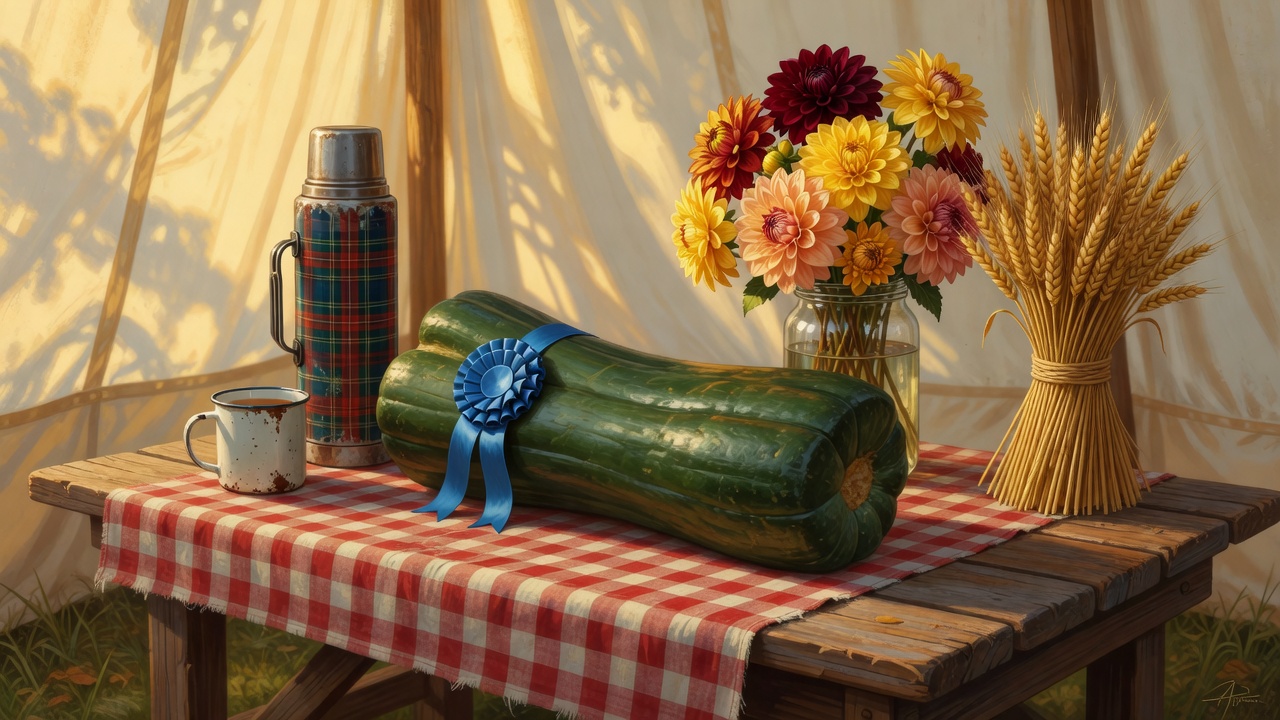
The Prize Marrow
Nettlecombe had buried Walter Crockaway under a record marrow before, in a manner of speaking, every August for nine years; this August it buried him in earnest, and the whole village agreed at once that it must have been Sidney Pyne, because that was the loud answer, and the loud answer is so very restful.
Pearl Tibbets did not agree, but then nobody asked her, on account of her being, in the general estimation, only the sign lady — the small round widow from the workshop on Forge Lane who could bend a length of glass tube over a flame and fill it with gas until it glowed, and who had been put, as she was every harvest fete, in charge of the tea urn, which is a great deal of work and very little glory, and which the parish considered exactly the right size of job for her. She did not mind. A woman behind a tea urn is invisible, and an invisible woman, with the whole green coming to her two at a time for a cup, hears and sees a remarkable amount.
She had lettered the banner herself, the one strung between the two oaks that read NETTLECOMBE HARVEST FETE in her good warm gold, and she had lettered the little card propped against the winning marrow not an hour before, FIRST PRIZE, in the same gold, smaller, because the marrow did not need much help to be noticed. It was a monster. It was the largest marrow Pearl had ever seen, and she had seen Walter Crockaway's marrows for nine straight years, each one larger than the last, green as a bottle and longer than a Christmas turkey, and this one had won him the blue rosette and the silver cup and the right, which he prized above either, to be unbearable about it until next August.
He had been unbearable about it for perhaps eleven minutes. Then he had sat down rather suddenly at the trestle table, with his cup of tea and his rosette pinned to his waistcoat, and gone a strange grey colour, and said that he felt queer, and put a hand to his collar, and slid sideways off the bench onto the grass, quite gently, almost politely, while around him the brass band played on and the bunting snapped in the warm wind and nobody understood for a long moment that anything had happened at all.
It was Della Mott who reached him first, dropping her tray of jam tarts and going down on her knees in the grass beside him, and it was Della who looked up white-faced and said somebody fetch Doctor Aldous, quick, and it was the whole village then that surged in and made a useless crowd, the way villages do, so that by the time Doctor Aldous came puffing across the green from the coconut shy there was very little for him to do but kneel, and feel, and after a while shake his head, and pull Walter's own good jacket up over his face there on the warm grass with the band still playing because no one had thought to tell them to stop.
"His heart," said Doctor Aldous, getting up, brushing the knees of his trousers. "Poor old Walter. Well — he was seventy-one, and built like a beer barrel, and he ate like a thresher, and he never would take his tablets as he was told. I'd warned him a dozen times." He said it kindly, and everyone nodded, because it made sense, and because it was restful, and because the alternative was unthinkable on a green hung with bunting on the best afternoon of the year. His heart. There was no shame in a heart, at seventy-one.
And it might have ended there, going out quietly with the milk, the way Pearl had nearly let another death do once before, except that the village did not let it end there, because the village had a much more interesting idea, and the much more interesting idea was Sidney Pyne.
You could not have grown up in Nettlecombe and not known about Walter Crockaway and Sidney Pyne. They were the two great marrow men of the parish, and they had hated one another with a pure and dedicated hatred for the better part of thirty years, the way only two men can who want exactly the same small thing and can only one of them have it. They had words at every show. They accused each other, annually, of nobbling — of slipping a drop of something into a rival's water butt in the dark of an August night, of measuring with a crooked tape, of bribing the judge with damson gin. Walter had won nine years running. Sidney had not won in nine years, and had said, this very afternoon, loudly, in front of the refreshment tent and at least a dozen witnesses, that Walter Crockaway's monster was a fraud and a swindle and that he, Sidney, would see the truth of it before the day was out if it was the last thing he did.
And then, not twenty minutes after, Walter Crockaway was dead on the grass.
So you could hardly blame the village. By teatime it had made up its mind, the way the village always did, passing the news along with the milk: that Sidney Pyne had finally cracked, after nine years of being beaten, and done for poor Walter at last. Hadn't he threatened him, in front of everyone? Hadn't he gone white with temper when the rosette was pinned? Hadn't he been seen near the trestle table — near Walter's very cup — only minutes before the old man took queer? It hung together beautifully. It was loud and it was scarlet and it had a villain in it, and a villain everybody had disliked for thirty years, which is the most comfortable kind of villain to have.
By the time young Detective Sergeant Okafor came over from Barnstaple — for a sudden death at a public gathering must be looked at, heart or no heart — half the parish was ready to swear that Sidney Pyne had done murder over a vegetable, and Sidney Pyne, who was a hot-headed old fool but not a fool about everything, had taken one look at the way the green was looking at him and gone home and bolted his door.
Pearl kept the urn going through all of it. She made tea for everyone, because a woman with a teapot is invisible and an invisible woman hears a great deal, and what she heard, all that long bright dreadful afternoon, pointed the one way, the way the loud answer always does, straight at Sidney Pyne — and Pearl distrusted it for exactly that reason, because it made too much sense, and a thing that makes too much sense has usually been arranged to.
But she would not have had a single solid thing to set against it, only a feeling, if it had not been for the marrow.
It was the sign-maker in her that caught it, the part of her that had spent forty years matching a curve of glass to a pencil line, that could tell at a glance when a thing was a hair off true, a tube bent two degrees shy, a letter set a whisker low — the eye that does not so much look at a thing as measure it without meaning to. She had lettered the FIRST PRIZE card and propped it against Walter's marrow at half-past two, and she had stood back and thought, as she always thought, good heavens, what a brute, and noted without trying to the great green length of it, the way it dwarfed the trestle, the curl at the stalk end like the prow of a boat.
And at five o'clock, with Walter an hour dead and the green emptying and Doctor Aldous gone and the Sergeant taking down what Sidney Pyne had shouted from a dozen eager mouths, Pearl carried a fresh urn of hot water past the produce table to top up the tea things, and her eye went, without being asked, to the winning marrow still sitting in its place of honour with the blue rosette and the silver cup beside it and her own gold card propped against it — and she went very still inside, the way she did, the way she went still over a faulty transformer, when the fault is suddenly not where you have been looking for it but somewhere quiet you walked past an hour ago without seeing.
Because it was the wrong marrow.
Oh, it was a marrow, and a fine one, green as a bottle, a good two feet of it, the sort of thing that would have won the prize in any year Walter Crockaway hadn't entered. But it was not Walter's marrow. Walter's marrow had dwarfed the trestle; this one merely lay along it. Walter's had had the curl at the stalk like a boat's prow; this one was straight as a rolling pin. She had lettered her card against a monster at half-past two and the card now leaned against a merely large thing, and the difference was a foot if it was an inch, and not one soul on that green had noticed, because not one soul on that green looked at a marrow the way a woman looks who has spent her life setting one true line beside another.
Somebody had taken the prize marrow away and left a smaller one in its place.
Now, Pearl thought, standing there with her urn going cold in her hands and the band packing up behind her, that was a very interesting thing for somebody to do.
For consider it. The whole village was busy hanging poor Walter's death on Sidney Pyne and a thirty-year feud over vegetables — and here, under everyone's nose, while they all looked the loud way, somebody had quietly done the one thing that the feud could not explain. Sidney Pyne wanted, above all things on this earth, to prove that Walter's marrow was a swindle — had said so an hour ago, in front of the tent. If Sidney Pyne had got his hands on that marrow he would not have swapped it for a smaller one and slunk off. He would have hoisted it over his head in front of the parish and split it open to show the iron bar or the water-pumped flesh or whatever fraud he was so sure was inside, and crowed about it till Michaelmas. A swap, a quiet swap, a smaller marrow left to stand in for the great one so that nobody would know the great one was gone — that was not the act of a man who wanted the marrow shown. That was the act of someone who wanted the marrow gone. Who needed it never looked at again.
And there was only one reason Pearl could think of why a winning marrow, a champion's marrow, the most stared-at object on the green, should suddenly need to disappear: because there was something in it, or on it, or about it, that mustn't be found.
She thought of Walter sliding so politely off the bench. His heart, Doctor Aldous had said, and a very good doctor was Doctor Aldous, but a doctor sees what he's given to see, and what he'd been given was a fat old man of seventy-one on a hot day, and a heart is always waiting to be blamed. Pearl had a different picture now. She had the picture of a man dropping dead an hour after his tea, with the one object that had been at the very centre of his triumph quietly spirited away and a smaller one stood in to keep the village from counting. Hearts do not need a marrow swapped to cover them. Poison might.
She did not say any of this to the Sergeant. The Sergeant had only the year before learned to look at her in quite a new way — over a business at the Regal she did not care to think about on a happy day — but learning a thing and remembering it under pressure are two different matters, and just now the Sergeant had a whole green telling him the loud answer with one voice, and a closed door is never opened by knocking. A thing shown is worth ten things said. So Pearl, who had learned long ago the quickest way past a closed door, said nothing, and put the urn down, and went to find Della Mott, and put the kettle on in her head, and listened.
She found Della stacking the last of the trestle tables, slow and heavy, her eyes pink. Della had done the teas with Pearl, as she always did, and the jam tarts, and she had been the one to reach Walter first and go down in the grass beside him, and it had shaken her, you could see it had shaken her badly, which was no wonder in a woman who had buried her own Ron and did not, Pearl knew, find death an easy visitor however gently it came.
"Sit down a minute, my love," said Pearl. "You're done in. I'll do that."
"It's the suddenness," said Della, sitting, gripping a tea towel. "One minute pinning his rosette, pleased as a dog with two tails, and the next — " She shook her head. "And now the whole green saying Sidney did him in. It's not — Pearl, it's not a kind way for a man to go, with everyone saying that the same hour he's dead."
"No," said Pearl. "It isn't." She set two cups, and poured, and pushed one across, because comfort is a thing you can hold, and because a woman with a teacup is easier to talk to. "You were near him, at the end. You'd taken him his tea, hadn't you. I saw you go across with the tray."
"I always do," said Della. "Every year. Walter liked his tea a particular way and the urn never did it right for him, too weak, he always said. So I'd bring him his own from the café, in the flask, the way he liked it — strong, two sugars, drop of milk — and carry it across to wherever he'd got to. He'd come to expect it." She smiled, a small watery smile. "Thirty years I've done Walter's tea. Since before my Ron, even. He was a difficult old so-and-so but he was one of ours."
"That was a kindness," said Pearl gently.
"It was nothing," said Della. "It was only his usual."
And Pearl, who had been about to drink her own tea, set the cup down very quietly in its saucer, and went still again, stiller than before, because there it was, sitting in plain sight the way the worst things do, said out loud and meant kindly and not seen by either of them for what it was for one whole moment.
Walter Crockaway had not drunk the village tea. The village tea came from Pearl's urn, and Pearl's urn had poured for two hundred people that afternoon, and not one of the other hundred and ninety-nine had so much as hiccuped. Walter had drunk his own tea, his usual, strong and two sugars and a drop of milk, carried to him across the whole length of the green in a flask, by the one person in Nettlecombe nobody on God's earth would ever think to suspect — because she had done it for thirty years, because it was a kindness, because it was only his usual.
You did not poison a man's marrow. You could not poison a marrow; it sat in a tent all morning being measured by three judges and stared at by the parish, and you could not get at the inside of a man through the outside of a vegetable. But the marrow had been swapped, all the same, swapped and carried off so that no one would look at it — and Pearl, who had been certain there was poison in the marrow, saw now that she had had it precisely backwards, the way you do when the loud answer has you turned the wrong way round. The marrow was not where the poison was. The marrow was where the misdirection was. The marrow was meant to be looked at, fussed over, suspected, fought over by two old men for thirty years, so that nobody, nobody, would look at the tea.
She thought of the swap again, and now it fit the other way, neat as a tube into its bracket. Somebody had not taken the marrow away because there was poison in the marrow. Somebody had taken the marrow away because the marrow was the thing the whole village would chew over for a week — the fraud, the feud, the swindle, Sidney Pyne's threat made good — and a village busy chewing over a marrow is a village not asking who brought the dead man his tea. The smaller marrow stood in its place so that the swap itself would pass unnoticed for long enough; and the missing monster, when its absence was finally felt, would set the whole green roaring down the loud red road after Sidney Pyne. It was beautifully done. It was done by someone who understood Nettlecombe to its marrow, if she might put it that way, and not unkindly: who knew that the village would always, always, reach for the loud answer, because the loud answer is so restful, and leave the quiet one sitting at the trestle table pouring the tea.
But why. That was the thing that stopped her, the thing that always stopped Pearl and that she would not go past until she had it, because a culprit without a reason is only a guess in a hat, and because she had no taste for hanging anyone, least of all a friend, on cleverness alone. Why would Della Mott, who carried a difficult old man his tea across the green for thirty years out of pure kindness, one August put something in the flask?
She did not ask. She poured more tea, and let the green grow quiet around them, the band gone now, the bunting limp, the last cars pulling away with their tombola prizes, and she let Della talk, because grief likes a listener and the guilty most of all, though Pearl did not yet let herself think the word guilty, only let her friend talk while she turned it gently in her hands, the whole sorry shape of it, looking for the seam.
And it came, the way it does, sideways, in the middle of something else.
"He was good to me once," Della said, into her cup, not really to Pearl. "People forget that. They only ever saw him swaggering about his marrows. But when my Ron was ill — that last winter — it was Walter brought the coal round, never said a word, just left it by the door. And when Ron went, it was Walter sat up with me, that first night, never said hardly anything, just sat. I've never told a soul." She turned the cup. "And then this spring he tells me he's selling the field. The little field behind the café, that runs down to the brook. My Ron's bench is in that field, Pearl. Ron made that bench and we set it under the willow and I go there — I've gone there every week for eleven years. Walter let me. It was a kindness between us, that field, all these years, his coal and my bench and never a word. And this spring he sells it, over my head, to a man who's putting up a barn, and the bench to go, and when I asked him — when I begged him, Pearl, I'm not too proud to say I begged — he laughed. The same laugh he gave Sidney over the marrows. Said business was business and a bench was only a bench and I should have it for firewood with my compliments." Her hands had gone quite still around the cup. "Eleven years I'd gone to that field. And he took it for a barn, and laughed."
There it was. The seam. Pearl saw the whole of it laid out then, quiet and sorrowful and entirely human, and it was not about marrows at all, and it never had been; the marrows were the loud thing, the scarlet thing the village shouted, and underneath was a pearly thing gone wrong, a kindness of thirty years curdled in a single spring by a man who let himself be cruel about the one thing in the world that mattered to a lonely woman, and laughed the way he laughed at everything, because to Walter Crockaway everything was a contest he had already won.
She did not feel triumphant. She never did. She felt only a great tiredness, and a great tenderness, sitting in the wreck of the fete with her oldest friend, knowing what she knew.
"Della," she said, very softly, and put her hand over the still hands round the cup. "What was in the flask?"
Della did not pretend. That was the thing about Della; she had not the lie in her for a long campaign, only the one quiet desperate act and then the long silence after, and now even the silence had run out. She did not look up, but Pearl felt the hands turn under hers and grip them, hard.
"His tablets," Della said, at last, barely a whisper. "The heart ones. He left a box at the café once, months back, and I never gave them back, and — and I read the paper that comes with them, the little folded paper, you know, about not taking too many. I never meant — " She stopped. "I did mean. That's the wickedness of it, Pearl, I'll not lie and say I didn't. I ground them up that morning at the café, all of them, and put them in his usual, strong and two sugars so he'd not taste it, and I carried it across the green to him the same as thirty years, and I watched him drink it pleased as anything with his rosette on, and then I picked up his great marrow when no one was looking and I carried it off to the brook and I sank it, because I knew — I knew the village. I knew if the marrow was gone they'd all go straight at Sidney and never think of the tea. I knew them. I'm one of them." The tears came now, slow and old. "I sank Ron's man's last marrow in the brook so they'd hang it on Sidney. And I'd let them, Pearl. That's the worst of it. I'd have let them take Sidney for it, an innocent man, sooner than lose Ron's field one more time. What am I."
"You're a woman who was very badly hurt," said Pearl, "and did a terrible thing about it, which are two different facts and both of them true." She held the hands a while. "But you'll not let them take Sidney. You know you won't. That's why you've told me — and you knew I'd seen the marrow; you saw me see it." Della nodded, just barely. "I think you've been wanting to be stopped since half-past two."
They sat. The willow over the brook would be turning, Pearl thought, away down behind the café, and Ron's bench under it, and the great marrow sunk in the cold water with its champion dead and his rival bolted indoors and the whole village none the wiser. It was a sorry harvest. But it was the harvest there was.
"I have to fetch the Sergeant," Pearl said gently. "You know that too."
"I know."
"He's a fair young man. He'll listen, if a thing's shown to him plain. And it'll go better, Della, told by you, than dragged out cold. I'll sit with you while you tell it. I'll not leave you." She squeezed the hands. "I sat with you the night your Ron went. I'll not stop now."
She did not, after all, have to argue young Okafor round from very far, which was a mercy, because she found she had no heart that day for the long meek game she had played with him over the Regal. She went and stood at his elbow while he was still taking down Sidney Pyne's threats from a dozen eager mouths, and she waited until he had a gap, and then she said, quietly, that before he settled on Mr Pyne he might care to look at the winning marrow, because it was the wrong one.
He turned to her — and she saw him remember, saw the year before cross his face, saw him decide, not without a small visible sigh, to take the sign lady seriously. "The wrong one how, Mrs Tibbets?"
"It's a foot too short," said Pearl, "and straight where Walter's curled, and I lettered my card against the real one at half-past two and it's gone. Somebody's swapped it and carried the champion off, and I'll tell you why, but you'll want to hear it from somebody who knows better than me, in a minute, when she's ready." She let that sit. "Only mind, Sergeant — the marrow's the loud part. It's meant to be. The whole green's roaring about marrows and feuds and Sidney Pyne, because that's what we do here, we reach for the loud thing. But Walter Crockaway never drank a drop from my urn. He drank his own tea, brought across to him in a flask by a hand nobody in Nettlecombe would think to look at, because it had been a kindness for thirty years. You'll want to ask Doctor Aldous to look again — at the flask, and at Walter, and not at the marrow at all. The marrow's only in the brook to keep your eyes off the tea."
Sergeant Okafor opened his neat little book, and this time he wrote in it, several lines, and then he looked at Pearl Tibbets for a long moment in a way that had nothing of the trembling old lady in it at all.
"You'd best show me," he said.
It went, in the end, much as Pearl had said it would. Doctor Aldous, asked to look again — and a good doctor will always thank you for it, in the end, however it stings — found what an overdose of a man's own heart tablets will leave to be found, once you know to look for it and aren't content with a fat man and a hot day; and Della Mott told it herself, all of it, sitting at the last trestle table with Pearl's hand over hers and her own tea going cold in front of her, told it plain and did not spare herself, the field and the bench and the laugh and the flask and the long cold walk to the brook with a champion marrow in her arms. The Sergeant was decent about it. He was decent because Pearl had shown him the human truth of it first, the field and the bench, so that he came to the wickedness already knowing the wound it grew from; and that, Pearl thought, was the whole of why she had insisted on sitting there, because a thing shown is worth ten things said, and a hurt shown is worth a hundred.
Sidney Pyne, when they told him, did not crow, which surprised the village, who had expected him to. He came out from behind his bolted door and stood on the green a while in the dusk, an old man who had wanted one small thing for thirty years and had it handed to him now by the death of the only man who had ever made it matter, and he found, you could see him find it, that he did not want it any more, not like this. He went and stood by the produce table where the wrong marrow still lay, and after a while he said, to nobody, that it wasn't a bad marrow, that one, whoever'd grown it, and that Walter would have beaten it all the same. Which was, from Sidney Pyne, very nearly a eulogy.
They were gentle, in the end, with Della Mott, the way the village can be gentle when at last it sees a thing whole; gentler than they had been quick to be with Sidney. There was no satisfaction in any of it for Pearl. There rarely was. She thought of Della carrying a difficult old man his tea across the green for thirty years, the realest kindness in the parish, and of the one August she carried him something else, and of the field and the willow and Ron's bench that started all of it; and she thought that the worst crimes in Nettlecombe were so often only the best kindnesses turned in the dark, the pearly things gone scarlet, love with nowhere left to go.
She packed up her urn herself, when the green was empty and the long light lay gold along the grass and the bunting hung still between the oaks. She rolled up the banner she had lettered, NETTLECOMBE HARVEST FETE, careful of the gold, for there would be another fete next August, there always was, the turning year coming round again whatever the parish had done to itself this once. And she took down the little FIRST PRIZE card and looked at it a moment, her own good gold lettering propped all afternoon against a lie, and she did not, after all, throw it away, but folded it into her pocket, because it had been the thing that saw what the whole green had not — a foot too short, and straight where it should curl, the one line in all the bright afternoon that hadn't matched.
Then somebody — she never afterwards knew who — pressed a cup of tea into her hands, the village tea, weak the way Walter had always complained of, from her own cold urn, and said never mind, Pearl, you did all the teas lovely, and went off across the green without the least idea what they had said or to whom; and Pearl Tibbets, the sign lady, stood in the last of the gold light with her tea she had not had to make, and let them all not notice her, and was, in her quiet sorrowful way, content.
Enjoyed this story?
Read next
 Nettlecombe had not had a murder in living memory, which was precisely the trouble, because it meant that when one finally arrived nobody recognised it, and they very nearly let it go out with the milk.
Lights Out at the Regal
 A torch singer hired me to find her kid sister, and I found her, which is the part of this work nobody warns you can be the cruelest thing you do all year.
The Number That Was Never Called
 There were nine setters at the centenary table, and only one of them could have written the last clue in the dead man's grid — because only one of them already knew how the evening would end.