
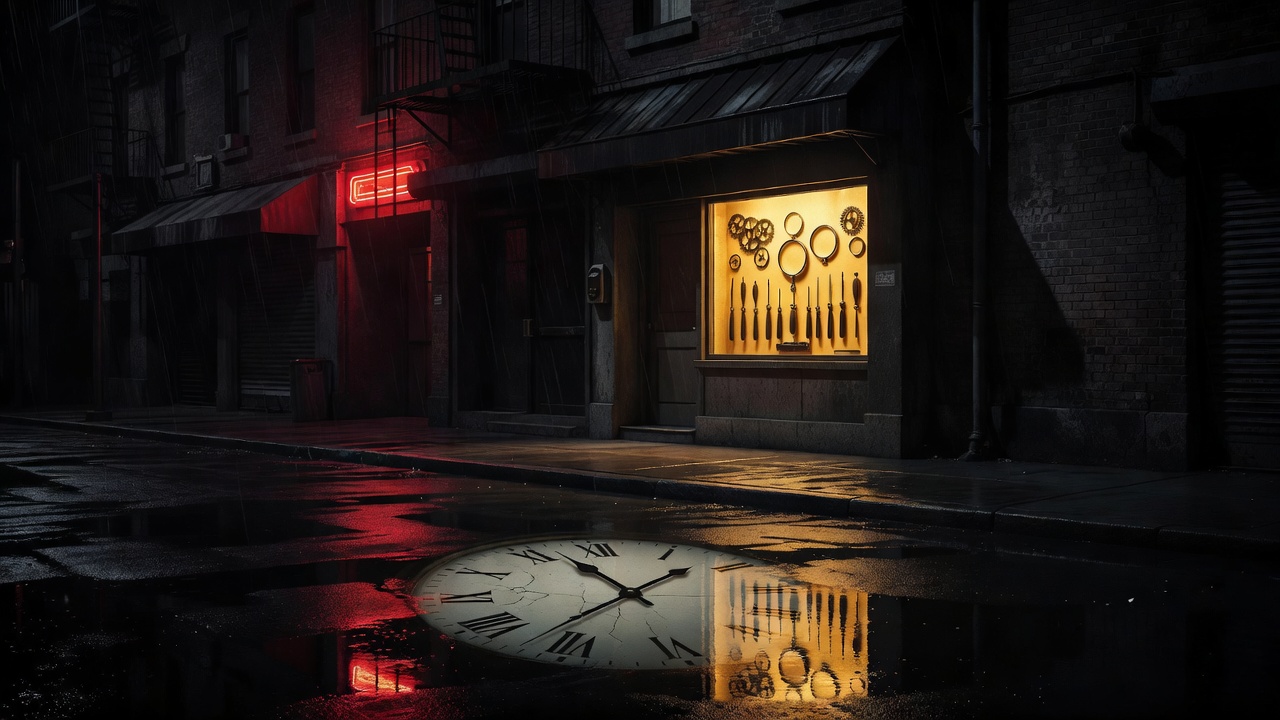
The Hour I Didn't Have
Content notes
violence, murder
12:51 a.m.
The clocks in Halloran's shop had all stopped at ten to twelve, which made them right twice a day and right about one thing forever, and I stood among them at ten to one being wrong about everything.
He'd hung them on every inch of wall, the old man — railway regulators and carriage clocks and a hundred wristwatches under glass, the whole room a held breath of brass and tick. Now nothing ticked. It's a particular quiet, a watchmaker's shop gone silent. Like walking into a chest that has decided to stop.
I won't tell you what they'd done to the place, or to him, because it wasn't the kind of thing you describe to strangers and it wasn't the kind of thing I'll ever stop describing to myself. He was behind the counter where he always was. The back room, where he'd hidden her, was open and empty, the cot still warm enough to lie to me about how long ago.
On the counter, set down neat in the wreck of everything, was a wristwatch. A man's watch, cheap, the crystal starred where it had met something harder than itself, the hands stopped at 9:14. Not ten to twelve like the others. 9:14. I knew that watch. I'd been chasing that watch for sixteen hours and I'd found it the way you always find the thing in this town — one room too late, with the lamp still swinging.
I put it in my pocket. It was evidence of a murder that no court in this city would ever hear, and it was the only thing in the room that was still mine to take, and a man holds on to what's left. I'd come to save a girl and a watch. I was an hour early for the watch.
You want to know how a man gets to be an hour late. Sit down. It only takes an hour. I had one once. I gave it away cheap.
11:55 p.m.
The bridge was up.
There's a draw bridge between the good part of the city and the part where people actually live, and it goes up for the gravel barges that move the city's secrets around at night, and it had gone up for me, personally, I was sure of it, the way you get sure of things when you've got nothing left to be sure of. I sat with the engine running and the rain coming down like the sky had finally decided to be honest about how it felt, and I watched a barge full of nothing important take its sweet time over water that didn't care, and I did the arithmetic.
The arithmetic was simple. The pickup was midnight; I'd promised her midnight. It was eleven fifty-five, and between me and a girl who'd been told to trust me was a river the city had lifted out of the way on purpose, and the only thing I'd accomplished with the hour I'd just spent was to keep my hands clean.
There's a thing they tell you, the older men, the ones who lasted. They say the city doesn't kill you. It just keeps you talking until the killing's done somewhere else. I'd always thought that was the kind of thing a man says to sound like he's been somewhere. Sitting at that bridge I understood it was a weather report.
When the span finally came down I drove across it like I meant to keep going off the far end, and the rain ran up the windshield instead of down, and I told the girl I'd never met that I was coming, out loud, like an idiot, like prayer for people who've forgotten the words and only kept the tune.
I was wrong, of course. You already know I was wrong. You've seen the clocks.
10:40 p.m.
Sokol bought me a drink I didn't touch in a bar that didn't have a name because the people who needed to find it already knew where it was.
He was the kind of man the city grows when it wants something done without doing it itself — soft hands, good coat, a face you'd forget on purpose. He worked for Councilman Verrick the way the wallpaper works for the wall. He'd been waiting for me, which told me I'd been making noise in the right place, which is the only good news a man in my work ever gets, and it always comes too expensive.
"You've had a busy day, Mr. Mercer," he said. "Asking after the Halloran girl. A typist. Why would a typist need a man like you?"
"I like to know where everybody is at all times," I said. "It's a hobby. Stamps got expensive."
He smiled the way a drawer slides shut. He laid an envelope on the table, fat as a guilty conscience, and beside it he laid a second thing, smaller, and the second thing was the one with the teeth. It was a photograph of my office door. Just the door. The number on the glass.
"There's a number in the envelope and a number on the door," Sokol said. "The councilman is a believer in round numbers. The girl took something that isn't hers — a watch, of all the foolish things, a dead man's watch — and she's gone to ground, and you have spent the day getting warm. So. The address, Mr. Mercer, or the assurance you don't have it. Either one buys the envelope. Both buy you a long quiet life, which I'm told is the only kind worth having."
I want to tell you I didn't think about it. That would be a nicer story and I'm not in the business of those. I thought about it. The envelope was a year of rent and the door was the rest of my life and the girl was a stranger who'd been stupid enough to keep a piece of evidence in a town that melts evidence down for the silver. I thought about it for as long as it takes a good watch to tick once.
Then I did the arithmetic wrong, on purpose, the only honest math there is.
"I don't have the address," I said, which was a lie, and "I wouldn't sell it to you if I did," which wasn't, "and you can tell the councilman his door photographs better than mine."
It is a fine thing, refusing the devil. It is a fine, warm, expensive thing, and it took the better part of an hour I have spent every night since trying to give back. Because while I was being a man worth writing about, somebody else was being given an address by somebody cheaper, and the difference between him and me was that he didn't stop to feel good about himself first. Virtue is slow. That's the part they leave out. Virtue stops to make a speech, and the speech costs an hour, and the hour costs a girl.
I left him the envelope and the photograph and the drink. I kept the only thing I came in with. For all the good it did anybody, I kept it.
8:15 p.m.
Before that — before the bar, before the bridge, before the warm cot and the cold counter — there was the part where I was good at my job, which is the part nobody pays for and the part that gets people killed.
Dooley took his supper in the same chop-house booth every night of his life, with the same view of the courthouse he'd spent forty years calling a liar in print. He was the last newspaperman in the city who remembered things on purpose, which made him either the bravest man I knew or the one with the least left to lose, and in this town those come to the same address. I bought him a plate of the gray meat he liked and let him finish it before I asked, because Dooley gave away what he knew the way the church gives away forgiveness — slow, and only after you'd suffered a little for it.
"Costa," I said, when the plate was clean. "In the river back in March. The inquest called it an accident."
He set down his fork like it had gone heavy. "There's a name I've been paid twice not to print. Once by the front office and once by my own good sense. Both checks cleared." He looked at me the way old men look at young trouble. "Costa kept Verrick's books, back before he caught a conscience and a downtown appointment to use it. He never made the appointment. He made the river instead, overcoat full of the dock."
"And the councilman was at a dinner."
"The councilman was at a benefit for crippled children that night, from ten o'clock to the small hours, under a chandelier, in front of two hundred of the finest people money can rent. Seating chart entered into evidence. And the inquest, bless its tidy heart, put poor Costa in the river somewhere near eleven — a slip, an accident, while the councilman was busy being seen. There has never been a man so beautifully somewhere else." He sipped his coffee. "Print it and they bury you in the column beside the man you printed it about."
I let the rain do the talking against the window for a while, then I gave him the one thing he didn't have, because that's the toll with Dooley, a fact for a fact. "Costa wore a watch."
The old engine turned over behind his eyes. "Careful men do."
"A man who goes in fighting takes it with him. And a watch that catches a hard one on the way under stops — stops and stays stopped, at the exact unforgiving minute, forever." I turned my cup a half turn on its saucer, as if that helped anything. "Costa's stopped at nine-fourteen. Not eleven, like the inquest wanted. A quarter past nine — a full hour before the councilman's perfect, witnessed evening even began, back when there wasn't a soul alive who could swear where Verrick was."
Dooley went quiet the way a man goes quiet when you hand him the thing he's wanted and he finally counts what it'll cost to hold. "A watch can't be cross-examined," he said softly. "Can't be bought. Won't change its story when the lawyer leans on it. It just keeps saying nine-fourteen." He almost smiled. "If somebody can swear it wasn't doctored."
"Somebody who knows the inside of a watch the way you know the inside of a city."
And there it was, landing in my chest — the part that turned my morning's frightened typist into a dead woman who didn't know it yet. The thing Lena Halloran had "come by," the thing she wouldn't surrender and had run to her estranged father to keep safe — it wasn't papers. It was Costa's watch. She'd squared Verrick's books long enough to understand what nine-fourteen meant, and she'd lifted the watch out of a property envelope it should never have outlived, and carried it to the one man in the city who could stand in a courtroom and swear a stopped watch tells the truth its owner no longer can. Her father. The watchmaker she hadn't spoken to in six years.
"There was a typist down at the property clerk's a while back," Dooley said, half to himself. "Asking after a drowned man's effects. Then she stopped coming to work." He looked up, and for once there was no price on his face, only the tiredness. "Whatever you mean to do for that girl, son, you'd best not waste the night doing it."
A watch is only a machine for agreeing with the sun; old Halloran told me so that morning, proud of it. It keeps no opinion. Costa's had seen the true minute of a murder and frozen with its hand up — nine-fourteen — the most honest witness in a city that had run every honest witness it ever had into the same cold river. I knew what she had, and what it could do, and exactly what it was worth to men who'd already killed once to keep an evening tidy. Knowing is the job. Knowing is also the thing that starts the second clock, the one you can't see, already running down somewhere across the water while you sit in a warm booth feeling clever and a girl you've never met gets closer to the minute that stops her too.
2:00 p.m.
Her voice on the shop's back line was nothing like the photograph on my desk, which is the only true thing photographs ever tell you.
Her father had given me the number and an hour to call it, and she picked up on the first ring the way people do when the telephone is the only door they'll still open. No hello. Just breathing, and then: "You're the honest one. Pop bet the rent on it."
"I get that a lot. It's load-bearing."
"He says you don't stay bought." A pause, the line humming between us like a held note. "Everybody in this city stays bought. It's the one thing it's really good at."
"I'm a disappointment to the local economy. It's mutual."
The ghost of something almost came down the wire — not a laugh, she'd spent her laughs — but the place where one used to be. Then it was gone. "They want the thing I've got," she said. "You know what it is?"
"I know what it cost the last man who had it. And I don't say the rest on a telephone, and neither should you."
"Smart." Her voice dropped, steadier than mine would have been in her chair. "It doesn't leave my hands for anyone under a judge. Pop can swear it's true — he's the one man in this town they can't make lie about the inside of a watch. That's worth my life to them, and it's worth my life to me, and I'd thank you not to pretend those are different numbers."
I've met a lot of brave people in this work. Heard a lot of them, anyway. Most are brave because they haven't done the arithmetic. She'd done the arithmetic. She knew to the penny what she was worth and she'd decided to spend it on the truth, which is the most expensive thing there is and the only thing the city can't counterfeit, and sitting there with the receiver going slick in my hand I felt the particular shame of a man about to ask someone braver than himself to please, for the love of God, be a little less.
"Then hear me," I said. "You don't move, you don't open the door, you don't so much as lift the blind, till I come. Midnight. I'll have a car and money and a road out of this city — you and the old man both — and tomorrow that watch tells its story somewhere they can't buy the bench. Midnight. Give me till midnight."
The line hummed while she hunted the lie in it, the way her father hunts the flaw in a movement, and whatever she didn't find she decided to spend the last of her trust on — a thing I'll answer for someday, to somebody with better standing than a city judge.
"Midnight," she said. "Don't be late, honest man. Late's the only thing in this town that comes free." And the line went dead, the way they all do, the way hers would stay.
I never did get to meet her. You hold on to what's left, and what she left me was a voice on a wire, telling me not to be late.
9:10 a.m.
It started, the way the worst of it always starts, with a knock so soft I almost didn't hear it over the radiator.
He came in out of the morning with rain on his hat and a cardboard box held against his chest like a man carrying something that might still be alive. Old, neat, a watchmaker's stoop and a watchmaker's hands, the fingers that have spent a life being gentler than the world deserves. He set the box on my desk and didn't sit, because men like him don't sit in places like mine until they're asked, and I didn't ask quickly enough, and I've thought about that too.
"They told me," he said, "you were honest." He said it like a symptom. "Down at the union hall. They said there's one left and he's not cheap and he doesn't stay bought. I don't have much. I have this." He opened the box. Inside, in a nest of shop cloth, folded small, was a photograph of a young woman who had her father's serious eyes and none of his caution. "My daughter's in trouble with the people who run this city, Mr. Mercer. She came by something — a dead man's watch, stopped at a time a powerful man would kill to keep buried — and she won't give it up, and God help me I won't ask her to. She's frightened, and she's hidden in the back of my own shop, and she'll only stay hidden so long. I need a man to get her out of this city before they find her. I can pay you in time. I can fix anything that keeps time, for the rest of my life, for free. It's all I've got that's worth anything."
Outside the rain kept its appointment. I should have told him no. The honest thing, the kind thing, the thing that would have left them both breathing, would have been to tell an old man that there is no one honest left, that the union hall was wrong, that he should take his daughter and his box of clean machines and his terrible faith in a stranger and run for a smaller, dirtier, kinder town. That's what a man who'd lasted would have said.
But he was looking at me the way you look at the last lit window on a dark street, and I have a weakness, the one they don't make a coat thick enough to cover: I believe the window means somebody's home.
So I poured the old man a coffee he was too polite to refuse, and I picked up his daughter's photograph, and I told him the only lie that ever costs more than the truth.
"All right," I said. "I've got time."
Enjoyed this story?
Read next
 A torch singer hired me to find her kid sister, and I found her, which is the part of this work nobody warns you can be the cruelest thing you do all year.
The Number That Was Never Called
 There were nine setters at the centenary table, and only one of them could have written the last clue in the dead man's grid — because only one of them already knew how the evening would end.
The Clue That Cut the Thread
 A developer's scaffold went up over a dead neon sign at the wrong end of our own street, and my wife of one-and-forty years climbed it at ten past seven in the morning with two flasks of tea and would not come down; and because a man cannot defend his own wife, the finest advocate of his generation sat at the back of a magistrates' court with his hands in his lap and no standing to say a single word, and there learned — at the same moment as the bench, the usher, and a bored young man from the Crown — what she had been quietly paying for since the year before we met.