
The Stilling of the Saint Wend
Content notes
death, grief, mass casualty (off-page)
There were forty-one habitable worlds left in the Reach, and the Empress had erased one of them before the people sailing toward it ever woke.
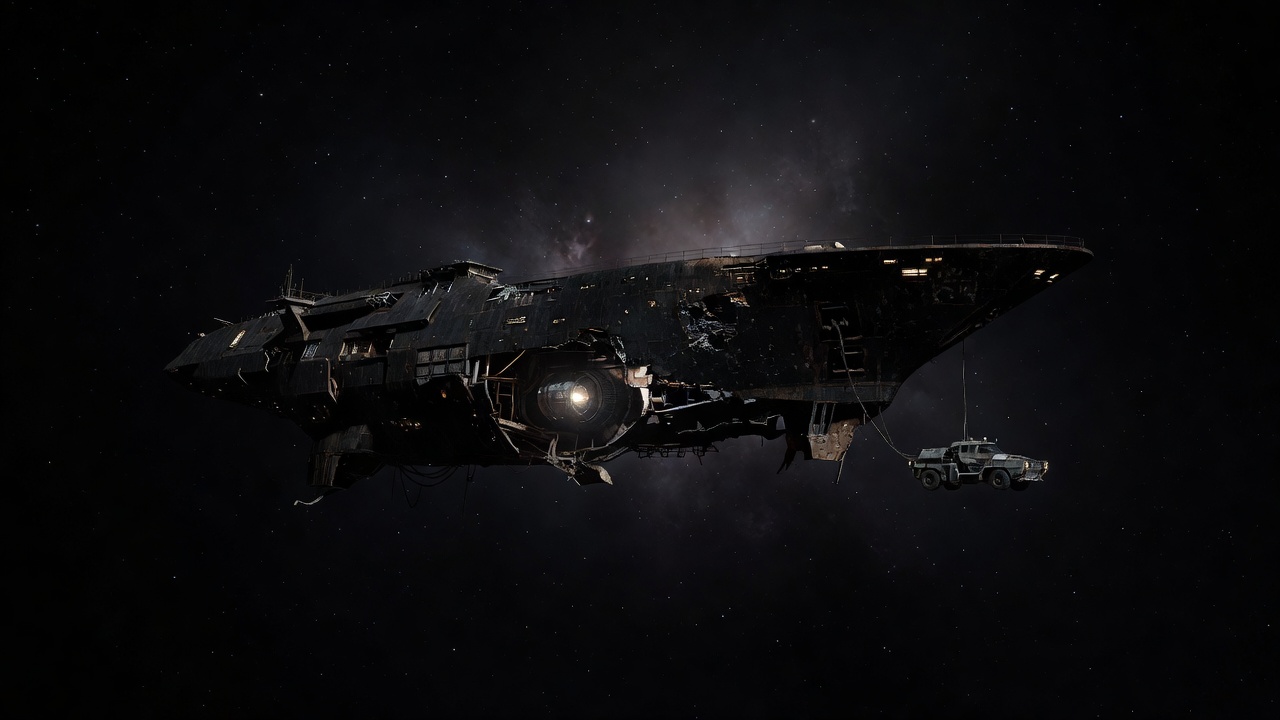
Sefa Brae did not know that yet. What she knew, hanging in the open dark with her boots magnetized to the flank of a dead ship, was that the Saint Wend was enormous, and quiet, and wrong.
"She's beautiful," Bran said over the line, which was the kind of thing Bran said. The big rigger was forty meters up the hull, a bright orange smudge against three kilometers of cold grey colony transport. "Old Meridian build. They don't make a keel like that anymore. They don't make anything like that anymore."
"They don't make anything like that anymore because everyone who could is dead or working for the Crown," Sefa said.
"You're a ray of sun, Brae."
"I'm a professional." She walked another two steps along the hull, each footfall a soft thud she felt in her teeth, and looked down the long curve of the Saint Wend toward where it broke. The break was clean. That was the first wrong thing. A ship killed by a meteor swarm — which was what the Crown's loss-register said had killed this one, six years and six hundred souls ago — did not break clean. It came apart in a chewed, ragged ruin, hull plate peeled like fruit skin, a thousand small punctures starred across the prow. The Saint Wend had one wound, amidships, surgical and total, as though something very large and very patient had simply decided where she would end.
"Odell," Sefa said. "How sure are we about the swarm?"
The captain's voice came up from the Deadlight, tethered a hundred meters off their stern like a tug beside a cathedral. "Sure as the register. Why?"
"Because the register's lying."
A pause. In the pause Sefa could hear Imo somewhere behind Odell, the kid's voice pitched up — told you, told you it'd be weird, it's always weird — and Odell telling her to mind the proximity board.
"Talk to me on the way in, not on the hull," Odell said. "Bran, cut us a door."
The Saint Wend let them in like she'd been waiting.
That was the feeling Sefa couldn't shake, drifting down the dead transport's spine with her wrist-lamp throwing a cone of pale light ahead of her and swallowing it again. The corridors were intact. Not pristine — six years of cold and slow vacuum had frosted every surface with a fur of crystallized air, and where the gravity had failed the loose things had risen, a soft frozen snowfall of cups and styluses and a child's shoe turning slowly in the beam — but intact. Nothing was scorched. Nothing was holed. A ship that died screaming did not look like this. This looked like a house whose people had gone out and simply never come back.
"Six hundred," Bran said quietly, behind her. He had stopped being chatty. "Cryo manifest said six hundred and four. Colonists. They were going out to — where were they going out to?"
"Halgren's Reach," Imo's voice said over the line, reading off the Deadlight's register. "Edge world. Agricultural charter. It's not — huh."
"What's 'huh,'" Odell said.
"It's not on the current chart. Halgren's Reach. I've got the old charter route but the destination's just — it's not there. Like the system got pulled."
"Systems don't get pulled, Imo."
"I'm telling you what the board's telling me."
Sefa stopped walking. Up ahead the corridor opened into the dark throat of the drive-bay, and from it came the only warmth in the whole dead ship: the faint, faint ember-glow of a core that had not entirely died. Six years, and the Saint Wend's heart still held a coal of itself. That was wrong too, and it was the kind of wrong that was hers.
"I've got the core," she said. "It's still warm. Bran, I want the cradle rigged before I read it. Odell — whatever the buyer thinks they're getting, tell them it's going to be a long read."
"Sefa." Odell's voice had gone careful. "We're getting paid to pull a core and re-tune it for resale. We are not getting paid to read it."
"I know."
"Then why are you going to read it."
Sefa looked at the ember-glow, the slow dim pulse of it, like something asleep that did not know it had died. "Because she broke clean," she said. "And clean is a decision. Somebody decided where this ship would end, and the only place that decision is written down is in there." She pulled herself toward the drive-bay, toward the warmth. "And because six hundred and four people went to sleep expecting to wake up somewhere, and somewhere isn't on the map anymore, and I want to know who took it off."
The line was quiet a moment.
"You always do this," Odell said, but there was no heat in it. There was something more tired than heat. "All right. Read her. But Sefa — if it's the Crown, we pull the core, we re-tune it, we sell it, and we forget her name. We are very small, and they are very large, and I have a kid aboard."
"I know what we are," Sefa said, and went in to read the dead.
A drive-core remembered everything.
That was the thing the Guild taught you first, before they taught you to fear it. People thought a resonant core was just an engine — the singing heart that bent space to the long note and carried a ship between the stars — and it was that. But every note it ever held left a wear in it, the way a stair wears under feet, the way a wedding ring wears thin on the side that faces the next finger. A core wore to the shape of its life. Every burn, every emergency stop, every long patient cruise, every panicked overdrive — it all went into the lattice as a kind of grain, and if you had the hands and the years and the ruined nerves to feel it, you could lay your palms on a dead ship's heart and read its whole crewed history like a blind woman reading a face she used to love.
Sefa had the hands. The Guild had given her that and then taken back everything else.
She settled into the reading-cradle Bran had bolted to the deck and let her gloves retract, baring her palms to the cold. This was the part that always frightened the others — the reader going bare-handed against a thing that could still, even half-dead, sing the flesh off a careless hand. She didn't explain it to them anymore. You couldn't read a core through a glove any more than you could read a lover's pulse through a wall.
She laid her hands on the Saint Wend's heart.
And the ship was alive.
Not now — six years ago, in the wear, in the grain, the way a photograph is alive. Sefa felt the long smooth cruise of her first leg out from the inner worlds, a fat happy hum of a core well-tended and lightly worked, six hundred sleepers stacked in the cold and a skeleton crew awake to mind them. She felt the daily small adjustments of a careful chief engineer, a woman — you could feel a hand the way you could feel handwriting — a woman who loved this engine, who babied it, who ran it lean and clean and proud. She felt the ship's name in the wear the way you feel a name spoken often: the Saint Wend, the Saint Wend, a transport full of farmers going out to make a world green.
It was beautiful. It was the most beautiful read she'd had in years, a whole healthy ship's life laid open under her hands, and for a moment Sefa forgot that everyone in the read was dead.
Then she felt the long note change.
"Talk to me," Odell said softly. They were all on the line now — she could feel them listening, the whole crew gone still around her like people around a sickbed.
"She was healthy," Sefa said. Her voice came out distant; part of her was six years away. "Beautifully kept. The chief loved this engine. They were forty days out, cruising easy, everyone asleep but the watch." She breathed. "Then there's a — message. I can't read words in the wear, you understand. I read what the ship did. And what the ship did, on day forty-one, is it cut the long note and stopped."
"Stopped," Bran repeated.
"Killed her forward burn cold. Full stop, dead in the deep, between stars, still pointed the way she'd been going." Sefa's brow creased under the bare lamp. "You don't do that. There's nothing out there. You don't stop a colony run in the empty unless someone tells you the place you're running to isn't worth running to anymore — and even then you'd keep your nose pointed at it, hoping, while you wait to hear different."
"Unless where you were going stopped being there," Imo said quietly.
The drive-bay was very cold and very quiet. Somewhere in the frozen corridor behind them the child's shoe was still turning, slow, in the dark.
"Keep reading," Odell said.
Sefa pressed deeper into the wear, past the turn, into the days that came after, and this was the part the Guild had warned her about — the part where a read stopped being history and started being witness. Because the Saint Wend did not die when she stopped. She sat. She sat in the dark between the stars for nine days, and Sefa felt every one of them in the grain: the chief engineer keeping the core warm and idling, holding the ship's heart at a low patient hum, waiting. Waiting for what? A message. A reroute. A new world to point the farmers at. Somewhere in those nine days a woman had stood in this bay with her hand on this engine, exactly where Sefa's hand was now, and waited for the Crown to tell her where six hundred sleepers should go now that the place they'd been promised had been taken off the map.
The waiting was not clean, though. That was the second wrong thing, and Sefa kept her hands on it longer than she meant to. A patient idle had a smooth grain, hour folded on identical hour. This idle frayed. By the seventh day it was carrying the small ragged scorings of a core worked at the edges — a query pinged out and held open, an answer that did not come, the engine flexed to listen and flexed again, the way you keep checking a door for a knock that hasn't happened. Whatever the chief was waiting for, she was no longer sure it was coming.
"Imo," Sefa said. "Halgren's Reach. When did it come off the chart?"
A pause full of keystrokes. Then, in a small voice: "The decommission order's dated forty-three days after the Saint Wend launched. 'Consolidation of unviable charter worlds.' They — Sefa, they pulled the funding and the patrol and the supply line. The colony that was already there. The world didn't blow up. They just stopped sending ships. They left it to — " Imo stopped. "They erased it. While these people were asleep, flying toward it, they erased the place they were going to live."
"The cost of the crown," Sefa murmured, an old phrase, a Verge phrase, the kind of thing her mother used to say.
"What?"
"Something my mother said. The crown costs. It just doesn't pay." She moved her hands a centimeter, finding the ninth day, finding where the waiting ended. "And here's where it ends. Something happens on the ninth day. The waiting just — stops."
"Stops how," Odell said.
Sefa followed it into the ninth day, and went cold in a way the dead ship had nothing to do with.
"Something reaches her," Sefa said. "Day nine. A message comes in — I feel the core flex to take a tight-beam, then go quiet. After that the waiting stops." She frowned, hunting the grain. "I can't read what it said. I keep telling you that and you keep wanting me to and I can't. I read what the ship did, not what the woman was told."
"So what did the ship do," Odell said.
"It came about." Sefa moved her hands, following. "She brings the nose around. Off the heading she'd held for fifty days, around toward the inner worlds. Toward home."
"Home's good," Bran said. "Home's — that's good, right?"
"No." Sefa's hands had begun, very slightly, to shake against the cold lattice. "Listen. Six hundred and four sleepers. A skeleton crew. A transport built for a one-way colony run — they don't carry the supply for a round trip, they were never meant to come back, they were meant to arrive. Turning home is turning to fly nine months on three months of supply, with six hundred mouths in the cold that have to be fed the moment you wake them, to a Crown that has just demonstrated it would rather erase a world than feed it." She swallowed. "Home isn't mercy. Home is six hundred farmers waking up halfway across the dark to starve slowly in a metal room while the watch crew decides which of them to space first to make the air last."
Nobody said anything.
"And she knew it," Sefa said. "I can feel her know it. The turn doesn't finish. She brings the nose part way around and then — " Sefa's hands stopped. "Then the grain goes to a thing I've only read once, in a Guild archive, in a ship they kept to teach us what not to do."
"What thing," said Odell.
Sefa didn't answer in words. She closed her eyes and went down into it, and let it have her.
The descent came up through her palms like cold water rising. She felt the long note bend downward, the great singing field of the core easing off its pitch — and the ship's warmth going with it, degree by degree, the cryo-holds sliding the last small distance from sleep into the deeper cold that has no morning. Six hundred bodies cooling under her hands and not one of them stirring. That was the whole horror of it: nothing struggled. It was the gentlest thing she had ever felt a ship do. Somewhere far down she could feel the chief engineer holding the note steady, one woman keeping six hundred people asleep while she walked them across the last few degrees by hand, and Sefa's own breath went ragged in the bay, six years late, in time with a descent that had already happened.
"It's the oldest mercy a core-engineer has," she said, when she could. "You sing the engine down — not off, down — and the field goes with it, very gentle, and the holds drop the last few degrees from sleep into stop. The sleepers never surface. They're already cold. You just let them go a little colder."
"On purpose," Bran said.
"On purpose. With her own two hands, awake and alone in the bay, feeling every degree." Sefa's eyes were still shut. "The Saint Wend didn't break, Odell. She wasn't killed. Her chief stilled her — put six hundred souls to sleep that they'd never wake, because the Crown took away the only place they had to wake up to."
She stopped. Her hands had gone still on the lattice. Because the grain under them was telling her something she did not want, and would not say yet, and could not stop reading.
The still was wrong.
Not wrong like the broken hull. Wrong like a thing done by a hand that wasn't sure. The descent she'd been taught — the textbook still, the one mercy the Guild let itself remember — ran nine hours, smooth as a held breath let out slow. This one ran four, and it juddered. Twice the note caught and started back up before it sank again, as if the woman at the engine had reached for the way back and then made herself let go. Near the end the field dropped faster than any hand should let it, a steep cold plunge that no archive would ever call gentle.
A mercy and a panic wore the same shape in the grain. That was the thing the Guild never told you, because the Guild dealt in clean cases. A long calm descent was a captain who had decided. A fast ragged one was a captain who had broken — who could not face waking six hundred farmers to tell them there was nowhere to go, and so put them past asking, fast, before her own nerve turned her around. Sefa could feel both women in the same nine — four — hours. The one who chose, and the one who couldn't bear to. And the wear would not tell her which.
"And then?" Imo whispered.
"And then the last thing. The clean break, amidships — you asked why she broke clean." Sefa's voice was barely there. "After the still, the grain shows the containment overloaded in one charge. One cut, surgical, total, made to look like the swarm the Crown was already going to blame." She drew a slow breath. "Six hundred peaceful sleepers and a chief dead at her post — that puts itself together too easily, for anyone who came looking. So she didn't leave it. She gave the Crown its lie and she went into it with them."
The ember-glow pulsed, slow, in the dark. Sefa took her hands off the core. They had stopped shaking. They were just cold now, and old.
"And I can't tell you why," she said. "That's the part I'd cut out of myself if I could. A woman who chose this and a woman who couldn't bear to wake them would both have wanted it read as a swarm — one to spare them, one to spare herself." A small, broken sound that wasn't quite a laugh. "She left the one thing only a reader could feel. She never imagined the Guild had thrown one of us out this far. And it doesn't even tell me the thing I'd give a hand to know."
They got her out of the cradle. Bran lifted her under the arms like she weighed nothing — she nearly did, after a read like that — and held her a moment longer than rigging required, his big helmet bent down to hers.
"You all right," he said. Not a question. A thing you say.
"No," Sefa said, which was the honest answer and the one he'd wanted.
On the Deadlight, in the galley that was the warmest crowded loud little room in all the cold Reach, they sat. Odell had made tea, which was what Odell did with his hands when his head couldn't carry the thing it was carrying. Imo had her knees up to her chest in the corner where she sat when she was small again, when the lost homeworld got close. Bran filled a third of the galley just by being in it.
"We sell the core," Odell said. It wasn't a decision. It was the thing they were paid for. "We re-tune it, we pull the still out of the grain — I can't, but you can — and we sell it clean, and the buyer puts it in some freighter and never knows."
"We could tell someone," Imo said. "The whole Verge. Everyone. Show them what the Crown does. Six hundred people. You could prove it, Sefa — you read it — "
"I can't prove anything," Sefa said gently. "A read isn't evidence. It's a feeling in a pair of ruined hands the Guild says don't work anymore. The moment I say I read a stilling, I'm an unlicensed reader who walked off the Guild, telling a ghost story about an Empress, with no chart and no body and no log, because she erased all three." She wrapped her hands around the tea Odell pushed at her, and didn't drink. "And I'd be telling it without knowing the end of it myself. You heard me in the bay. I don't know if she chose or if she broke. I will never know. The wear holds both and I can't make it pick."
"So she dies a murderer," Imo said, and her voice cracked. "In the register. Forever. 'Lost to a swarm.' Nobody ever knows she — that she—"
"That she loved them, or that she panicked, or — God, Imo, both, probably both, a person can be both at once with her hand on the note." Sefa looked at the tea. "That's what nobody knows. Not even me."
"Then say she chose." Imo's chin came up. "If you can't tell — if the wear won't say — then say she chose."
The galley went still. It landed in Sefa like a hand on a bruise, because the girl had walked straight to the thing she'd been circling all the way home. A read isn't evidence. A read isn't even an answer. It was only the whole weight of a woman, handed to whoever had the hands to lift it — and the lifting was a choosing.
"That's not fair to her," Sefa said quietly. "Deciding what she was. She doesn't get a say."
"It's not fair either way," Imo said. "The register already decided. It says swarm. It says nobody. At least we'd be deciding toward her." She scrubbed at her face, furious, fifteen and grieving a world of her own. "You don't just hold the last of someone in your two hands and then drink tea and sell the engine and let the register be the only thing that ever called her anything."
The galley was quiet. The Deadlight hummed her small healthy hum around them, the warm low note of a ship that was very much alive, tethered to a dead one in the dark.
And Sefa Brae, who had been thrown out of the Guild for reading things they had told her to leave unread, set down her tea.
"No," she said. "You don't."
Here is what they did, the bickering crew of the salvage tug Deadlight, on the edge of an empire that did not know their names.
They pulled the core, and Sefa read the still out of the grain — every ragged hour of it, the catch and the steep cold plunge and all — and she did not erase it. She copied it, laid the wear into a blank lattice of her own, the way a Guild reader could, a thing the Guild had a law against and a name for and had thrown her out partly for being too good at. She made a true copy of the Saint Wend's heart: the whole healthy beautiful life of her, and the turn, and the wait that frayed, and the four hours nobody could name, exactly as they were and no cleaner. The doubt went into the copy with everything else. She would not fix the dead woman into a saint to make the carrying easier.
Then she re-tuned the original clean, and they sold it, and it went into a freighter and sang the long note across the Verge for thirty more years and nobody aboard ever knew.
And the copy, the true heart, the one that remembered — Sefa kept that. She put it in the reading-cradle on the Deadlight where she sat her own watches, and now and then, on the long quiet legs between the stars, she would lay her bare hands on it and read the chief engineer's name out of the grain, the name no register would ever carry right, and she would say it out loud in the warm loud galley. Not because she knew what the woman had been. Because no one else would ever say it at all.
"Captain Wensleigh Marr," Sefa said the first time, her hands on the dead chief's last work. "Of the Saint Wend. Six hundred and four souls. She brought them home the only way home was left." It was a thing she'd decided to believe, with no proof, against a register and an empire and the silence of the grain itself. She'd weighed it on the long way back and she'd weigh it again, every watch, for the rest of her life. That was the cost, and she paid it on purpose: to call a woman the kindest name the evidence would bear, knowing the evidence would never bear it out.
"Captain Wensleigh Marr," said Odell.
"Captain Wensleigh Marr," said Bran.
Imo said it last, and she said it like a vow, like a thing she would carry a long time, out past forty-one worlds and whatever the Crown left of them.
The Empress had burned a world before the people sailing toward it ever woke, and the register said a swarm did it, and the register would go on saying so, because the truth had no chart and no body and no log and only one pair of ruined hands to hold it — and even those hands could not say the whole of it.
But what could be held was held, and what couldn't was carried anyway.
The Deadlight sang her small bright note and turned for the next wreck, the next dead ship, the next official story waiting to be read against its grain. There were forty-one worlds left in the Reach, and somewhere a great cold engine was making a list of which ones were unviable, and out here on the frayed edge of all of it a tug full of salvors and one cast-out reader went looking, again, for the names that no one else would say back.
Enjoyed this story?
Read next
 A nineteen-year-old Cobb is caught with the dock-workers' burial fund and will not say one word in his own defence — and the silence everyone has read as guilt is in fact the only act of love his family has left, and the one thing standing between the boy and the truth.
The Burial Fund
 The spectrometer said the wine was a forgery, the master of wine agreed, and a man's life was to be ended over a bottle — and not one of them had thought to ask the only question that matters about a fake, which is who it was made to please.
A Question of Vintage
 They had her on three cameras, her phone, and a swipe card, which in the modern view is the same as having a confession — and which proves only that the machine saw exactly what she did, and understood nothing whatever about why.