
The Grid Will Hold
Content notes
terminal illness of a child (off-page), grief
The forecast came in at the change of shift, and Wren read it the way you read a letter you already know is bad.
Nine days. No wind worth the name, no break in the high pressure that had parked itself over the whole watershed like a lid on a pot. The autumn sun would clear the ridge each morning and do its honest work, but the days were short now, and the panels could only bank what the short days gave them, and the river had dropped so far through the dry summer that the turbines at the weir were turning more out of habit than effect. She had the numbers in front of her in soft amber light. The valley would spend more than it could make for nine days running, and there was no machine anywhere in Calder Reach that could change that arithmetic.
There was only her, and the board.
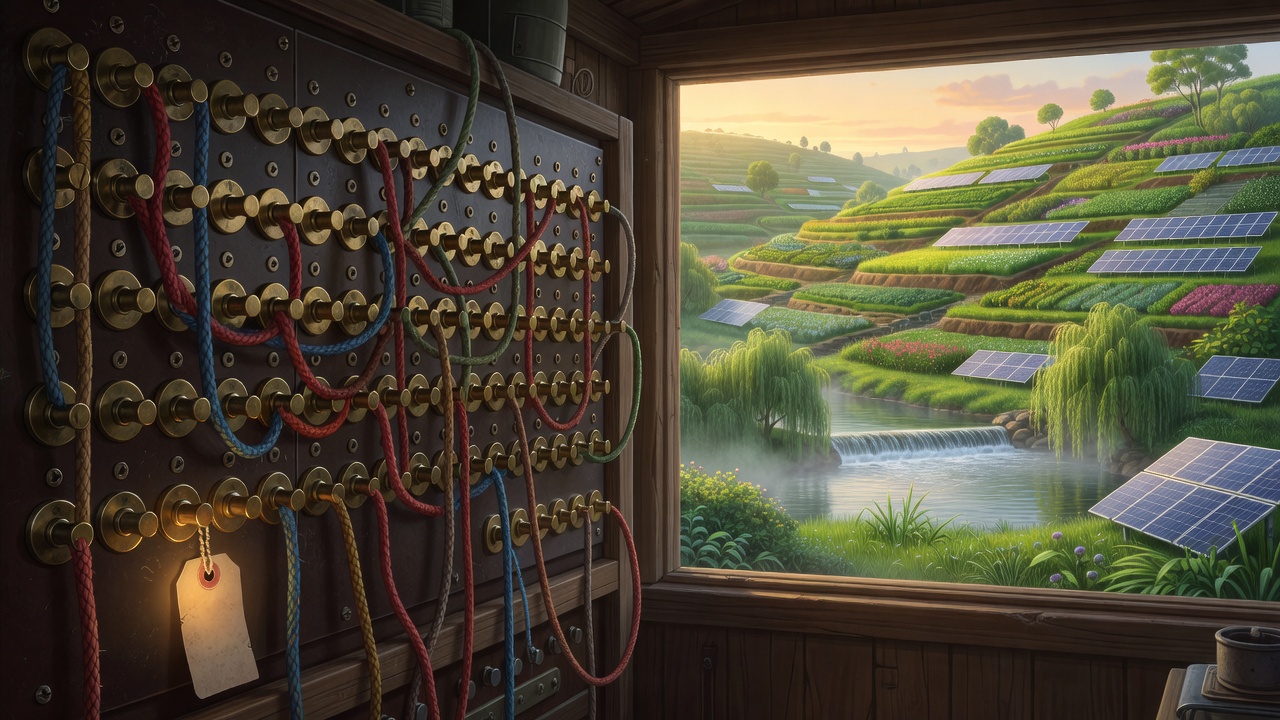
The board took up the whole north wall of the little dispatch house above the weir — a panel of brass jacks and patched cords and hand-labelled switches that Tomas Oye had built across forty years and that Wren had inherited, cords and all, when he died. Most valleys had gone to glass by now, a screen and a model and an allocation that balanced itself. Calder Reach had voted twice to keep the board. People liked knowing a person sat up here through the nights. They liked that the hand on the current was a hand they could name.
She made the tea Tomas had always made, too strong, and she sat down to fail people on purpose.
This was the part nobody outside the house understood. They thought the dispatcher kept the lights on. What the dispatcher actually did, on a night like the first of these nine, was decide whose lights went off, and in what order, and for how long, so that no one's went off for too long at once. The commons had rules for it — a rota, a fairness ledger, priorities agreed in open meeting and revised every spring. Hospitals first, which here meant the clinic and the three houses the commons had agreed, in open meeting, to carry — the ones with someone on home oxygen who could be brought through to the far side of an illness. Then the cold stores that held the valley's winter food. Then the cooperatives that needed power to not lose a day's work and a week's livelihood. Then, last, the houses, rotated so that the same families never sat in the dark two nights running.
Wren knew the rules better than anyone alive, because Tomas had made her recite them until she hated them, and then he had taught her the thing under the rules, which was that the rules were a promise the valley made to itself and the dispatcher was the one who had to keep it with her hands.
She began to shed load a little after eight. She pulled the cord that fed the upper terraces and the houses out toward Stannet went quiet — she heard it as a small green light dropping out on the board, and then, a minute later, as a call routed up the line.
It came to her as half a conversation. That was how the old talk-down circuit worked, the one Tomas had wired into the board so the houses could reach the dispatch house without going through the open channel everyone could hear. She got the household side only. The board's side was hers to keep or not keep, and mostly she just listened.
"— gone again up here," a man's voice said, tired, not angry. "No, I know. I know it's our turn. I'm just saying, the little one's got a cough, is all, and the heat pump —" A pause, while the board's silence stood in for her answer. "No, you're right. We've blankets. We'll manage. You take care of yourself up there. Cold night for it."
"Cold night for it," Wren agreed, to no one, after the light had gone.
She managed Stannet, and the river road, and the two big cold stores that could ride an hour dark on their own thermal mass without spoiling a thing. She walked the shed around the valley the way you'd walk a fire line, never letting it burn too hot in any one place. By midnight she had the whole Reach running on a third of a normal night's draw, every family taking its fair small turn in the dark, and the great soft battery of the hillside holding just enough to limp them to dawn.
Every cord, that is, but one.
There was a jack at the bottom left of the board, third from the corner, with a paper tag gone soft and brown at the edges. The tag said HOLLOW LANE in Tomas's square hand. Into that jack went a cord that Wren did not pull, had not pulled in the eleven months since she'd sat down at this board alone, and would not pull tonight, though the rules said she must, though the rota had Hollow Lane down for the dark hours twice this week, though there was no priority code in the whole fairness ledger that put a single house out past the river bend ahead of the cold stores and the clinic and her neighbours' sleeping children.
She kept it lit. She had kept it lit through the small sheds of the dry summer, when no one noticed a watt here or there. Through nine days of dunkelflaute, with the whole valley counting, keeping it lit would cost her something she did not yet know the size of.
She wrote the ledger anyway. That was the part that turned a kindness into a lie. Each night she logged Hollow Lane as shed on schedule, dark and fair like everyone else, and each night the cord stayed in and the current ran out past the bend to a house she had never once visited, and the ledger that the commons trusted because a person kept it by hand said a true-looking thing that was not true.
She told herself, that first night, the thing she told herself every night. It's a small house. It's almost nothing. The valley will never feel it.
On the first night that was true.
The board talked to her all through the dark, the way it always did, the valley reaching up the talk-down line in half-conversations she stitched into a kind of company.
"— you'll laugh, but I can't find the candles, after all that. Saving them so well I've lost them." A woman, the seed-keeper down at Ostler's, laughing at herself. "No, don't send anyone over in the cold, for heaven's sake. I'll feel along the shelf. I've felt along this shelf in the dark for thirty years."
"— is it the whole valley or just us? Just checking he's not done something to the box again." A father, anxious, the way the careful ones got. "All right. All right, that's all I wanted. As long as everyone's the same."
As long as everyone's the same. Wren's eyes went to the soft brown tag at the bottom left of the board, and she said nothing, and the cord stayed in.
By the third day the valley had stopped pretending it was an ordinary shed.
You could feel it in the half-conversations. The voices that came up the talk-down line had a new edge to them, not anger yet, but arithmetic. People had started doing the same sum Wren had done at the change of shift on the first day, the sum where fair stopped being the same word as comfortable. The seed-keeper rang up to say her cold frames had dropped two degrees overnight and could she trouble the board for an hour's pump in the dawn to lift them, and Wren gave it to her, and took the hour from somewhere else, from the river road, from a family who had already sat dark twice and would sit dark a third time and would call up the line at nine to say, not angry, not angry, only tired, that they understood it was their turn.
This was the work. Tomas had told her, near the end, when his hands had stopped being any good for the cords and hers had had to learn the whole board in a hurry: the easy nights anyone can do, girl. The board does itself. You're not the dispatcher for the easy nights. You're the dispatcher for the nine days of no wind, when there isn't enough, and there's no clever fix, and the only thing left to do is decide who goes without and then carry it.
She was carrying it. She was carrying all of it, the whole valley's small darknesses balanced on her two hands across the brass.
And she was carrying Hollow Lane, which the valley did not know it was carrying at all.
On the fifth day the meeting was called.
She heard about it the way she heard about everything, in fragments. A neighbour came up the path at midday while she was trying to sleep through the bright useless sun and knocked and told her, kindly, that the commons would gather that evening, that no one was blaming the board, heaven knew, that it was the sky's fault and not hers, but that they needed to look at the ledger together and decide whether to drop the rationing another notch before the cold stores started to suffer. Would she come down and read them the numbers?
"I'll come down," Wren said.
She did not sleep after that. She sat at the board through the long bright afternoon and looked at the cord in the soft brown jack and ran the only honest sum there was. If she dropped the valley another notch — if she asked every household to take a longer turn in the dark, the elderly and the children and the careful anxious fathers and the seed-keeper feeling along her shelf — and if she did that while one house out past the river bend stayed lit every single night, then she was not the dispatcher anymore. She was a thief who had appointed herself, and the promise the valley made to itself was a promise she had quietly broken on their behalf without asking, and the worst part, the part that sat in her chest like a swallowed stone, was that she would do it again. She knew she would do it again. She had decided eleven months ago, the night of Tomas's funeral, sitting alone at the board for the first time, that there was one cord she would never pull, and she had not changed her mind, and nine days of no wind had not changed it, and a commons meeting was not going to change it either.
She went down to the meeting and read them the numbers and did not tell them about the cord.
The meeting was in the long room over the granary, and it was the most solarpunk thing in the valley and the most ordinary — sixty people on benches under hanging lamps dimmed to almost nothing to save the draw, the lamps themselves throwing more shadow than light, and the people in the dark choosing, together, out loud, how to be poor for a few more days without anyone going cold who couldn't bear it.
Wren had expected it to be hard to sit through. She had expected to feel the lie burning a hole in her the whole time. What she had not expected was how good they were at it. How they argued — and they did argue, this was no utopia-tour, the cooperative that made the valley's medicines wanted a guaranteed block of power and the cold stores wanted theirs and an old man stood up and said flatly that the children's houses should never be dark before his because he'd had his life and they hadn't and several people told him to sit down and several more went quiet because he'd said the unsayable true thing — but how, under the arguing, they were trying so hard to share a shortage fairly that it made her throat ache.
They voted to drop another notch. They voted to ask more of themselves. The seed-keeper, who Wren had given a stolen hour of pump to at dawn, stood and said she'd take her cold frames down to the bare survival temperature and lose half her starts rather than have a child sit dark for it, and the room murmured, and it was decided.
And Wren sat in the dimmed light among the best people she knew and held inside her the fact that she had already given one house more than its share, every night, and would keep giving it, and that the notch they had just voted to drop would fall on everyone but Hollow Lane.
Afterward, in the cold outside, the seed-keeper found her.
"You look terrible, love," the old woman said, not unkindly. "When did you last sleep a whole night?"
"I'm all right."
"You're not. None of us are. That's what makes it bearable, that none of us are." She put a dry warm hand on Wren's arm. "Tomas looked like that, the bad winters. Like he was carrying us all up that hill on his back. You don't have to carry it alone, you know. That's the whole point of us."
Wren almost told her then. The words came right up to the gate of her teeth — there's a cord I don't pull, there's a house I've been stealing for, I'm not the person you think sits up there. But she looked at the seed-keeper's kind tired face and she understood that telling her would not lift the weight off Wren's back. It would only move it onto sixty other backs, and they were already carrying everything they could carry, and the thing about a secret that protects is that the protection is real even when the secret is a sin.
"I know," Wren said. "Thank you."
She walked back up to the board and pulled the valley down another notch and left the soft brown cord exactly where it was.
The seventh day was the worst.
The high pressure held like a curse. The morning sun cleared the ridge and the panels drank what little the short day gave and it was not enough and everyone knew it was not enough. Wren shed and shed. She had the clinic running on its own little dedicated bank now and nothing to spare for the houses but a few hours each, rotated tight, and the talk-down line was busy all night with voices that were trying so hard not to complain that the trying was worse than complaint.
"— no, we're fine, we're fine, it's just the baby doesn't understand why the night-light won't —" A young mother, and then, catching herself, gentle: "She'll learn. We all learn. You take care, up there."
"— third night for us, but who's counting." A man's laugh with no laugh in it. "We're counting. I won't lie to you, we're counting. But so's everyone. Goodnight, dispatcher."
And then, near three in the morning, a call came up the talk-down line that Wren had been dreading for seven days and eleven months both.
It came from out past the river bend.
She knew the line the instant the light woke on the board — third from the corner, bottom left, the soft brown tag. In eleven months that cord had carried current out and never once carried a voice back. Hollow Lane did not call the dispatch house. That had been part of how she'd borne it, that the house she stole for was silent, a number and a draw and a tag in a dead man's hand, almost not a real place at all.
Now the light was live, and a voice was on the line, an old woman's voice, thin and steady the way voices get when they have decided to be steady.
"Dispatcher. I know you can hear me, even if you don't answer. Tomas told me how the board works. He told me a lot of things." A breath. "I'm not calling to ask you for more. I want you to know that. I'm calling to tell you you can stop."
Wren's hand was already on the cord. Not to pull it. To hold it, the way you hold something to keep it from being taken.
"He's gone, love," the old woman said. "An hour ago. Peaceful. The machine kept breathing for him right up to the end, and that was your doing, and his mother's, and mine, and Tomas's before all of us. So you can stop now. You can let the cord out. We don't need it anymore." A pause, and the steadiness cracked, just once, and came back. "Thank you for the borrowed time. I know what it cost the valley. I know what it cost you to never tell them. He was six. He had the floods in his lungs from the day he was born, the doctors said, the old water never left him. We were only ever stealing him days. But the days were his, and they were good, and you gave us every one of them. Tomas started it. You kept it on. Let it out now, love. Go and sleep."
The light stayed live a moment longer, and then it dropped, and Hollow Lane was silent again, the way it had always been silent, except that now Wren knew what the silence had been holding.
She did not pull the cord that night.
She sat with her hand on it until the dawn came up over the ridge, useless and golden, the eighth dawn of nine, and she let herself understand the shape of the thing Tomas had handed her along with the board. He had not told her, the way he had not told the valley, because telling her would have made it hers to refuse, and he had not wanted to give her a thing she could refuse. He had wanted to give her a thing she would simply keep, the way you keep breathing. A boy out past the river bend with the drowned world still in his chest, and a machine that breathed for him, and a draw of current no fairness ledger in the world would ever protect, because the valley's rules were built to keep everyone alive a fair amount and there was no fair amount of alive for a child the floods had already half-taken before he drew a breath.
So Tomas had cheated. Quietly, for years, one cord he never pulled. And when his hands gave out he had not handed Wren a clean board. He had handed her his sin and his mercy, which turned out to be the same cord, and he had trusted her to know which it was without ever making her decide.
She understood, now, the title the valley gave the work. They called the dispatcher the one who kept the grid up. The grid will hold, people said to each other on the bad nights, the way you'd say it'll be all right — the grid will hold. As if the grid were a thing with a will, a thing that held itself.
It didn't. There was no grid. There was a wall of brass and a stack of batteries and a river running too low and a sky that gave what it gave, and there was a person, one person at a time across forty years and now eleven months, sitting up through the dark deciding by hand whose small darkness the valley could bear and whose it could not. The grid did not hold. Someone held it. The holding was the whole of it, and the holding was a choice made over and over with two hands, and some of the choices were against the rules, and the rules and the choices were both how a valley loved itself.
On the morning of the eighth day, at last, Wren pulled the cord from the soft brown jack, and Hollow Lane went dark like everywhere else, and the boy it had kept lit did not need it anymore, and the current it had carried ran back into the common store where it had always belonged.
The valley felt it. A few extra watts, spread across sixty households on one of the hardest nights of a nine-day drought — it was almost nothing, the way it had been almost nothing the other way for eleven months. But it was something. It was the difference, that night, of one more hour of warmth in the river-road houses, and Wren routed it there, to the family who had sat dark three times and counted, and she heard the father's half a conversation come up the line near midnight, puzzled and grateful.
"— no, it came back early, didn't it? I thought we had another hour dark. No, I'm not complaining, God, no. I'll take it. Tell the dispatcher thanks, if you ever — does anyone ever actually talk to her up there? Tell her thanks."
"You're welcome," Wren said, to no one, and meant it the way you mean the truest things, to no one, in the dark.
On the ninth day the wind came back.
She felt it before the instruments did, a change in the held breath of the valley, and then the turbines at the weir found their voice and the soft battery of the hillside began, for the first time in nine days, to climb instead of fall. By noon the high pressure had broken and clouds were running across the ridge and the panels were drinking light and giving it forward, and by evening Calder Reach was a valley with enough again, lit window by window up both sides of the river, ordinary, abundant, saved.
No one would ever write the nine days down as anything but weather. That was how it should be. The grid held, people would say, and mean it as a kindness to one another, and Wren would let them, because the lie was a good one — better than the true thing, which was too heavy to hand to people who had carried enough.
But she would tell one person. She had decided that, somewhere in the eighth night.
She did not wait long. There was a girl in the valley, the seed-keeper's apprentice, sixteen and steady-handed and the kind who stayed late and asked how things worked. Wren had caught her more than once standing in the dispatch-house doorway looking at the board with the particular hunger of someone who could be trusted with it. Tomas had looked at Wren that way once, she supposed, and not told her either, and made her recite the rules until she hated them, and then taught her the thing under the rules.
She would do it differently. She would tell.
When the girl came up the path, drawn by the board the way the right ones always were, Wren made the tea too strong and sat her down in front of the brass and the patched cords and the soft brown tags, and she pointed to the jack third from the corner, bottom left, empty now, its tag gone soft with eleven months and forty years of a hand that wasn't hers.
"There's a thing about this work nobody tells you," Wren said. "I'm going to tell you, because someone should have told me before I had to find it out alone at three in the morning. The grid doesn't hold. People say it does. It doesn't. There's just whoever's sitting here, deciding by hand. Most nights the deciding is easy and you keep the promise the valley made. And once in a long while there's a cord you don't pull, that you can't pull, that no rule will ever let you keep — and you keep it anyway, and you carry it, and you don't tell the valley, because the valley's carrying enough." She looked at the empty jack a moment. "And then one day you let it out, and you tell one person, so they're not alone with it when their turn comes."
The girl looked at the empty jack, and then at Wren, and did not say anything for a while, and her hand came up and touched the soft brown tag of its own accord, the way you touch a thing you have just been made responsible for.
"How will I know," the girl asked, "which cord it is? The one I'm not supposed to pull?"
Outside the window the ninth-day sun was going down over a valley with enough, every window warm, the turbines turning, the river finding its low autumn voice again. The wind moved in the willows by the weir. The grid would hold tonight, which only ever meant that someone would.
"You'll know," Wren said. "That's the terrible part. You'll always know. Now drink your tea. It's a cold night for it."
Enjoyed this story?
Read next
 A nineteen-year-old Cobb is caught with the dock-workers' burial fund and will not say one word in his own defence — and the silence everyone has read as guilt is in fact the only act of love his family has left, and the one thing standing between the boy and the truth.
The Burial Fund
 The spectrometer said the wine was a forgery, the master of wine agreed, and a man's life was to be ended over a bottle — and not one of them had thought to ask the only question that matters about a fake, which is who it was made to please.
A Question of Vintage
 They had her on three cameras, her phone, and a swipe card, which in the modern view is the same as having a confession — and which proves only that the machine saw exactly what she did, and understood nothing whatever about why.