
The Debt of the Table
Content notes
death, grief, social cruelty
Nan Coyle had buried three reputations in her life — her father's, her own, and the one the parish had given her in their place — and she'd come to think of the work as a kind of gardening. You couldn't stop people putting things in the ground. You could only decide what you'd do with what came up.
So when the boy from Marl Hall hammered on her door at the wrong end of a January dusk, she didn't ask who had died. She asked whether the family knew what they were sending for.
"The young master sent me." The boy would not cross her threshold. None of them ever would. He stood in the lane with his cap wrung to a rope and his eyes fixed on the frost between his boots, as though her doorstep were the lip of a well. "Old Mrs. Ashworth. She passed in the night, and the young master, he says — he asks would the — would you come. Tonight. Before the morning, he says."
"He used my trade's name, did he? Or did he do what you're doing, and leave a hole in the sentence where the word should be?"
The boy flushed to his ears. "He said the sin-eater, miss."
"Then he's braver than the rest of you," Nan said, "or more desperate. We shall find out which." She took her shawl from the peg — the good one, the grey, because the dead were owed a guest who had at least troubled to brush her hem — and stepped out past him into the cold. He flinched back the careful eighteen inches that everyone left her, the invisible moat a parish digs around the one person it needs and cannot bear to touch.
Behind her, through the cottage's thin wall, she heard her mother begin to cough, and her sister Bett murmur something low and steadying. That was the whole of it, really. That was the entire argument. Eight shillings to eat the sins of Marl Hall's matriarch, and eight shillings was the apothecary, and the apothecary was March, and March was her mother still breathing in April. A gentlewoman didn't take up the most despised office in the county. A gentlewoman also didn't watch her mother drown in her own chest for the want of a fee she was too proud to earn. Nan had decided, two winters ago, which kind of woman she was going to be, and she hadn't yet found cause to revise it.
Marl Hall had been grand once and was now merely large, which is a sadder thing. They brought her in by the scullery, naturally — the dead might lie in the best bedchamber, but the one who came to unburden them ate her supper standing in the cold by the coppers, if she was offered supper at all. A housekeeper with a face like a shut drawer led her up the back stair, and at the door of the laying-out room a man was waiting who was plainly no servant.
He was perhaps thirty, dark and ill-slept, in mourning that had been put on in a hurry. He had the kind of face the county would have called handsome before it decided to call him other things. And he was looking at her directly, which no one in Glasswick had done in two years — not at the moat, not at the frost, not at the convenient middle distance, but at her, with the frank desperate attention of a man who's run out of better options.
"You're younger than I expected," he said.
"And you are ruder than I expected, Mr. Ashworth, though I confess my expectations of this house were not high." It came out before she could weigh it; the old voice, her father's drawing-room voice, the one she kept folded in lavender and almost never wore now. She watched it land. Watched him register that the parish unclean spoke like a woman who had once poured tea for a baronet.
His mouth did something that was not quite a smile but remembered the country where smiles were made. "Forgive me. I haven't slept, and I find I've forgotten how to talk to anyone who isn't either lying to me or paid to." He glanced at the closed door. "My grandmother is inside. I don't know the — I don't know how it's done. The vicar wouldn't come. He says the practice is heathen and that he's said so from the pulpit."
"The vicar is correct," Nan said. "It is heathen, and he has indeed said so, at length, while taking his tithe from a parish too poor to bury its dead twice over. Show me to her."
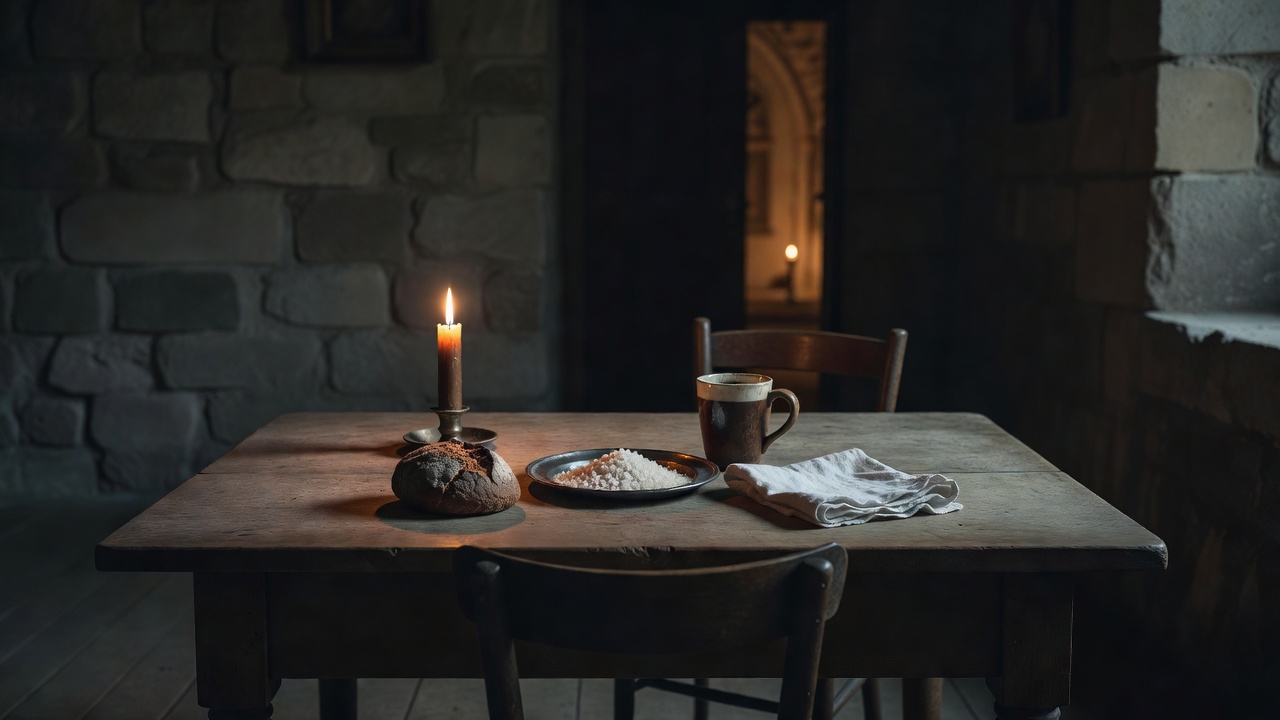
The old woman lay very straight under a clean sheet, and someone had done the kind office of weighting her eyes, and the room smelled of beeswax and the particular cold that comes off the recently dead. Nan set her small case on the table they had drawn up — they always drew up a table, even the ones who would not name her trade; the table was the one part of it everyone understood. On the table she laid the cloth. On the cloth, the bread. Beside the bread, the little dish of salt. The wooden cup of ale last, because she had learned to keep her hands busy to the end so they would not shake at the beginning.
"You may stay or go," she told him, not turning. "Most go. It isn't pleasant to watch a stranger take your grandmother's sins into her own body and walk out the door wearing them."
"Is that what you do?" His voice had come closer. He had not gone. "Truly? You believe — "
"I believe eight shillings will keep my mother alive until the weather turns." She set the cup down with a small definite click. "What I believe past that is my own affair, and I'll thank you not to inquire into it any more than you'd inquire into the beliefs of the man who empties your night-soil. We are both performing a service the parish needs and prefers not to think about. Now. It is customary for the family to speak the dead one's name, and to name what she wishes lifted. Some say a general confession. The bold ones are particular." She finally looked at him. "Which was your grandmother?"
He was quiet for long enough that she thought he might not answer. The candle leaned and righted itself. And then he said, in a different voice altogether, low and worn smooth with carrying:
"She was particular. She told me three days ago, when she knew. She made me promise the sin-eater would have it whole, because she said no one else in this world would ever take it from her — not the vicar, not God, who she had stopped being on speaking terms with. She said you'd have to swallow it because you're the only soul in the county forbidden to spit it back out."
Nan's hands went still over the bread. "Then she understood my trade better than my clients usually do. Say it, Mr. Ashworth. Whatever it is, it dies in me. That is the entire point of me."
He told her.
He told her standing at the foot of his grandmother's bed, in the smooth ruined voice, while Nan held the bread above the still chest and made herself a vessel the way she'd taught herself to do — empty, listening, a jug held under a tap she couldn't turn off. Two years ago, a tenant farmer named Pryce had been found drowned in the Marl weir with the rent he owed the estate gone from his pocket, and the county had quietly, comprehensively decided that Roland Ashworth — the heir, profligate and in debt, the last seen quarrelling with the man — had pushed him in and taken it. No charge was ever laid. There was no proof, only the shape of the thing, only the way a story sets like a jelly once it's poured. He hadn't hanged. He'd merely been buried alive, socially, which in a county this size is the more thorough death. Invitations stopped. The bank grew cool. The girl he was to have married found she couldn't, after all.
And his grandmother, this straight cold woman under the sheet, had let it stand — year upon year, of her own grandson — because the man who'd truly taken Pryce's rent and left him drunk at the weir's edge that night was her other grandson. The good one. Roland's younger cousin Hugh, the one the county adored, whose respectable marriage and clean name were the only assets the dying estate had left to trade on. Faced with two grandsons and one good name between them, she'd pinned the ruin on the one already half-ruined and saved the one still saleable. She'd carried it two years, and three days ago, dying, found she couldn't carry it into the ground.
"She told me," Roland said, "so that someone would know it was a lie. And then she told me to fetch you, so that no one ever could prove it. She did love me — in the particular way of people who love you and ruin you in the same breath." He laughed, once, with no pleasure in it. "She's tidy even now. She confesses to the one mouth in England the law would never let testify, and dies clean, and Hugh marries his heiress in the spring, and I go on being the man who drowned a farmer for nine pounds. And you walk out of here with my whole life inside you and a trade that forbids you ever to set it down."
Nan stood with the bread in her two hands and understood that she had walked, for eight shillings, straight into the worst position of her life.
Because she believed him. That was the appalling part. She'd heard a great many confessions across a great many cold tables, and she'd developed, the way a fence develops an eye for which goods are warm, an ear for the true ones. The false confessions performed. The true ones were always too specific and too small — nine pounds, not ten; the weir, not the river; the good grandson, not a faceless villain. This was true. And it was, precisely and cruelly, the one kind of true thing she could do nothing with.
She'd built the only dignity left to her on a single iron rule. The sin-eater eats and is silent. That silence wasn't heathen superstition; it was the whole transaction. A dying soul gave up its worst secret only because the mouth that took it would be shut for ever. Break that once — repeat one thing, save one good man, right one wrong — and she was no longer the sin-eater. She was merely a poor woman who knew everyone's worst and could be bought to tell. The parish wouldn't pay that woman eight shillings. The parish would drive that woman into the weir. Her silence was the apothecary. Her silence was March, and April, and her mother breathing.
She finished the rite. Her hands didn't shake; she'd decided long ago that they wouldn't, and on this of all nights she wouldn't let them make a liar of her. She passed the bread across the dead woman and ate it. She took the salt. She drank the ale. She spoke the old words that lifted the burden from Margaret Ashworth and laid it upon Nan Coyle, who would answer for it, and she felt — she always felt something, whatever she told her clients about belief — the cold particular weight of it go into her, this one heavier than most, because this one had a living man tied to the end of it like a stone to a drowning rope.
Then she wrapped her cloth, and closed her case, and looked at Roland Ashworth, who was watching her with an expression she had no shelf to put away on.
"You shouldn't have looked at me like that," she said.
"Like what?"
"Like I was a person. Your housekeeper has the right of it. It's a great deal easier on everyone if you treat me as the drain I am." She lifted the case. "I'm sorry for your grandmother. And I'm sorry for you, which is worse, because there is nothing I am permitted to do about it. Good night, Mr. Ashworth."
She didn't sleep, and she went back.
Not the next night. She held out four nights, which she considered creditable, then put on the grey shawl again and walked the cold mile and was let in at the scullery by the drawer-faced housekeeper, who plainly didn't know what to make of a sin-eater who returned to the scene of her work like a dog to a buried thing.
He came down to the scullery himself, which no gentleman should have done, and sat across the deal table from her among the hanging coppers, which no gentleman would have done, and that — more than the dark eyes, more than the ruined voice — was the thing that undid her by inches over the following weeks. He came down to where she was. He didn't summon her up. In a county built entirely of who stood above whom, Roland Ashworth was the only soul who kept coming down the back stair to sit on a level with her, and a woman can starve a long time for that particular bread without admitting she's hungry.
They talked. God help her, they talked the way she hadn't talked since her father's house was sold out from under them — about books, because he had a library going to mildew and no one to lend it to, and she had a head full of a gentlewoman's education and nothing to spend it on. About her father, a clever fond foolish man with a weakness for canal shares. About his debts, which were real, which he didn't pretend away — "I was a profligate," he said, "that part's true; I simply never drowned anyone, which the county finds a tedious distinction." About what it was to have been one kind of person and be looked at now as another, and to know the looking would never, ever stop.
"You could leave," she told him once. "Sell what's left. Take a name no one knows in a town no one knows it in."
"And you?" he said. "You could do the same. You speak like a baronet's daughter. Three counties over, you'd be a governess inside a fortnight."
"And leave my mother to die in a cart on the road? No." She turned the wooden cup — he gave her ale now, and bread, as though feeding the sin-eater were a thing a household simply did — round and round on the deal. "We're neither of us going anywhere, Mr. Ashworth. That's the trouble with us. We're both chained to something we won't put down for our own comfort. Yours is your name. Mine is my mother." She didn't say the third chain. It was sitting at the table with her, getting dearer every week, and she hadn't the smallest idea what to do about it except not name it, the way the boy in the lane hadn't named her trade.
It was the second week of March when he said it plainly. She had brought a book back — she had been borrowing them, one at a time, in defiance of every rule of sense — and he took it from her and did not let go of it, so that they were both holding it, a foot of old calfskin between them on the scullery table, and he looked at her with the frank desperate attention of that first night and said:
"Marry me."
Nan laughed. It was not a kind laugh; it was the laugh you give a thing too cruel to be meant. "Don't. Of all the men in England to make game of the sin-eater — "
"I have never been less in jest in my life." His grip on the book was hard. "I know exactly what I'm asking. I'm asking you to marry the man who drowned Pryce. I'm asking you to take a name that's already in the gutter and pour your own down beside it. I am, in short, offering you nothing — no money to speak of, no standing, no return of yours. The most disreputable proposal in the history of the county." A breath. "And I have thought of nothing else for a month, and I find I would rather be ruined with you at that table than respectable without you at any other. There. Now you may say no, and you may keep the book."
And here was the thing she couldn't say to him, the thing that sat in her like the cold weight of his grandmother's confession: that she wanted to say yes so badly her teeth ached with it. That she'd built two years of careful dignity precisely so she'd never again want a thing she couldn't have, and he'd walked through it as if it were frost on a window. That she could marry him — a sin-eater could marry; there was no law against the unclean wedding the disgraced; they'd simply be the two most shunned people in the parish, which, between them, they nearly were already.
But.
But if she married Roland Ashworth, she married a man she knew to be innocent and could never say so. She'd lie down each night beside the proof of it and rise each morning sworn to silence, watching him bow his head under a crime that wasn't his, watching Hugh's clean children grow up in the spring sun, and she'd carry the antidote in her own mouth the rest of her life and never be permitted to give it. She'd have eaten his ruin. She'd be married to the cure she couldn't administer.
"I can't," she said. "And I can't even tell you why I can't, which is the whole of my profession in one sentence." She let go of the book. "Ask me again when you're sleeping better. You'll see sense."
He didn't ask again. He was a gentleman; she'd said no, and he took it for an answer, and the borrowing of books stopped, and the cold mile to Marl Hall became simply a cold mile she didn't walk, and her mother, with the apothecary's draughts and the turning weather, began at last and unmistakably to mend. She had what she'd set out for. Eight shillings well spent. Her mother breathing in April. It was exactly what she'd wanted, and Nan discovered that getting exactly what you want is its own particular cruelty when it costs you the thing you didn't know to ask for.
She might have left it there. She nearly did. She was a practical woman, and the practical thing was to let the iron rule hold, let the good man drown slowly in his good name, and keep her own poor dignity intact. She told herself this for three weeks, in the dark, with her mother breathing easily in the next room — and it wasn't until she understood that the breathing was the problem, that she'd let a man go to save a life now plainly saved, that the price had bought its goods and she was still paying it, that she saw the gap.
Because there was a difference, she realised, between the thing she'd eaten and the thing she'd seen.
She'd eaten Margaret Ashworth's confession. That was the sin, hers now, and she'd carry it silent to her grave; that rule she wouldn't break, because the rule was the only clean thing she owned. But the night she'd walked the cold mile back, and the weeks after at the deal table among the coppers — she hadn't been eating anyone's sins then. She'd been a woman, borrowing books, listening to a man. And one of those nights Roland had told her, idly, grieving, a small living fact that had nothing to do with the rite: that on the night Pryce drowned, his cousin Hugh had come in past midnight with his boots soaked to the knee and a tale about a lame horse, and had burned the boots himself in the kitchen grate before morning — and that Roland, fool that he was, had thought nothing of it for two years, because you don't suspect the grandson everyone loves.
That wasn't a confession. That wasn't eaten. That was a thing told across a table by a living man to a woman he was courting, and no rule of her trade, no law of God or the parish, forbade her to have heard it.
She couldn't say what the dead had given her. But she'd never sworn to forget what the living let slip.
It was thin. A woman of no character at all, standing up before a magistrate to say she'd been told of a pair of burned boots by the very man the boots would clear — testimony from the parish unclean, hearsay at one remove, the kind of thing a county could laugh back down the road it came in on. She knew exactly how thin it was. She'd buried three reputations; she knew precisely how little it took to bury a fourth and how much to raise one.
But thin wasn't nothing. Thin was a thread, and a thread laid beside the right loom can be pulled. Hugh Ashworth had a respectable marriage pending and a clean name he was selling to an heiress's father, and a man with a clean name to sell will do a great deal to keep a sin-eater from standing up in the market square and asking, loudly, in the educated voice of a baronet's lost daughter, why his cousin's boots had burned the night a man drowned. She didn't need to win in a court. She needed only to make the lie cost more to keep than it had ever cost to tell.
She went to the magistrate first, because she was nobody's fool and wished it on the record before she breathed it anywhere it could be answered with the weir. And then she did the thing that frightened her far worse. She put on the grey shawl, and walked the cold mile, and went up — for the first time in her life — to the front door of Marl Hall, and knocked on it, the sin-eater at the great door in the daylight where all the parish could see, and when the drawer-faced housekeeper opened it with her mouth already shaping the word for the back stair, Nan said, in the voice she'd kept folded in lavender:
"Tell Mr. Ashworth that Miss Coyle has called. Miss Anne Coyle, of the Glasswick Coyles, lately of the very best drawing-rooms in this county. He will know which Mr. Ashworth I mean. There is only one in this house worth the name."
He came to the door himself. Of course he did. He stood in the wreck of his grandmother's grandeur and looked at her in the full light of an April morning, where the whole parish might pass and see the unclean woman at the clean door, and she watched him understand, by degrees, that she hadn't come to borrow a book.
"What have you done," he said. Not a question. A kind of wonder.
"Nothing I'm forbidden to do," Nan said. "I've eaten what I was paid to eat, and I've kept it, and I'll keep it until I die — your grandmother's safe with me, and you must never ask me what she gave, because that door I can't open even for you, and you'd think the less of me if I could." She lifted her chin. "But a man told me a thing once, across a table, when he was grieving and forgot to be careful, and that thing was never eaten and never sworn, and I've given it to the magistrate this morning, with my name on it. My real name, the one I'm about to drag through every gutter in three counties on your behalf. It won't hang your cousin. It may not even fully clear you. But it'll make the lie expensive, Mr. Ashworth, and I'm very, very good at making a comfortable man uncomfortable. I had a great deal of practice being made so myself."
He came down the steps, down to where she stood, the way he always came down, and in the open daylight of the front of the house he took both her hands in both of his — the unclean hands, the hands that had passed bread across his dead — and she let him, and the housekeeper made a sound, and somewhere a curtain moved, and Nan Coyle found she didn't care a single farthing for any of it.
"You said you couldn't tell me why you refused me," he said. "I think I know now. You couldn't bear to marry a man you knew was innocent and never be allowed to say it."
"I couldn't bear to be the cure you couldn't take." Her voice wasn't quite steady; she let it not be, this once. "So I found a different medicine. A worse one — a scandalous, half-proof, ruinous one I can actually administer. It's all I have. A thin thread and a loud voice and a name I'm spending entirely on you, and it's offered, Mr. Ashworth, by the most disreputable woman in the county, with no money and no standing and a trade that'll follow me to whatever town we run to — "
"Marry me," he said again.
"That's my line," said Nan, "and yes."
They were married in June, quietly, by a curate three parishes over who didn't know what she was and wasn't told, with her mother breathing easily in the front pew and her sister Bett weeping into the grey shawl. It was, the county agreed, the most disreputable match in living memory: the drowner of farmers and the eater of sins, the two uncleanest souls in Glasswick, joined in unholy poverty and good riddance to the pair of them.
The thread held better than it had any right to. It didn't hang Hugh Ashworth — the law moves slowly and kindly for men with clean boots and unburned consciences — but a sin-eater with a baronet's voice asking her loud expensive question in the market square, a magistrate's record, a betrothal that grew suddenly and conspicuously cold and then dissolved, an heiress's father who decided on reflection that he preferred a different family: the lie grew too costly to keep. Hugh and his prospects left for London by autumn and didn't come back. The county, which had set the story of Roland like a jelly, found the mould had cracked, and a story once cracked never quite sets again. He wasn't made clean. But the parish could no longer be quite certain he was dirty, and uncertainty, Nan had learned, is the most a fallen person ever truly gets, and is enough to build a life in.
She kept eating sins. They needed the eight shillings, and besides, she'd discovered she was the best the borders had ever had, and a woman shouldn't waste a gift merely because the world calls it filth. But now, when the boy came to the wrong end of a dusk, she didn't walk the cold mile alone. Roland came with her as far as the gate of whatever cold house had sent for her, and waited in the lane in the eighteen-inch moat the parish kept around her, and walked her home after with her case in his hand, and never once asked what she'd taken in. He had married a woman with a mouth full of other people's worst secrets and the iron will to keep them, and he'd decided the keeping was the loveliest thing about her, which it was.
She carried his grandmother's confession to her grave forty years later and never said it, not to him, not even at the last. It was hers; she'd eaten it fairly; the dead were owed that much, and Nan Coyle paid her debts.
But she'd given him the other thing — the living thing, the unsworn thing, the burned boots told across a table by a careless grieving man — and that had been enough. She'd learned, the hard cold way a fallen woman learns everything, that you can't give back what you've swallowed. But there's always, if you're clever and brave and very nearly out of patience with being clean, some other dish on the table you're still allowed to pass.
Enjoyed this story?
Read next
 A nineteen-year-old Cobb is caught with the dock-workers' burial fund and will not say one word in his own defence — and the silence everyone has read as guilt is in fact the only act of love his family has left, and the one thing standing between the boy and the truth.
The Burial Fund
 The spectrometer said the wine was a forgery, the master of wine agreed, and a man's life was to be ended over a bottle — and not one of them had thought to ask the only question that matters about a fake, which is who it was made to please.
A Question of Vintage
 They had her on three cameras, her phone, and a swipe card, which in the modern view is the same as having a confession — and which proves only that the machine saw exactly what she did, and understood nothing whatever about why.